Introduction
In the pantheon of Greek gods, where Zeus thunderously rules from Olympus, there exists a deeper, older, and more profound power. This is not the power of lightning bolts or tridents, but the essential, enveloping power of Night. Her name is Nyx. While often overshadowed in popular myth by the dramatic exploits of the Olympians, Nyx occupies a unique and terrifying space in the ancient Greek imagination. She is not merely a celestial phenomenon but a primordial goddess, one of the first beings to coalesce from the void of Chaos. Her story is not one of conquest and love affairs but of autonomous generation and profound, abstract influence. To understand Nyx is to peer into the pre-Olympian worldview, where feminine forces like Night, Earth, and Darkness were the foundational, generative principles of the cosmos. From a sociological and psychological perspective, Nyx represents an archetype of the feminine as the source of both life and its inevitable shadows—a complex figure that challenges simplistic notions of gender and power in the ancient world.
The Prolific Mother of All Shadows
Hesiod’s Theogony (c. 700 BCE), the foundational text for Greek divine genealogy, establishes Nyx’s impeccable pedigree. She is born from Chaos itself, alongside Erebus (Darkness). In the first act of procreation, Nyx and Erebus produce their luminous opposites: Aether (Upper Sky) and Hemera (Day). This initial pairing establishes a fundamental cosmic rhythm—the eternal alternation of night and day.
However, Nyx’s most significant act is one of parthenogenesis (virgin birth). Without a consort, she gives birth to a brood of children who are not anthropomorphic gods but personified abstractions of the human condition and cosmic forces:
* Moros (Doom), Ker (Destruction), Thanatos (Death)
* Hypnos (Sleep) and the Oneiroi (Dreams)
* Momus (Blame), Oizys (Pain), Apate (Deceit)
* The Moirai (Fates), Nemesis (Retribution), Eris (Strife)
* Geras (Old Age) and Philotes (Affection)
This genealogy is profoundly psychological. Nyx does not birth heroes or city-founders; she births the inescapable realities of mortal existence: our fears, our dreams, our end, and the forces that govern our lives. From a psychological standpoint, she is the mother of the collective unconscious’s darker aspects. Her autonomy in this generation marks her as a uniquely powerful feminine entity, creating life (and its attendant struggles) from her own essence, a stark contrast to the patriarchal sexual dynamics of the Olympian generation.
The Goddess Whom Even Zeus Feared
Early Greek literature paints a vivid picture of Nyx’s formidable presence. In Homer’s Iliad (Book 14), we find a startling admission of her power. The god Hypnos (Sleep), fearing Zeus’s wrath, flees to his mother, Nyx. Homer states that Zeus, despite his rage, stopped his pursuit, “in awe of doing anything to swift Night’s displeasure.” This brief episode is monumental. It suggests a hierarchical limit to Zeus’s Olympian authority. Nyx belongs to an older, more primal order that commands respect even from the king of the gods. This echoes sociological concepts of primordial authority versus institutionalized power; Nyx represents a foundational, natural law that the newer political order (Olympus) dare not violate.
Hesiod locates her dwelling at the edge of the world, near the entrance to the Underworld, a place “wrapped in dark clouds.” He describes the beautiful, almost domestic symmetry of Nyx and her daughter Hemera, who share a home but never meet—one exits as the other enters, eternally trading places across the sky. Other early poets like Alcman and Stesichorus place her home in the far north or west, beyond the encircling river Oceanus, emphasizing her connection to the liminal, unknown spaces of the world.
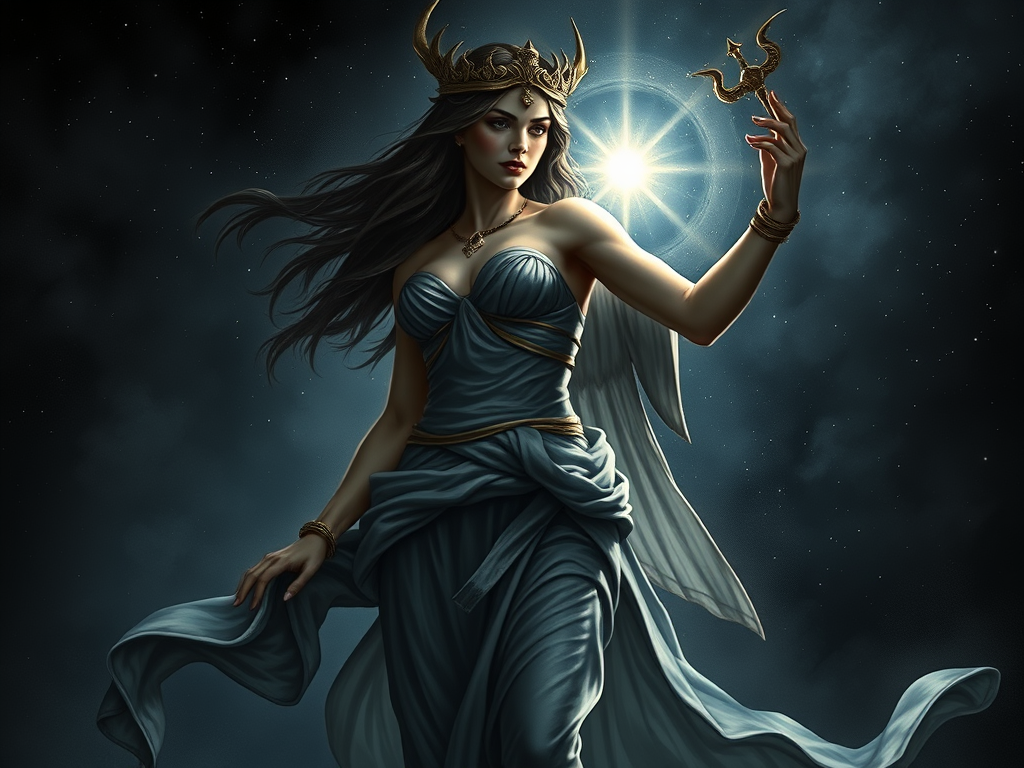
In 5th-century BCE tragedy, her imagery becomes iconic. Euripides calls her “black-robed,” driving a chariot pulled by horses, with the stars as her entourage. Aeschylus envisions her star-studded cloak. She is the cosmic transition, the daily, inevitable descent of darkness that even the sun must yield to.
Roman and Later Sources: Nox and the Expansion of Dread
The Roman adoption of Nyx as Nox often amplified her terrifying aspects. While maintaining her core genealogy, Roman authors like Cicero and Hyginus expanded her brood to include a more detailed catalogue of abstractions like Invidentia (Envy), Labor (Toil), and Miseria (Misery), reflecting perhaps a more systematized, legalistic Roman view of negative forces.
Roman poets emphasized her dread. Virgil associates her with the underworld. Statius makes Sleep her charioteer. Ovid crowns her with a poppy wreath, linking her to narcotic oblivion. This literary treatment underscores a cultural psychology in which Night is not just the absence of light but an active, oppressive force—a time of fear, uncertainty, and the haunting of one’s own mind —concepts that resonated deeply in Roman literature and thought.
Nyx as Cosmic Sovereign and Prophetess
It is in the esoteric, mystic tradition of Orphism that Nyx’s role reaches its zenith, offering a radical alternative to the Hesiodic and Olympian worldview. Orphic theogonies are complex, layered, and often place Nyx at the very heart of creation.
In the likely oldest Orphic tradition (referenced by Aristotle and Eudemus), Night is the first principle, the solitary origin point. The Derveni Theogony (4th century BCE) calls her the “immortal nurse of the gods” and mother of Uranus. In a dramatic scene, the young Zeus, after overthrowing Cronus, seeks her counsel in her adyton (inner shrine). She, “who knows all oracles,” prophesies how he can secure his sovereignty. Here, Nyx is the ultimate advisor, the repository of primal wisdom upon which even the new king’s power depends. This mirrors a sociological reading of matriarchal wisdom underpinning patriarchal rule.
The later Orphic Rhapsodies elaborate a breathtaking narrative. Here, the first deity is Chronos (Time), who produces an egg. From it emerges Phanes, the luminous first king. Nyx, existing from the beginning, witnesses this birth. She becomes both the daughter and consort of Phanes, and by him, the mother of Uranus and Gaia. Phanes willingly hands the scepter of rule to her, making Nyx the second sovereign of the cosmos. She later passes it to her son Uranus, establishing a line of peaceful succession. She is again the nurse and prophetess, raising Cronus and advising Zeus.
Some Neoplatonic commentators even speak of three separate Nights in the Rhapsodies: one who prophesies (connected to intellect), one who is revered (connected to moderation), and one who gave birth to Justice. This tripartite figure suggests a sophisticated theological conception of Night as a multifaceted feminine principle encompassing wisdom, order, and morality—a far cry from a simple personification of darkness.
The Winged Charioteer of the Sky
Ancient art captures Nyx’s ethereal and mobile nature. She is most consistently depicted as a winged goddess driving a chariot, often pulled by two or four horses, transitioning across the sky. On a 5th-century BCE Athenian pyxis, she is shown racing toward a column marking the world’s end, followed by Helios (Sun) and Selene (Moon), visually narrating the daily celestial cycle.
She is difficult to distinguish from other celestial deities, such as Eos (Dawn) or Selene (Moon), often identified by context—emerging as Helios sets —or by attributes like a black-bordered robe. A powerful later depiction is on the Pergamon Altar (2nd century BCE), where she battles giants in the Gigantomachy, grasping a giant’s shield, symbolizing the primordial forces defending cosmic order.
The Whisper of Worship
Unlike the Olympians, Nyx had little organized, public cult. This is telling; her power was omnipresent but diffuse, not channeled through city-state rituals. However, she was associated with oracles. Pausanias mentions an oracle of Night on the acropolis of Megara. Some traditions claimed she was the original possessor of the Delphi oracle before Themis and Apollo. This links her, once again, to primal, prophetic wisdom. Plutarch also notes oracles belonging to Nyx and Selene.
Evidence of ritual comes from Roman poets who mention nocturnal sacrifices of black animals—a sheep, a bull, a rooster—to her, aligning her worship with chthonic (underworld) practices and the color of her domain.
Nyx’s Enduring Shadow
Nyx is far more than a poetic fancy for darkness. She is a foundational archetype of immense depth. From a sociological and cultural psychological lens, she represents the ancient recognition of the feminine as the source of both creation and dissolution, of comfort (Sleep) and terror (Death). Her autonomy in generation and the fear she inspires in Zeus highlight a worldview where feminine primordial power preceded and undergirded the later patriarchal divine order.
In the Olympian pantheon, goddesses are often defined by their relationships—as wives, mothers, or virgins. Nyx transcends these categories. She is a self-sufficient generator, a sovereign ruler in Orphic myth, and the keeper of fateful wisdom. Her study, particularly through the interdisciplinary lenses of women’s studies and cultural psychology, reveals the complexities of how ancient Greeks conceptualized gender, power, and the fundamental forces of existence. She is the dark mother, the necessary shadow, the silent power that even a thunder god must heed—a timeless reminder that before order, there was the deep, generative, and formidable power of Night.

Hesiod. (c. 700 BCE). Theogony.
Homer. (c. 8th century BCE). Iliad.
West, M. L. (1983). The Orphic poems. Clarendon Press.
Burkert, W. (1985). Greek religion. Harvard University Press.
Brisson, L. (1995). Orphée et l’Orphisme dans l’Antiquité gréco-romaine. Variorum.
Pausanias. (c. 2nd century CE). Description of Greece.
Apollonius of Rhodes. (c. 3rd century BCE). Argonautica.
Orphic Hymns. (c. 2nd-3rd century CE?). Hymn to Nyx (Hymn 5).
Leave a Reply