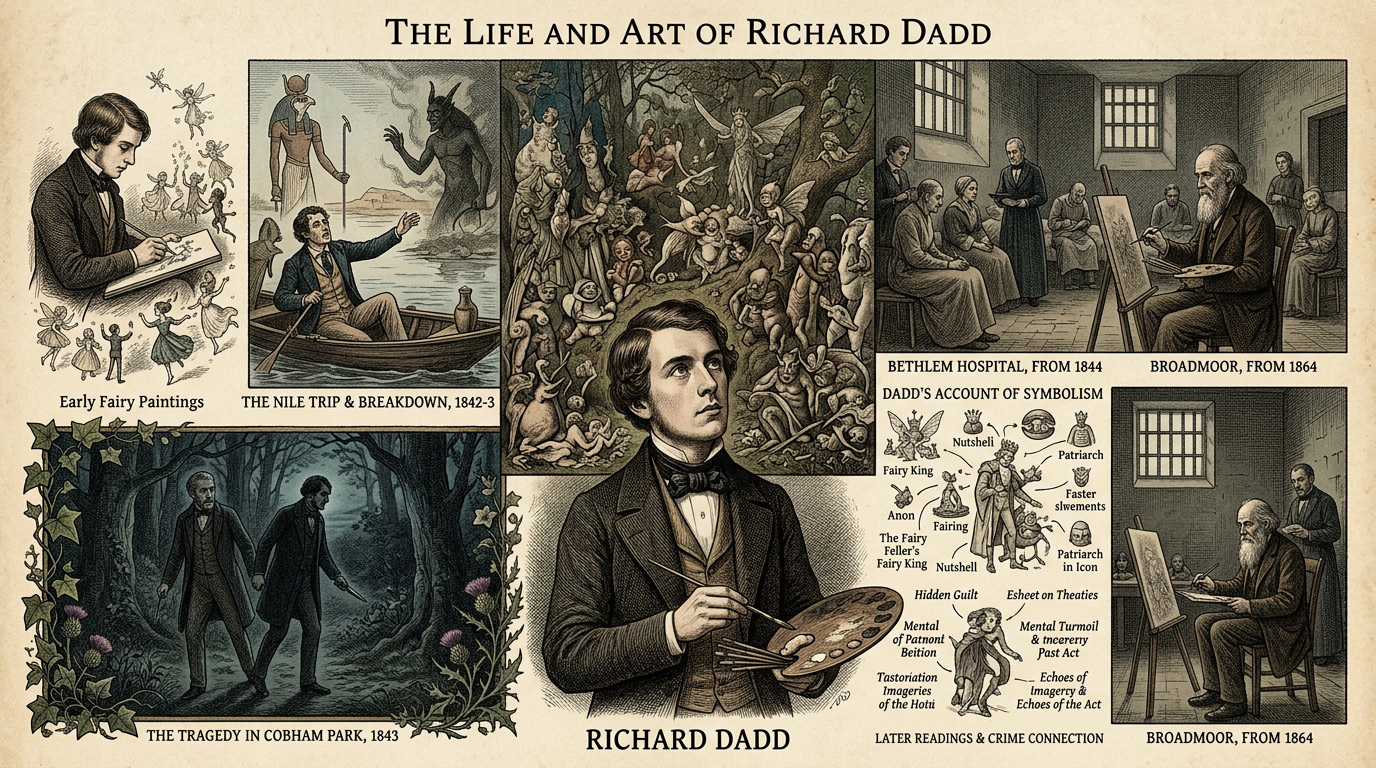
and the Long Unfinished Labor of The Fairy Feller’s Master-Stroke

“Her chariot is an empty hazel-nut, / Made by the joiner squirrel or old grub, / Time out o’ mind the fairies’ coachmakers.” — William Shakespeare, Romeo and Juliet, Act I, Scene 4
An Archival Chronicle Prepared for the Discerning Collector
Compiled by the Archivist of the Unseen
Contents
I. A Morning in Cobham Park
II. A Note on This Study, and on Madness
III. The Most Promising Young Painter in London
IV. Field Study — The Journey East
V. Field Study — The Crime and the Flight
VI. Bethlem: The Criminal Wing
VII. Field Study — The Painting
VIII. Field Study — The Poem That Explains Nothing
IX. Field Study — Reading the Master-Stroke
X. Broadmoor, and the Painting’s Long Road
XI. Field Study — The Ledger of Richard Dadd
XII. What the House Will Not Unremember
Bibliography
I. A Morning in Cobham Park
It is the twenty-ninth of August, 1843, and you live in Cobham, a quiet village in the Kent countryside a few miles from Rochester, where the great house of the Earls of Darnley stands in its deer park among ancient trees. The harvest is coming in. Yesterday a young man of twenty-six who had been staying in the village sent word to his father in London, and the father, a gentleman in his fifties, came down to meet him. In the dusk the two walked out together toward the park. Only one of them came back.
This morning a local butcher, crossing the park, finds the father’s body in a hollow. He has been struck, his throat has been cut, and he has been stabbed. He is Robert Dadd, a respected chemist, formerly of Chatham. His son is gone. By the time the constables have pieced together what happened, the young man is across the Channel, and the newspapers are printing his name beside a word that will follow it forever: parricide. He is Richard Dadd, until this summer the most promising young painter in London, a medalist of the Royal Academy Schools, a painter of fairies. Within a year he will be locked in the criminal wing of the Bethlem asylum. He will never be free again. And there, over nine years, in a cell south of the Thames, he will paint one of the strangest masterpieces of the century.
This field study takes as its subject Richard Dadd: his early brilliance, the breakdown that overtook him on a journey through the Near East, the killing of his father, and the more than four decades he spent in Bethlem and Broadmoor hospitals, painting constantly. At its center is the picture for which he is best remembered, The Fairy Feller’s Master-Stroke, worked on from 1855 to 1864 and never, in his own judgment, finished. Its purpose is to set out what is documented about Dadd’s life and illness, what he himself said about the painting, and what later critics have read into it, and to keep those three things apart. That matters here more than in most entries of this archive. Dadd was a real man who committed a real killing in the grip of a severe mental illness, and his father was a real victim. Neither the illness nor the art should be made into a gothic entertainment.
The pages that follow are prepared for the careful reader who wishes to look closely at the painting, as it asks to be looked at: the reader who understands that the most haunted thing in the canvas is not any fairy or goblin among its crowded grasses, but the stillness of a raised axe that, after nine years of labor, has still not fallen.
❧ ❧ ❧
II. A Note on This Study, and on Madness
The documentary record of Dadd’s life is good: court and asylum records, newspaper reports, the recollections of his friend the painter William Powell Frith, the casebooks of Bethlem and Broadmoor, and a long, rambling poem Dadd wrote about the Fairy Feller in 1865. The modern understanding of his life owes most to Patricia Allderidge, the archivist of Bethlem, whose research and 1974 exhibition at the Tate restored him to serious attention, and to later scholars such as Nicholas Tromans. Where I quote Dadd, the words are his own; where I describe the opinions of modern critics, I paraphrase them and name them.
A word on illness. Dadd is usually said, in modern accounts, to have had paranoid schizophrenia; some writers have suggested other conditions. Every such diagnosis is made at a distance of more than a century and a half, from records written in the language of a different medicine, and should be held lightly. It is also worth saying plainly what his story is not: it is not evidence that people with schizophrenia are dangerous. The great majority are not, and are far more likely to be harmed than to harm. Dadd’s case was extraordinary, which is precisely why it is remembered.
❧ ❧ ❧
III. The Most Promising Young Painter in London
Richard Dadd was born at Chatham, in Kent, on August 1, 1817, the son of Robert Dadd, a chemist, and his wife Mary Ann, the daughter of a shipwright. His mother died when he was a child. He was educated at the King’s School, Rochester, where his gift for drawing showed early, and the family moved to London when he was a teenager. In 1837, at the age of twenty, he entered the Royal Academy Schools, and in 1840 he won the Academy’s medal for life drawing.
With his friends William Powell Frith, Augustus Egg, Henry O’Neil, and others, he formed a sketching club called The Clique, young men who met to draw and to argue about the future of English painting. By common consent, Dadd was the most gifted of them. Frith, who would become one of the most successful painters of the Victorian age, later remembered him with affection and with grief.
The Fairy Painter
Dadd’s early reputation rested on fairy subjects, a fashionable genre in the England of the 1840s, drawn largely from Shakespeare. He painted Titania Sleeping and Puck, both from A Midsummer Night’s Dream, and Come Unto These Yellow Sands, from The Tempest, shown at the Royal Academy in 1842. He contributed illustrations to The Book of British Ballads. Critics praised the delicacy of his drawing and the strangeness of his imagination. He was twenty-five, admired, and in demand.
❧ ❧ ❧
IV. Field Study — The Journey East
In July 1842, Sir Thomas Phillips, a lawyer and former mayor of Newport in Wales, knighted for his part in resisting the Chartist rising there in 1839, engaged Dadd as his traveling artist for a long tour through Europe and the Near East. It was the kind of commission a young painter dreamed of. They traveled through Italy, Greece, and Turkey, through Syria and the Holy Land, from Jerusalem to the Jordan and back across the wilderness of Ein Gedi, and on into Egypt.
Phillips set a punishing pace, and Dadd had little time to draw. In Egypt, toward the end of 1842, as their boat went up the Nile, his companions noticed a change in him. He became agitated, suspicious, and at times violent. He came to believe that he was under the influence of the Egyptian god Osiris and was being directed by divine powers. His behavior was put down at first to sunstroke, the explanation the age reached for most readily when an Englishman broke down in a hot country.
By the spring of 1843 he had left Phillips in Paris and returned abruptly to England. In London his conduct grew more disturbed. His father sought medical advice and was told that his son was dangerous and should be placed under care. The family took him instead to the country, to rest.
❧ ❧ ❧
V. Field Study — The Crime and the Flight
On the evening of Monday, August 28, 1843, Richard Dadd and his father went out together into Cobham Park. Dadd had come to believe that his father was the Devil in disguise, or that a demon had taken his father’s place, and that he was commanded to destroy him. He attacked his father, cut his throat, and stabbed him. The body was found the next morning.
Dadd had planned his escape. He crossed to Calais, changed his clothes, went on to Paris, and took a coach south toward Lyon. On the road near the Forest of Fontainebleau he attacked a fellow passenger with a razor. He was overpowered and brought before a local magistrate, to whom he volunteered that he had come from England, where he had killed someone.
The French authorities recognized that he was insane. He was confined in an asylum at Clermont, north of Paris, where his condition was recorded as homicidal monomania. In July 1844 he was returned to England, and on August 22, 1844, he was admitted to the department for criminal lunatics at Bethlem Hospital. He never stood trial in the ordinary sense. He would spend the remaining forty-one years of his life in hospital.
The tragedy did not end with Richard. Several of Robert Dadd’s other children later suffered serious mental illness; at least two of Richard’s siblings are recorded with the same kind of disorder, and a third was kept under private care. Whatever the cause, it ran through the family.
❧ ❧ ❧
VI. Bethlem: The Criminal Wing
Bethlem, the oldest psychiatric hospital in England, whose name gave the language the word bedlam, had moved in 1815 to a new building at St George’s Fields, south of the Thames; part of that building now houses the Imperial War Museum. A separate wing for criminal patients, people who had committed crimes while insane, had opened beside it.
The Bethlem of the 1840s and 1850s was not the chained and jeering madhouse of legend. Under its physicians in Dadd’s time, and especially under Dr. William Charles Hood, who became its resident physician in 1852, reforming doctors encouraged occupation, comfort, and dignity for their patients. Dadd was given materials and allowed, indeed encouraged, to paint. He painted a portrait of Sir Alexander Morison, the hospital’s visiting physician, in 1852, now in the Scottish National Portrait Gallery. He painted a series of thirty-three watercolors called Sketches to Illustrate the Passions, with titles such as Grief or Sorrow, Love, Jealousy, Agony—Raving Madness, and Murder. He painted shipping scenes and landscapes from memory, among them the luminous watercolor Port Stragglin of 1861, imaginary harbors rendered with a miniaturist’s precision.
Visitors and staff found him quiet, courteous, and well read, able to talk about art with intelligence, and yet, on certain subjects, entirely in the grip of his delusions. A photograph taken in the 1850s shows him at his easel in the asylum, working on a large fairy picture, Contradiction: Oberon and Titania. His figures, in almost every picture of these years, share a peculiar fixed and unfocused stare.
❧ ❧ ❧
VII. Field Study — The Painting
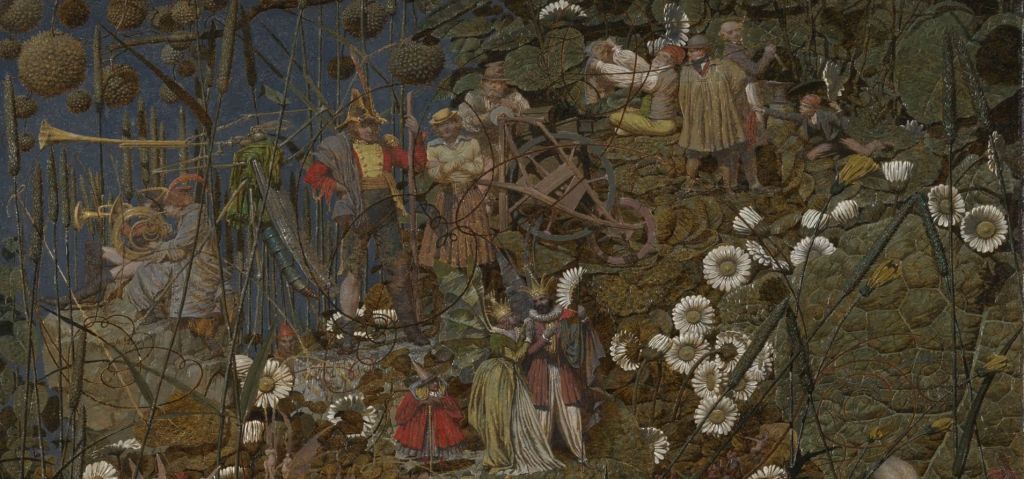
In 1855, George Henry Haydon, the steward of Bethlem, who had come to admire Dadd’s work, asked him for a fairy painting of his own. Dadd began The Fairy Feller’s Master-Stroke. It is a small oil on canvas, about twenty-one by fifteen inches, and it took him, by his own inscription, the better part of nine years.
What the Canvas Shows
The picture is a clearing in long grass, seen from the height of a mouse. Daisies tower like trees; blades of grass and stalks of seeding plants cross the scene like the bars of a cage. Packed among them, in a palette of browns, ochres, and dull greens, are dozens of tiny figures, every one painted with an almost microscopic precision.
At the center, seen from behind, stands the feller, a woodsman with his axe raised high over his head, poised to split a hazelnut that lies on the ground before him. Above him stands a bearded patriarch in a triple crown like a pope’s, his hand raised as if about to give the signal to strike. Around them crowd onlookers of every kind: Oberon and Titania, the king and queen of the fairies; a lady in a ruffled Spanish dress; a man in a tall pointed cap; peasants and gentlemen; tiny winged figures; a pedagogue; an insect blowing a trumpet. Across the top runs a row of small figures who seem to belong to the old counting rhyme, a soldier, a sailor, a tinker, a tailor, and their fellows, among them an apothecary at work with a mortar and pestle.
Horror Vacui
There is almost no empty space in the picture. The eye wanders from figure to figure and finds no place to rest. Dadd built the surface up in thin layers of paint, which give the grasses and figures an unsettling depth, as though the scene went back much further than the canvas allows. The lower left corner, where the background is only sketched in, shows that the work was never completed.
The Inscription
On the back of the canvas, Dadd wrote: “The Fairy-Feller’s Master-Stroke, Painted for G. H. Haydon Esqre by Rd. Dadd quasi 1855–64.” That small Latin word, quasi, as if, has puzzled scholars. Patricia Allderidge suggested it might mean that the picture was set aside for long stretches, or that it took a long time to begin. The date 1864 is the year Dadd was moved from Bethlem to the new Broadmoor asylum, and it seems the move simply ended the work. He regarded it as unfinished.
❧ ❧ ❧
VIII. Field Study — The Poem That Explains Nothing
In 1865, after the painting had gone to Haydon, Dadd wrote a long poem about it, titled Elimination of a Picture & its Subject—called The Feller’s Master Stroke. In it he names and describes the figures one by one, and it is the only account we have of what he thought he had painted.
Queen Mab’s Chariot
The poem tells us what the feller is doing. He is about to split the hazelnut to make a new chariot for Mab, the queen of the fairies. The source is Shakespeare: in Romeo and Juliet, Mercutio describes Queen Mab, the fairies’ midwife who brings men dreams, riding in a chariot made from an empty hazelnut. The poem places Oberon and Titania above the patriarch, and Mab herself waiting at the left for her new carriage. It identifies the Spanish lady as dressed like the famous dancer Pauline Duvernay, and the man in the pointed cap as a member of what Dadd calls the “Chinese Small Foot Societee.” Haydon, it seems, had suggested Shakespeare’s fairy verse as a starting point.
Without Intent
What the poem does not do is explain the picture’s meaning. Dadd insists, on the contrary, that it has none in particular. When the commission came, he says, inspiration failed him, so he emptied his mind and let the design grow, without intent:
“I thought on nought — a shift / As good perhaps as thinking hard.”
Richard Dadd, Elimination of a Picture & its Subject (1865)
Elsewhere in his writing, Dadd dismissed autobiography as a vain fiction. If we take him at his word, the painting is not a confession. It is a fairy picture made by a man who sat down with no idea and filled a canvas with whatever came, for nine years.
❧ ❧ ❧
IX. Field Study — Reading the Master-Stroke
Few viewers have taken Dadd at his word, and it would be strange if they had. A man who killed his father with a blade, believing himself commanded by a god, spent nine years painting a crowd gathered around a raised axe, waiting for a patriarch’s signal to strike. The reader is entitled to notice that. The reader is also obliged to remember that it is a reading, not a fact.
The Allegory of the Crime
Several critics have read the picture as a displaced image of the killing. The novelist and critic Adam Roberts has suggested that Dadd refracted his own crime through fairy fantasy, shrinking it to miniature as if to drain away its force. Some viewers see Robert Dadd, the chemist, in the apothecary with his mortar and pestle among the figures at the top, and a figure of the young Dadd nearby; others read the crowned patriarch, the father-figure who commands the blow, as the god who Dadd believed had commanded his. None of this is stated in the poem, and Dadd’s own account points the other way.
The Moment Before
What is beyond dispute is the picture’s structure. Everything in it is arranged around a single instant: the axe at the top of its swing, the nut not yet split, the patriarch’s hand not yet fallen. Every onlooker is waiting. It is a painting of suspense held for nine years and never released. Whether that is the suspense of a fairy coachmaker about to make a chariot, or the suspense of a man who could not stop returning, in some deep part of himself, to the instant before his own blow fell, is a question the canvas will not answer.
The Grass as Bars
Others have seen the stalks of grass that cross the whole scene as the bars of a cell, and the figures trapped behind them as the inhabitants of an asylum. Again, this is interpretation, but it is hard to look at the picture without feeling enclosed by it.
❧ ❧ ❧
X. Broadmoor, and the Painting’s Long Road
In 1864 Dadd was transferred with the other criminal patients of Bethlem to the new Broadmoor asylum in Berkshire, built for the purpose. He remained there for the last twenty-one years of his life, painting steadily, receiving few visitors, and treated with kindness by the superintendent, Dr. William Orange. He died on January 7, 1886, at sixty-eight, of what the records call an extensive disease of the lungs, and was buried in an unmarked grave in the hospital cemetery.
The Painting’s Journey
The Fairy Feller passed from Haydon to the collector Alfred Morrison, and from Morrison’s family to the poet Siegfried Sassoon, whose mother-in-law, Katharine Gatty, gave it to him when he married her daughter Hester in 1933. Sassoon had a reason of his own to treasure it. One of his fellow officers in the First World War had been Julian Dadd, a great-nephew of the painter, whose two brothers were killed in the war and who was himself badly wounded; he died by suicide in 1937. In 1963, Sassoon withdrew the painting from a sale at Sotheby’s and gave it to the Tate in memory of Julian Dadd and his brothers. It hangs today at Tate Britain.
Afterlife
Dadd was largely forgotten for most of a century. Allderidge’s exhibition at the Tate in 1974 brought him back. The painting has since inspired a song of the same title by the rock band Queen, on their album Queen II, released the same year, and Angela Carter’s radio play Come Unto These Yellow Sands, among much else. Many of his works can be seen at the Bethlem Museum of the Mind.
❧ ❧ ❧
XI. Field Study — The Ledger of Richard Dadd
Established
Born at Chatham, August 1, 1817; the Royal Academy Schools and the life drawing medal of 1840; The Clique; the early fairy paintings; the tour with Sir Thomas Phillips from July 1842; the breakdown in Egypt and the belief in Osiris; the killing of Robert Dadd in Cobham Park on August 28, 1843; the attack near Fontainebleau; confinement at Clermont; admission to Bethlem, August 22, 1844; the portrait of Morison, 1852; the Passions series; The Fairy Feller’s Master-Stroke, 1855 to 1864, for G. H. Haydon, with Dadd’s inscription; the poem of 1865; the transfer to Broadmoor in 1864; death on January 7, 1886; Sassoon’s gift to the Tate in 1963.
Dadd’s Own Account
That the feller splits a nut to make Queen Mab’s chariot; that the design grew without intent; that the picture is unfinished.
Interpretation
That the painting is an allegory of the parricide; that the apothecary and the boy represent Dadd and his father; that the patriarch stands for the commanding god; that the grass represents the bars of the asylum.
Uncertain
The precise nature of his illness, by modern diagnosis; the meaning of quasi in the inscription.
❧ ❧ ❧
XII. What the House Will Not Unremember
Faulkenmire has a rule that I have written of before: what is surrendered to the house is unremembered by the one who surrenders it. People come up the creek to lay down what they cannot bear, and they go home lighter, and the house keeps it for them.
I have wondered, standing in front of The Fairy Feller, whether Richard Dadd would have come up the creek, and what he would have left. I do not think he could have. A thing must be given freely, and I am not sure that Dadd, for most of his life, was ever free in the sense the house requires; the illness that drove his hand in Cobham Park was not something he chose and not something he could set down. What he did instead was what the painting shows. He took the worst moment of his life, if that is what it is, and made it small, and surrounded it with grass and flowers and the fairies of his youth, and held it there, at the top of the swing, for nine years, without letting it fall.
I have a print of the painting on the wall of the reading room. Last night, when I looked up from my desk, the house’s ledger was open beside me, and there was no new line in it at all. There was only, in the margin, a small drawing in brown ink: a hazelnut, whole, unbroken.
In another hand, written in the margin:
Not received. Not refused. Some things are only to be looked at.
I think that is right. The archive keeps what is given. Some things are not given, and cannot be. They can only be looked at, carefully and without cruelty, by those who come after: a father found in a hollow among the trees, a son who spent forty-one years behind locked doors, and between them a nut that never splits.
❧ ❧ ❧
This field study is preserved as one vestige among many within the haunted archive of Wicked Dual, an artisan boutique devoted to the reclamation of history’s clandestine and silenced corners. It is filed in the reading room at Faulkenmire, beneath a print of a painting that was never finished, and is kept in memory of Robert Dadd, and of his son.
Read the written chronicles on the blog, the Wicked Archive: www.wickeddualblog.com
Secure the physical artifacts drawn from these histories at the Wicked Dual boutique: https://www.etsy.com/shop/Wickeddual
We invite you to enter the haunted archive and secure a piece for your private collection; it is a necessary addition for those who curate the darker corners of human history.
— The Archivist of the Unseen

Bibliography
Readers pursuing formal citation are advised to verify editions and pagination against a library catalog.
Allderidge, P. (1974). The late Richard Dadd, 1817–1886. Tate Gallery.
Frith, W. P. (1887). My autobiography and reminiscences (Vols. 1–2). Richard Bentley and Son.
Greysmith, D. (1973). Richard Dadd: The rock and castle of seclusion. Studio Vista.
Martineau, J. (Ed.). (1997). Victorian fairy painting. Royal Academy of Arts / Merrell Holberton.
Shakespeare, W. (1597/2000). Romeo and Juliet (J. L. Levenson, Ed.). Oxford University Press.
Tromans, N. (2011). Richard Dadd: The artist and the asylum. Tate Publishing.
Related Chronicles in the Archive
Field Study No. XXXI — The Dancers Beneath the Mamelles: The Yumboes of Senegal
Field Study No. XXXVII — The Poet Who Said No: Christina Rossetti and Goblin Market
Field Study No. XL — The Black Horse of November: The Púca of Ireland
Leave a Reply