and the Husband Who Broke His Promise

“In the morning the meadow above the stream was white with linen that no woman of the village had washed. By the water’s edge, pressed into the mud, were the prints of small cloven hooves.”
An Archival Chronicle Prepared for the Discerning Collector
Compiled by the Archivist of the Unseen
Contents
I. Linen on the Meadow at Moonrise
II. A Note on Living Heritage
III. A Hundred Names for the Women of the Water
IV. The Body of the Anguana
V. The Laundry, the Loom, and the Gift of Knowledge
VI. Field Study — The Bride Who Must Not Be Struck
VII. Danger at the Water’s Edge
VIII. Footprints in Stone: The Rock Art Hypothesis
IX. Karl Felix Wolff and the Making of the Dolomite Legends
X. An Archival Aside: On Thin Citations
XI. Field Study — The Ledger of the Recorded, the Regional, and the Reworked
XII. The White Cloth in the Morning
Bibliography
I. Linen on the Meadow at Moonrise
A valley in the eastern Alps, some centuries ago. The village sits where a mountain stream comes down out of the forest, cold and fast and green. Above the last houses the stream runs through a gorge, and in the side of the gorge there is a cave that no one enters. The old women say that the anguane live there.
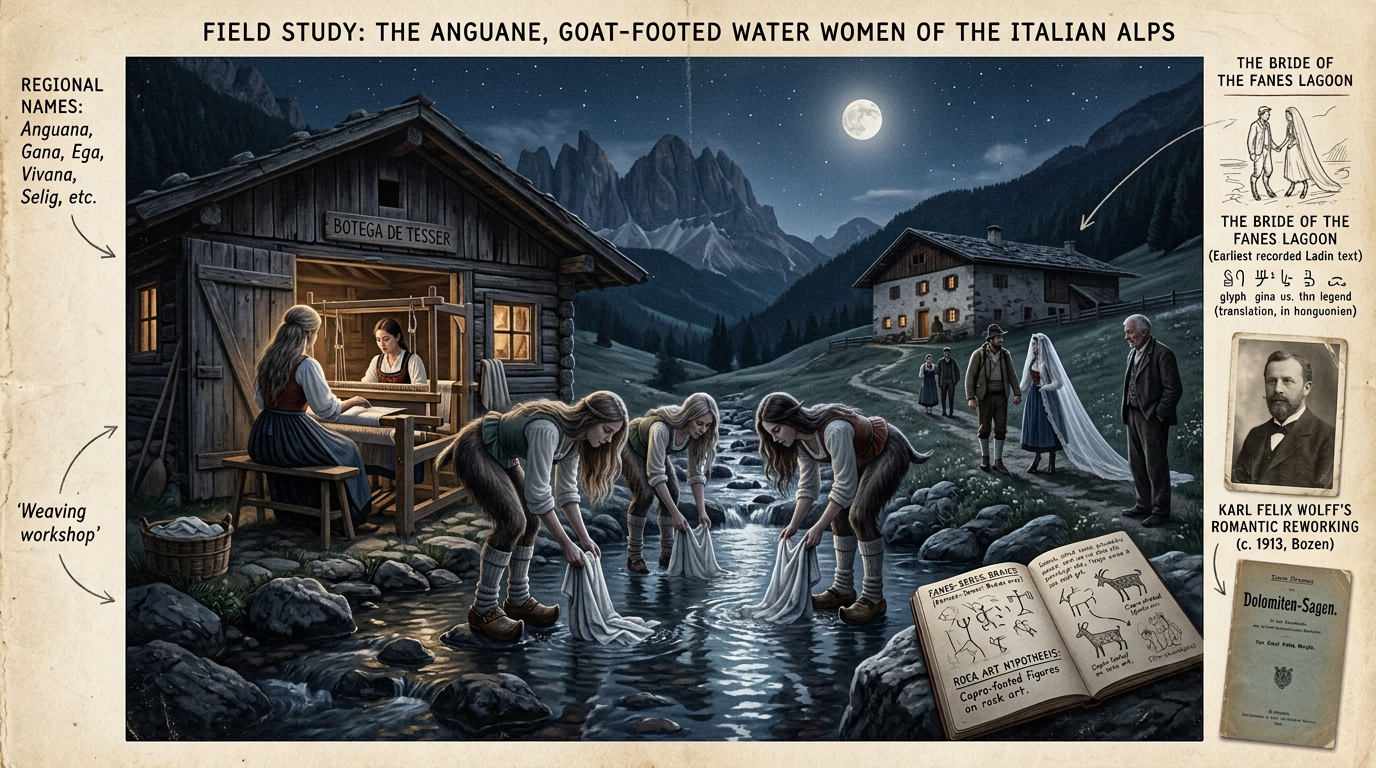
On clear nights, when the moon is full, the anguane come down to the water. They are beautiful, people say, with long hair and pale faces, and they wash their linen in the stream and spread it on the meadow to bleach in the moonlight. In the morning the cloth is gone, and the grass where it lay is a little whiter than before. Sometimes a shepherd, coming late along the path, has seen them dancing. Sometimes he has looked down, and seen that beneath their skirts they have the feet of goats.
An anguana may be kind. She may teach a girl to spin, or leave a skein of thread that never runs out. She may even marry a mortal man, keep his house, and bear his children. But she will set him a condition, and the stories agree that he will break it, and that when he does, she will go back to the water and never return.
The anguane (singular anguana) are water spirits of the folklore of northeastern Italy and the neighbouring Alpine regions. They are known under many related names across Veneto, Trentino, the Ladin valleys of the Dolomites, Friuli, and Lombardy. They are usually female, usually associated with springs, streams, lakes, waterfalls, and caves, and usually described as beautiful women betrayed by a single animal feature: the feet of a goat.
The short description now circulating most widely in English presents them as cloven-footed water nymphs with long breasts, who carried their children in baskets on their backs and threw their breasts over their shoulders to nurse them, who lived near lakes, seduced male travelers, and helped infertile women conceive. That summary is broadly in line with the tradition, but it compresses a large, varied, and regionally specific body of belief into a few lines, and it rests on thin sources.
This field study sets out the anguane in their full regional variety, examines the most important tale told of them, considers the modern scholarly theories about their origins, and gives the devoted student of the uncanny a clear guide to the difference between the recorded oral tradition and the romantic retellings of the early twentieth century.
❧ ❧ ❧
II. A Note on Living Heritage
The anguane belong to the traditions of living communities: the Ladin-speaking people of the Dolomite valleys, who number roughly thirty thousand; the Friulians; the Venetians of the mountain districts; the Cimbrian-speaking communities of the Venetian and Trentino uplands; and the Slovene-speaking villages of the Natisone valleys, where related figures are called krivapete. In many of these places the anguane are no longer an object of active belief, but they remain a cherished part of local identity and heritage.
They survive in place names, such as caves, springs, and rock shelters called the cave of the anguane or the house of the agane. They survive in local museums and in an ecomuseum network in the Friulian Dolomites that takes its name, Lis Aganis, from them. They survive in the stories grandparents still tell. They are treated here as the heritage of these communities, and the study takes care to distinguish what those communities recorded from what outsiders later wrote about them.
❧ ❧ ❧
III. A Hundred Names for the Women of the Water
Few beings of Alpine folklore have as many names as the anguane. The variety itself is evidence of how deep and widespread the belief once was, carried in a dozen dialects across hundreds of separate valleys. The archaeologist and folklorist Giacomo Camuri, writing in 2012, treats them as a single family of water women stretching across the Alps, and gathers many of their names.
The Family of Names
In Veneto and much of Trentino they are anguane or aguane. In Friuli they are the aganis, and in parts of Trentino and Friuli, agane. In the Ladin Val di Fassa they are vivane. In other Ladin valleys related female beings are known as ganes, a name preserved in the earliest Ladin collections. In the Slovene-speaking villages of the Natisone valleys in Friuli, their counterparts are the krivapete, “the ones with twisted heels,” a name that refers directly to their backward or deformed feet. In Lombardy’s Valcamonica, Camuri connects the name of the famous rock art site of Naquane to the same root, and the Cimbrian communities speak of the beate donnette, the little blessed women. Other regional forms appear in the record as well.
The Problem of Etymology
The most widely accepted explanation derives the name from a popular Latin form, aquana, meaning a being of the water, from aqua. This fits the forms aguana, agana, and aganis particularly well, and it fits the anguane’s unwavering association with springs and streams. An alternative has sometimes been proposed linking the n in anguana to the Latin anguis, a snake, and it is true that in some Venetian traditions anguane can transform into serpents, eels, and other water creatures. A Venetian expression, “to vanish like an anguana,” captures their elusive, slippery nature. The water etymology remains the stronger and more commonly accepted of the two, but the snake association is part of the tradition.
❧ ❧ ❧
IV. The Body of the Anguana
Descriptions of the anguane vary from valley to valley, and from story to story. Some details recur widely; others are local.
The Feet of a Goat
The single most consistent feature is the foot. In many tales the anguana appears as a beautiful woman whose nature is revealed only by her feet, which are the hooves of a goat, or which are turned backward, or otherwise twisted. Camuri records goat-footed figures throughout the region, including a Cadore anguana known simply as Pie’ di capra, “Goat-foot.” The krivapete of the Natisone valleys are named for the same feature. The animal foot is a mark shared by wild beings across the Alps and far beyond: a sign that however human she may look, the anguana belongs to the wild.
Long Breasts and the Basket
The image of the anguana with long breasts, who carries her children in a basket on her back and throws her breasts over her shoulders to nurse them, appears in folklore compilations about the anguane and in the brief summary now in wide circulation. It deserves careful treatment. The motif of the wild woman with long breasts thrown back over the shoulders is one of the most widely distributed images in world folklore. It is attached to the wild women of the Tyrolean Alps, to the albasty of the Central Asian steppe, examined in Field Study No. XXXII of this archive, and to wild women in many other traditions. It is a marker of wildness and of a body that is not quite human. Its presence in the anguane tradition is plausible, but in the sources examined for this study it is less consistently attested than the goat feet, the water, and the laundry, and the reader should treat it as one regional feature rather than the defining image of the anguane.
Beautiful and Terrible
The anguane are most often beautiful, but not always. Some Venetian traditions describe them as old and withered, with goat feet. Others describe them as women above the waist and fish or eel below, a form reminiscent of the mermaid and probably influenced by it. Some can change their shape at will, becoming serpents, otters, or salamanders, and slipping away at the first sign of danger. The variety reflects the many communities that told the stories, each with its own anguane.
❧ ❧ ❧
V. The Laundry, the Loom, and the Gift of Knowledge
If one activity defines the anguane, it is washing. They are the washerwomen of the Alpine waters.
The White Linen
The anguane are said to wash their linen in streams and springs and to spread it to bleach on the meadows, often by moonlight. Camuri records that the aguane of Roncegno in Trentino laid out white laundry on the meadows on Fridays, and that the vivane make the lye that whitens cloth. In Friuli the aganis are seen on full-moon nights dancing in white garments and drying their clothes in the moonlight. Linen and laundry were among the most laborious and important work of women in the Alpine village, and the anguane perform that work in a supernatural register, with impossible whiteness and at impossible hours.
The Thread That Never Ends
The anguane are also spinners and weavers, and they are teachers. Legends tell of anguane who give a girl a skein of thread or a ball of yarn that never runs out, so long as she does not reveal where it came from, or who look at it to see the end. Others teach the arts of weaving, embroidery, or cheese-making to the villagers, often under a condition of silence. In a number of Alpine traditions, the wild women are credited with teaching humanity some of its essential crafts. The gift is real, but it is conditional, and when the condition is broken, the gift is lost.
Fertility
The anguane are linked to fertility in several ways. The vivane are credited with the fertility of pastures and crops. The brief English summary in circulation states that they helped infertile women conceive, and Camuri notes that the church dedicated to the saints Faustina and Liberata near the rock art site of Naquane, where Santa Liberata was invoked to protect women in childbirth, may preserve the memory of an earlier female cult connected with the water. The specific claim that anguane helped barren women become pregnant is, however, thinly documented in the sources examined here.
❧ ❧ ❧
VI. Field Study — The Bride Who Must Not Be Struck
The most important story told of the anguane and their kin is the story of the supernatural bride. It is told in many versions across the region, and its earliest Ladin recording is among the most moving.
The Gana of Pezzedi
In 1881 the Ladin writer and scholar Giovanni Battista Alton, a native of Colfosco in Alta Badia, published a collection of proverbs, traditions, and anecdotes from the eastern Ladin valleys. Among them is a tale of the ganes and salvans, wild women and wild men who lived in dens among the rocks, dressed in the skins of wolves and bears, and feared thunder. In winter, cold and hungry, they came down to the valley.
One young gana, beautiful and hardworking, came often to the farm of Pezzedi to warm herself, and there she learned to speak Ladin. The farmer, an unmarried man, came to love her. She learned of Christianity, was baptized, and agreed to marry him, but on one condition: he must never strike her on the face with the back of his hand. If he did, she would have to leave. For many years they lived happily and had children. Then one day, as she was washing the children, he came home tired, saw something on her forehead, and brushed it away with the back of his hand. She cried out, looked at her husband and her children, and was gone. They never saw her again.
The Name That Must Not Be Spoken
In other versions the condition is different. In a Cadore tale recorded by Camuri, the anguana called Pie’ di capra is lost when a name taboo is broken: her husband speaks the name he was forbidden to speak, or mentions her feet. In a legend from Roncegno, a young farmer marries an aguana, and other aguane descend from their union, so that certain families were said to carry the blood of the water women. The structure is always the same. A mortal man wins a supernatural wife. She brings him prosperity and children. She sets a single prohibition. He breaks it, often by accident, and she returns to the wild.
The Wider Pattern
This tale belongs to one of the great international story types, the supernatural wife who leaves when a taboo is broken. Its most famous European example is the French legend of Mélusine, the serpent-woman whose husband was forbidden to see her on Saturdays, and who flew away when he broke his word. The Welsh lady of Llyn y Fan Fach, who returned to her lake after her husband struck her three times without cause, is another. The swan maidens and selkie wives of northern Europe belong to the same family.
The anguana’s version carries particular weight. The gana of Pezzedi is not stolen like the selkie or tricked like the swan maiden. She chooses her husband, learns his language, takes his faith, and sets her own condition. When she leaves, it is not because she is reclaimed by the wild but because a promise has been broken. The story speaks to the fragility of the bond between the village and the wild world around it, and perhaps, too, to the precarious position of a wife in a household where a blow could end a marriage.
❧ ❧ ❧
VII. Danger at the Water’s Edge
The anguane are not always benevolent. Like most beings of the water, they can be dangerous.
The brief English summary states that the anguane seduced male travellers. Camuri records the darker form of this belief: that anguane lure men away, after which those men are enslaved or killed. Like the sirens of classical tradition, to whom some writers compare them, and like the water women of many European traditions, the anguane are associated with the risk of being drawn into the water and not returning. In mountain country, where streams run swift and cold and gorges are deep, such stories carried a practical warning.
In some valleys the anguane, or their Friulian kin, were also said to abduct children. Camuri notes a tradition from Val d’Arzino in which agane take children, and suggests it may preserve a memory of the initiation of girls. As in many child-stealing traditions, the story could also serve to keep children away from dangerous water.
Like the ganes of Alton’s tale, who did no harm to those who gave them something but took savage revenge on those who mocked or offended them, the anguane were governed by a principle of respect. The person who gave food, kept a promise, or held their tongue was safe and might be rewarded. The person who insulted, spied, or broke faith was punished.
❧ ❧ ❧
VIII. Footprints in Stone: The Rock Art Hypothesis
One of the most ambitious modern interpretations of the anguane comes from the study of Alpine rock art. Valcamonica in Lombardy holds one of the largest collections of prehistoric rock engravings in Europe, and its best-known site is called Naquane, a name that Camuri connects to the aquane.
In his 2012 article in the journal Preistoria Alpina, Camuri argues that motifs found in the rock art, including cup-marks, footprints, looms, labyrinths, and birds, recur in the oral legends of the aquane across the region. Footprints carved in rock become the hoofprints of the anguane. Looms engraved on stone correspond to the anguane’s weaving. Labyrinths, which Camuri reads as figures of a female divinity, compared to the Cretan labyrinth and to Ariadne, correspond to their tangled threads. He concludes that the legends and the engravings may reflect “a common background of ritual practices and cults,” and that the stories of the anguane may preserve, in distorted form, the residues of ancient rites of initiation, death, prophecy, and sacrifice.
This is a stimulating hypothesis, but it is a hypothesis. The rock art of Valcamonica spans thousands of years, from the Neolithic to the Iron Age and beyond, while the anguane are known only from oral tradition recorded in the last two centuries. Proving a continuous line between a carved footprint and a modern legend is extremely difficult. Camuri himself acknowledges that later tales often distort whatever content they preserve. The reader should treat the connection as an interpretation offered by a serious scholar, not as an established fact. It is entirely possible that the anguane descend from ancient water cults; it is also possible that a later people looked at the strange carvings of an earlier one and explained them with the beings they already knew.
❧ ❧ ❧
IX. Karl Felix Wolff and the Making of the Dolomite Legends
No account of the Dolomite folklore of water women can avoid Karl Felix Wolff. His collection of Dolomitensagen, Dolomite legends, first published in 1913 and expanded in many later editions, became a bestseller and shaped how the whole world imagines the mythology of the Dolomites. His tales of the kingdom of Fanes, of King Laurin and the rose garden, and of countless water women and wild men are the stories that most visitors encounter.
Wolff’s method has long been disputed. He was accused, already in his lifetime and increasingly since, of not merely recording Ladin oral tradition but reworking, combining, and embellishing it, in a romantic literary style suited to the tourism that was transforming the Dolomites in his era. The literary scholar Ulrike Kindl has spent more than forty years studying his work, publishing a critical reading of the Dolomitensagen in three volumes, the most recent in 2025. As reported by the University of Innsbruck in 2026, Kindl found that Wolff adapted some passages and was responsible for merging separate traditions: the German medieval epic of King Laurin, for example, with Ladin legends of the alpenglow. His papers, including field notebooks and manuscripts, are preserved at the Brenner-Archiv in Innsbruck, so his methods can now be studied in detail.
For the student of the anguane, Wolff’s legacy is important. Many of the most popular modern retellings of Dolomite water women derive from his books, and some of the beings named in them, such as the mjanines, appear chiefly in his versions. His tales are beautiful and valuable, and they often preserve genuine tradition. But they are not raw ethnographic records, and where possible the earlier and plainer collections, such as Alton’s of 1881, should be preferred. The careful reader should ask, of any Dolomite legend, whether it comes from the people of the valleys or from Wolff’s writing desk.
❧ ❧ ❧
X. An Archival Aside: On Thin Citations
The short English summary of the anguane quoted at the start of this study is not wrong in its broad outline, but it is worth examining its foundations. The sources it cites include a study of a Tuscan festival of the Befana, a book on the Mediterranean water crisis, a popular treasury of sea and river folklore, a rock art study, and an English abstract from an Italian folklore journal. Several of these mention the anguane only in passing, and none is a dedicated study of the anguane tradition.
This matters because short summaries become the foundation for everything built after them. The details that are most vivid, the long breasts thrown over the shoulders and the help given to barren women, are precisely those that rest on the thinnest citations, while the most deeply attested features, the hundred regional names, the goat feet, the washing and weaving, and the tale of the bride who must not be struck, are reduced to a phrase or omitted entirely. The archive’s rule holds: the vivid detail is not always the well-documented one, and the reader should go back, wherever possible, to the regional collections and the scholars who have studied them.
❧ ❧ ❧
XI. Field Study — The Ledger of the Recorded, the Regional, and the Reworked
Widely Recorded
The anguane are female water spirits known under many related names across northeastern Italy and the neighboring Alps. They live in or near springs, streams, lakes, waterfalls, and caves. They are often beautiful women marked by goat feet or twisted feet. They wash linen and bleach it on the meadows, often by moonlight. They spin, weave, and teach crafts under conditions. They may marry mortal men and leave when a taboo is broken. They reward respect and punish offense.
Regional or Variable
The long breasts thrown over the shoulders and the children carried in baskets; the fish or eel lower body; the transformation into serpents and other creatures; the fertility of pastures attributed to the vivane; the luring and killing of men; the abduction of children in Val d’Arzino; and the descent of certain families from an aguana bride.
Interpretive and Contested
The derivation of the name from Latin aquana, the most widely accepted view, against the alternative from anguis; the connection of the anguane to the rock art of Valcamonica and to ancient water cults; and the link between the anguane and the Christian cult of Santa Liberata.
Reworked or Thinly Sourced
Many of the most popular Dolomite water-woman legends as told in Karl Felix Wolff’s Dolomitensagen, which combine genuine tradition with literary reworking; and, in the short English summary, the claim that anguane specifically helped infertile women conceive.
❧ ❧ ❧
XII. The White Cloth in the Morning
The anguane are, in the end, figures of the boundary between the village and the wild. They live where the mountain stream leaves the forest, at the exact point where the world of people meets the world of rock and water. They do the work of women, washing and weaving, but they do it by moonlight and with impossible perfection. They marry into human families and bear human children, but they keep their goat feet, and they keep the right to leave.
In the oldest Ladin version of their best story, the gana of Pezzedi does everything asked of her. She learns the language, takes the faith, keeps the house, and raises the children. She asks only one thing, that she never be struck. When that promise is broken, by accident and in a moment of weariness, she does not argue or bargain. She looks once at her husband and her children, and she goes.
There is something in that ending that has kept the anguane alive in the valleys long after belief in them faded. They are a memory of a world in which the waters had keepers, the meadows were white with linen no one in the village had washed, and a promise, once broken, could not be mended.
❧ ❧ ❧
This field study is preserved as one vestige among many within the haunted archive of Wicked Dual, an artisan boutique devoted to the reclamation of history’s clandestine and silenced corners. The goat-footed women of the Alpine waters are kept here with respect for the Ladin, Friulian, Venetian, Cimbrian, and Slovene communities whose valleys still carry their names.
Read the written chronicles on the blog, the Wicked Archive: www.wickeddualblog.com
Secure the physical artifacts drawn from these histories at the Wicked Dual boutique: https://www.etsy.com/shop/Wickeddual
We invite you to enter the haunted archive and secure a piece for your private collection; it is a necessary addition for those who curate the darker corners of human history.
— The Archivist of the Unseen

Bibliography
The following works include the earliest Ladin collection, the principal critical study of Wolff’s legends, and recent scholarship on the water women of the Alps; readers pursuing formal citation are advised to verify editions and pagination against a library catalog.
Related Chronicles in the Archive
Field Study No. XXIV — The Kappa
Field Study No. XXXII — The Red Mother at the River’s Edge: Al Ana
Field Study No. XXXIII — The Small Keepers of the Milpa: The Alux of the Yucatán
Leave a Reply