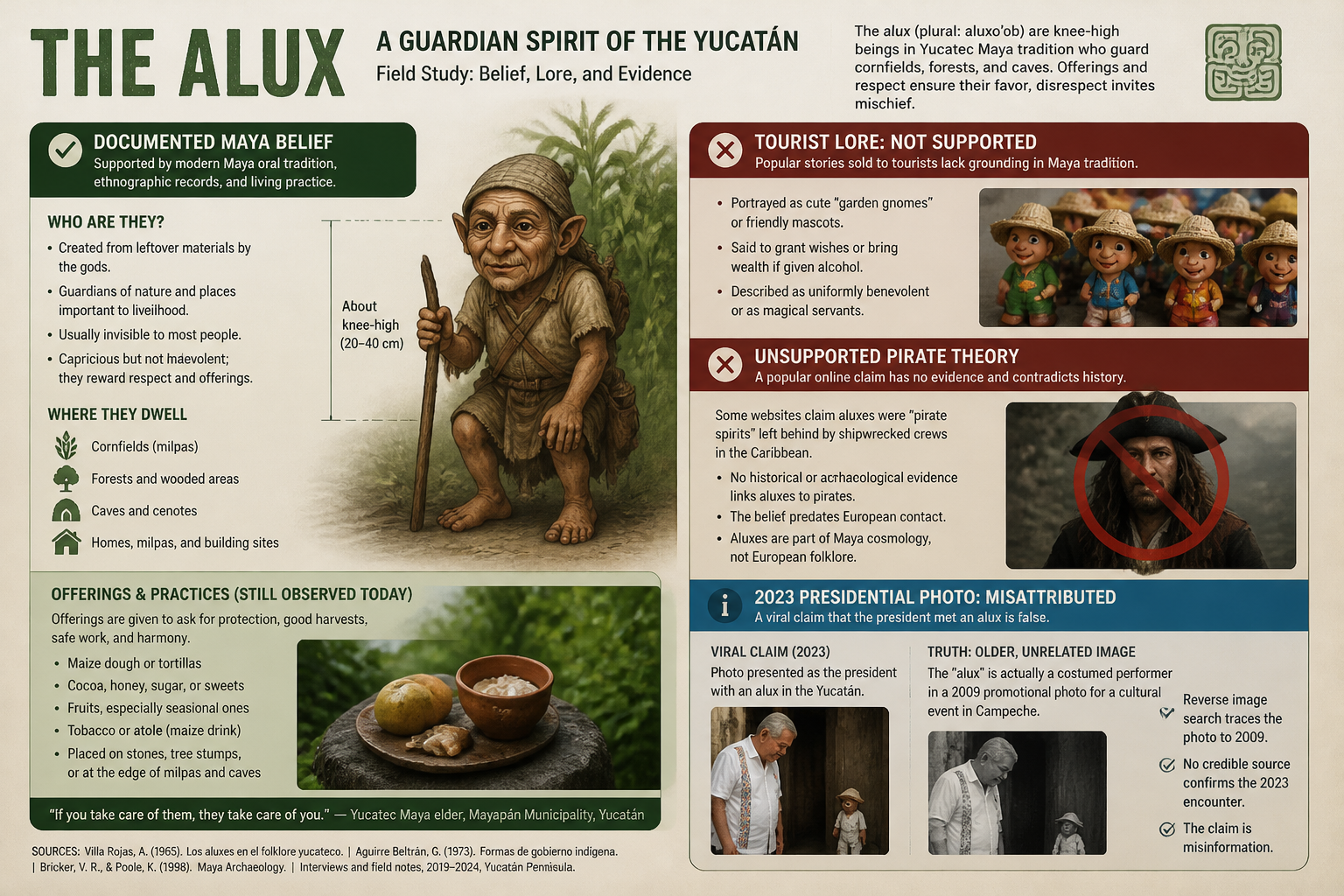
and the Question of Where the Little People Came From

“At the corner of the field there is a small house with a small door. A gourd of maize drink waits on its step. The farmer does not say the name of the one who lives there. He only listens, after dark, for the whistling.”
An Archival Chronicle Prepared for the Discerning Collector
Compiled by the Archivist of the Unseen
Contents
I. The Whistle in the Milpa
II. A Note on a Living Tradition
III. What the Ethnographers Recorded
IV. The House in the Cornfield
V. Mischief, Illness, and the Rule of Reciprocity
VI. The Builders’ Rite
VII. Field Study — The Question of Origins
VIII. Cousins, Not Twins: Chaneque, Duende, Leprechaun
IX. The Little Houses of the Coast
X. The President’s Photograph
XI. Field Study — The Ledger of the Recorded, the Repeated, and the Unfounded
XII. The Gourd on the Doorstep
Bibliography
I. The Whistle in the Milpa
Late in the dry season, somewhere in the low scrub forest of the Yucatán. A farmer has cut and burned a patch of forest, as his grandfather did and his grandfather’s grandfather before him, and planted it with maize, beans, and squash. This is the milpa, and it is not only a field. It is a negotiation with the forest, which has lent him the ground and will want it back.
At one corner of the milpa stands a small structure of stone and mortar, no taller than a man’s waist, with a single tiny doorway and sometimes a window. In front of it lies a small offering: a gourd of saka’, the sacred drink of ground maize and water, perhaps a little honey, perhaps a cigarette. The farmer does not linger there, and he does not say aloud the name of the one for whom it was left.
After dark, people say, a whistle can be heard moving among the rows of corn. Something small is walking the field. If the farmer has kept faith, it is walking for him, driving off the animals and the thieves. If he has not, his children may fall ill, his cooking fire may go out, and in the morning his pots may be found thrown into the yard.
This is the alux (pronounced roughly ah-LOOSH), plural aluxo’ob, a small spirit of the Yucatec Maya world. The alux is said to be about knee-high, usually invisible, and, when it does show itself, to look like a miniature Maya person in traditional dress. It lives in forests, caves, stones, and fields, and it can be invited, with offerings, to live in a house that a farmer builds for it. It is protective and dangerous at once, a guardian who must be fed.
The alux has become one of the most recognizable figures of Maya folklore outside Mexico. It appears in hotel brochures, on tour guides’ lips, and on the names of restaurants along the Riviera Maya, and in 2023 it appeared, after a fashion, in a photograph shared by the President of Mexico. With fame has come a great deal of confident retelling, and not all of it agrees with what Maya people themselves, and the ethnographers who have listened to them, have said.
This field study sets out what the scholarly record actually contains, tests several popular claims against it, and leaves the patient seeker of hidden things with a clear sense of which parts of the alux belong to living Maya tradition, which are guesses, and which are inventions of the last few decades.
❧ ❧ ❧
II. A Note on a Living Tradition
The alux is not a relic of a vanished people. The Yucatec Maya are a living people of many hundreds of thousands, and Yucatec Maya, the language in which the word alux belongs, is among the most widely spoken Indigenous languages in Mexico. Related beliefs are reported among Maya communities in Belize and Guatemala. Belief in the aluxo’ob, offerings to them, and ceremonies performed by Maya ritual specialists, the h-meno’ob (singular h-men), continue across the peninsula today, in rural milpas and, as later sections show, beside highways and on the construction sites of a modern tourist economy.
These are beliefs held by living families and practised by living specialists, often alongside Catholic or Protestant Christianity. They are treated here with the respect owed to any people’s religious life. Where this study corrects popular claims, it is correcting the outsiders’ retellings, not the Maya tradition itself.
❧ ❧ ❧
III. What the Ethnographers Recorded
The alux enters the academic record through the great twentieth-century ethnographies of the Yucatán, among them Robert Redfield and Alfonso Villa Rojas’s study of the village of Chan Kom, published in 1934, and Villa Rojas’s later work among the Maya of east-central Quintana Roo. In these and later studies, the aluxo’ob appear among the many beings who inhabit the forest and the milpa, a company that also includes the yuntsilo’ob, the lords or guardians of the forest; the balamo’ob, protectors of the village and the fields; and the chaako’ob, the bringers of rain.
Clay Given Life
One of the most consistent and most striking ideas in the ethnographic record concerns how the aluxo’ob come to exist. A 2014 study by the Yucatecan anthropologist Nidia Beatriz Villanueva Villanueva, which surveys earlier literature as well as her own fieldwork, records two main traditions among Maya farmers. In the first, aluxo’ob are clay or stone figures, sometimes wooden ones, made by ritual specialists and brought to life. Some accounts say they were given life with blood. In Tepich Carrillo, adults described them as dolls of clay or wood made by an h-men and set at the corners of a field to guard the crops. In the second tradition, the aluxo’ob are the spirits of the first inhabitants of the Yucatán, the people who lived on the land before the present world.
The clay-figure idea is grounded in something physical. Farmers clearing land in the Yucatán regularly turn up ancient objects: figurines, carved stones, worked fragments left by the Maya of earlier centuries. Villanueva records that farmers in Tahmek pointed to carved and perforated stones found in their fields as evidence that the aluxo’ob exist. In a landscape where the past lies just beneath the plough, it is not hard to see how small clay figures from earlier ages might be understood as the bodies of the field’s small guardians.
In the Prayers of the H-men
The aluxo’ob also appear in the ritual language of Maya specialists. The Mayanist Bruce Love, surveying the gods and spirit beings named in Yucatec ritual texts and prayers from the colonial period to the late twentieth century, notes that a transcription of a shaman’s prayers made at Balankanché in 1970 names both a chan alux, a “small alux,” and a noh alux, a “great alux.” Love treats the aluxo’ob as a borderline case of deity: they receive offerings and are expected to protect the farmer in return, which places them within the reciprocal relationship that defines much of Maya religious practice.
❧ ❧ ❧
IV. The House in the Cornfield
The most familiar image of the alux is its house. In many accounts a farmer builds a small structure in his milpa, often called in Maya kahtal alux, “the dwelling of the alux.” The alux takes up residence there and, in return for regular offerings, guards the field: it walks the rows at night, whistles to frighten away animals and thieves, and in some tellings helps call the rain.
The Offerings
Ethnographic accounts are specific about what the aluxo’ob are given. Villanueva records that in Tepich Carrillo, field owners offer saka’, the drink of ground maize, and k’óol, a thickened maize dish, once a year; in Xcanchakan, residents likewise make an annual offering of saka’. These are the same foods offered to other beings of the forest and the rain, and they place the alux within the wider structure of Maya agricultural ritual, in which the milpa is fed so that it will feed the farmer.
The Seven Years
A widely repeated account, found in many English-language summaries, holds that the alux serves a farmer for exactly seven years, helping the corn grow and summoning rain, and that at the end of seven years the farmer must seal the doors and windows of the little house, shutting the alux inside. If he fails to do so, the alux runs wild and turns to mischief.
The Archivist was unable to locate this seven-year rule in the scholarly ethnographies consulted for this study, including Villanueva’s survey of the alux literature. That does not prove it is false. Folk belief varies from village to village, and a detail can be real without having been written down by an anthropologist. But readers should know that the seven-year sealing, despite its frequent repetition, has a much thinner documentary footing than the clay figures, the offerings of saka’, and the role of the h-men. It should be cited as a reported popular belief rather than as established Maya tradition.
❧ ❧ ❧
V. Mischief, Illness, and the Rule of Reciprocity
At the heart of the alux tradition lies a principle that runs through Maya religious life: reciprocity. Beings of the forest and the field give protection, rain, and abundance, and they expect to be given something in return. A farmer who offers to the aluxo’ob is guarded. A farmer who neglects them, or a stranger who disrespects their place, is punished.
The Punishments
The punishments attributed to aluxo’ob range from the playful to the grave. They throw stones. They hide tools. They put out cooking fires and toss pots and pans into the yard. They frighten people on lonely paths, appearing suddenly and vanishing again. More seriously, neglected or offended aluxo’ob are believed to cause illness, especially in children. Villanueva’s sources note that aluxo’ob are thought to cause sickness when they are not fed, and that in Tepich Carrillo an h-men may formally name the members of a household so that the aluxo’ob will recognize them and do them no harm.
The Unspoken Name
Popular accounts often add that one should not say the word alux aloud, because to name one is to call it, and a disturbed alux is not a pleasant visitor. Similar taboos surround powerful beings in many cultures. In practice many Yucatecans speak freely about aluxo’ob, and the caution, where it is observed, is less a rigid rule than a habit of respect.
What the Children Say
Villanueva’s 2014 study is unusual in that it asked children. In 2010 she surveyed thirty-eight schoolchildren of Yucatec Maya descent in Tepich Carrillo. Most described the aluxo’ob as beings that are not of flesh and blood, and most emphasized their power to frighten and harm. Only one child mentioned their role as guardians of the forest. Many blended in Catholic ideas, and about a third drew on television, describing aluxo’ob that resembled film characters. The study is a valuable reminder that a living tradition is not a museum piece. It changes with each generation, and today it changes partly through the screen.
❧ ❧ ❧
VI. The Builders’ Rite
The alux has crossed from the milpa to the construction site. The Yucatán Peninsula has seen enormous building since the founding of Cancún in the 1970s, and much of the labour has been done by Maya workers. It is widely reported that construction projects in the region sometimes commission ceremonies from an h-men before work begins, asking permission of the beings of the land and making offerings so that the work will proceed safely.
The Bridge at the Airport
The best-known story concerns a road bridge near Cancún’s international airport. As told in the Yucatecan newspaper Por Esto! and repeated by long-time residents, the bridge was a routine piece of work, yet the project kept failing. Each morning the workers found reinforcing bars bent, cement wet, tools missing; in some tellings the structure itself had collapsed overnight. The workers, many of them Maya, concluded that the aluxo’ob were angry at the intrusion on their land. On the advice of the master builder, a ceremony was held, offerings were made, and a small pyramid-shaped house for the aluxo’ob was built beneath the bridge. After that, the story goes, the trouble stopped.
The newspaper presents this as a local legend, and the Archivist records it as such. No engineering report is cited, no construction company named. What the story documents with certainty is not a supernatural event but a living belief: that the land of the Yucatán has owners who must be asked, and that even a highway bridge built for international tourism is subject to their consent.
The House on Avenida Tulum
In October 2025, local news in Cancún reported that a small alux house standing on Avenida Tulum, one of the city’s main thoroughfares, had been set on fire. The response was telling. Residents expressed anger and sorrow, many asked that it be restored, and some recalled accidents that, they said, had followed the demolition of a similar structure in the past. Within days the house had been rebuilt on the same spot by a neighbour, reported to be a Cuban immigrant, as a gesture of gratitude to the city. Residents suggested leaving sweets or a small bottle of rum. A tradition rooted in the cornfield had become a shared civic custom in one of the most international cities in Mexico.
❧ ❧ ❧
VII. Field Study — The Question of Origins
Where did the alux come from? Is it an ancient Maya being, carried down unbroken from before the Spanish conquest, or something newer? The question has drawn several answers, of very unequal quality.
The Pre-Columbian Case
Maya people themselves often describe the aluxo’ob as ancestral spirits or as the spirits of the land, older than any European presence. The ancient Maya world was certainly crowded with spirit beings of forest, cave, and field, and the reciprocal feeding of such beings is deeply rooted in Mesoamerican religion. Some writers point to small figures in pre-Columbian art as possible early aluxo’ob. But there is no direct evidence: no pre-conquest text names the alux, and no ancient image can be securely identified as one. The honest position is that the alux sits comfortably within ancient Maya patterns of thought, but its specific form cannot be traced before the colonial and modern record.
The Colonial Case
A more careful scholarly argument, discussed by Villanueva and attributed to the anthropologist Michel Boccara, proposes that the aluxo’ob as we now know them took shape in the colonial period, built upon pre-Hispanic foundations. On this view, the clay idols of the old religion, which Spanish friars sought out and destroyed, survived in memory as small living beings of clay. The alux would then be, in part, the afterlife of the forbidden figurines: the old gods made small, hidden in the fields, and fed in secret. This argument is attractive because it fits the clay-figure tradition so closely, though like all origin theories it remains an interpretation.
The Pirate Theory
A third explanation, which circulates widely online, holds that the alux developed from contact with Spanish settlers or with pirates in the sixteenth century, many of whom are said to have come from the British Isles and to have carried a belief in fairies with them. The resemblance between the alux and the leprechaun or the brownie, the argument goes, is too close to be coincidence.
This theory should be set aside. It appears in popular summaries without supporting evidence or scholarly citation. It assumes, without demonstration, that pirates had sustained enough contact with inland Maya farming communities to reshape their religion, and it treats a general resemblance among small helpful-but-dangerous spirits, a type found across the world, as evidence of borrowing. Small guardian spirits who must be fed and who punish neglect are found in Scandinavia, Japan, the Slavic lands, and West Africa, none of which needed English pirates to imagine them. It also, uncomfortably, credits Europeans with an idea that Maya people themselves locate in their own ancestry and land. The Spanish word duende, which is sometimes used for the alux in Spanish, shows that Spanish speakers mapped the alux onto a familiar category. It does not show that the alux came from Spain.
Mud, Leaves, and Breath
A related popular claim states that the aluxo’ob were created by the ancient Maya gods from mud, leaves, and divine breath. The Archivist could not trace this formula to an ethnographic source. It may echo, at a distance, the K’iche’ Maya Popol Vuh of highland Guatemala, in which the gods’ first, failed attempt to make human beings used mud. But the Popol Vuh belongs to a different Maya people, and it says nothing of aluxo’ob. The documented Yucatec traditions speak instead of clay figures animated by human ritual specialists, or of the spirits of the first inhabitants.
❧ ❧ ❧
VIII. Cousins, Not Twins: Chaneque, Duende, Leprechaun
The alux is often equated with other small beings, and some of these equations deserve qualification.
The Chaneque
The chaneque, or chanekeh, belongs to the Nahua and other peoples of central and Gulf Coast Mexico, particularly Veracruz. Chaneques are small guardian beings of forests, springs, and wild places, and like the aluxo’ob they punish those who trespass or take without asking. They are especially associated with susto or espanto, the fright that causes a person’s soul to be lost. The two beings are clearly related in type and in their place in Mexican folk belief, and Spanish speakers sometimes use one name for the other. But the chaneque is not a Nahuatl name for the alux. They are distinct beings belonging to distinct peoples, and treating them as one erases the particularity of both.
The Duende
Duende is a broad Spanish word for a household goblin or mischievous spirit, and across Latin America it has been used to translate a great many local beings. Its use for the alux is a translation, not a statement of identity.
The Leprechaun and the Brownie
The comparison with the Irish leprechaun or the Scottish and English brownie is natural for English-speaking readers, and it captures something real: the brownie, like the alux, works for a household in exchange for offerings and turns troublesome if insulted. But the resemblance is one of type, not descent. The alux is bound to the milpa, to maize, to rain, and to the h-men’s ritual. It belongs to the Maya world of reciprocal obligation between people and the beings of the forest, and it is best understood within that world rather than as a Maya edition of a European fairy.
❧ ❧ ❧
IX. The Little Houses of the Coast
Visitors to the Caribbean coast of the Yucatán often notice small stone structures, single-chambered and sometimes only a few feet high, standing near the ruins of Postclassic sites and along the shore. Some contemporary Maya and many tour guides call such structures alux houses.
Archaeologists see these buildings differently. The Postclassic East Coast of Quintana Roo, occupied roughly from 1200 to the mid-sixteenth century, at sites such as Tulum, Xcaret, Xel-Há, and Tankah, is known for small square shrines with a single entrance, standing on the shore of the sea or a lagoon and sometimes within temples or cenotes. They are commonly connected with the religious life of that period, including the worship of the goddess Ixchel and the veneration of the sea, and with the pilgrimage routes that led to the island of Cozumel. Their precise purposes are not fully understood.
The modern reading of these shrines as houses of the alux is itself a piece of living folklore: Maya people encountering the small buildings of their ancestors and understanding them through the beliefs of the present. It should be reported as such, without asserting that the shrines were built for aluxo’ob.
❧ ❧ ❧
X. The President’s Photograph
On 25 February 2023, Andrés Manuel López Obrador, then President of Mexico, publicly shared two photographs while reporting on the progress of the Tren Maya, the tourist railway being built around the Yucatán Peninsula. One showed sculptures at the archaeological site of Ek Balam. The other was a dark, indistinct image which he said had been taken three days earlier by an engineer working on the project, apparently showing an alux. He closed with the words “Todo es místico”: everything is mystical.
The images were seen by millions, and the response was largely sceptical. Reporters and users quickly found that the same image had circulated online well before February 2023, attached to entirely different stories: in one version, a creature photographed in Manchester, England; in another, a witch seen in northeastern Mexico. The image was soon publicly flagged as false. It remains unclear whether the president believed the image or shared it as part of his well-known interest in Indigenous tradition.
The episode is instructive for the student of folklore. It shows how readily a recycled image can be fitted to a new legend, and how powerfully the alux has entered national as well as local imagination. It also took place against a serious background. The Tren Maya was contested by some Maya communities and environmental groups, who raised concerns about forests, cenotes, and archaeological sites along its route. A guardian spirit of the land appearing on the project’s construction site carried meanings that went well beyond a curious photograph.
❧ ❧ ❧
XI. Field Study — The Ledger of the Recorded, the Repeated, and the Unfounded
Recorded in Ethnography
The aluxo’ob are small spirit beings of Yucatec Maya belief, associated with forests, fields, caves, and stones. They are understood either as clay, stone, or wooden figures given life by ritual specialists, or as spirits of the first inhabitants of the land. They guard the milpa and receive offerings, including saka’ and k’óol. They cause illness and misfortune when neglected. H-meno’ob perform ceremonies involving them, and they are named in shamans’ prayers. Belief in them continues today and has changed with each generation.
Widely Reported, Lightly Documented
The knee-high stature and miniature traditional dress; the whistling at night; the taboo on speaking the name; construction ceremonies to placate them; and the reading of small coastal shrines as alux houses. These are well attested in popular accounts and plausibly reflect real belief, but their documentation in scholarly sources is uneven.
Repeated Without Clear Source
The seven-year service and the sealing of the house; the creation of the aluxo’ob by the gods from mud, leaves, and divine breath; and the Cancún airport bridge story, which is reported as local legend rather than documented event.
Unfounded or Mistaken
The theory that the alux was introduced by sixteenth-century British pirates; the claim that chaneque is simply the Nahuatl name for the alux; and the 2023 photograph, which was an older image recycled from unrelated stories.
❧ ❧ ❧
XII. The Gourd on the Doorstep
The alux is small, but the idea it carries is large. It says that the land is not empty. The forest has owners, the field has keepers, and a person who would plant, build, or travel must ask permission and give something back. That idea is far older than any European visitor to the Yucatán, and it has outlasted conquest, missionaries, plantations, and the arrival of mass tourism.
Today the aluxo’ob live in milpas and in the shrines of the coast, beneath airport bridges and beside city avenues, in the prayers of the h-men and in children’s drawings that borrow from film. They have been photographed, falsely, by a president, and explained, wrongly, as the gift of pirates. Through all of it the essential practice continues: a small house, a small door, and a gourd of maize drink left on the step for the one who keeps the field.
The careful reader who visits the Yucatán and passes one of those little houses may do well to remember that it is not a curiosity built for visitors. It is an offering in an ongoing relationship, kept by people who still listen, after dark, for the whistling.
❧ ❧ ❧
This field study is preserved as one vestige among many within the haunted archive of Wicked Dual, an artisan boutique devoted to the reclamation of history’s clandestine and silenced corners. The small keepers of the milpa are kept here with respect for the living Yucatec Maya communities who still build their houses and leave their offerings.
Read the written chronicles on the blog, the Wicked Archive: www.wickeddualblog.com
Secure the physical artifacts drawn from these histories at the Wicked Dual boutique: https://www.etsy.com/shop/Wickeddual
We invite you to enter the haunted archive and secure a piece for your private collection; it is a necessary addition for those who curate the darker corners of human history.
— The Archivist of the Unseen

Bibliography
The following works include the foundational ethnographies of the Yucatec Maya and recent scholarship on the aluxo’ob; readers pursuing formal citation are advised to verify editions and pagination against a library catalog.
Love, B. (2011). The gods of Yucatán from A.D. 1560 to 1980. Estudios de Cultura Maya, 37, 121–148.
Villa Rojas, A. (1945). The Maya of east central Quintana Roo. Carnegie Institution of Washington.
Related Chronicles in the Archive
Field Study No. XXIV — The Kappa
Field Study No. XXXI — The Dancers Beneath the Mamelles: The Yumboes of Senegal
Field Study No. XXXII — The Red Mother at the River’s Edge: Al Ana
Leave a Reply