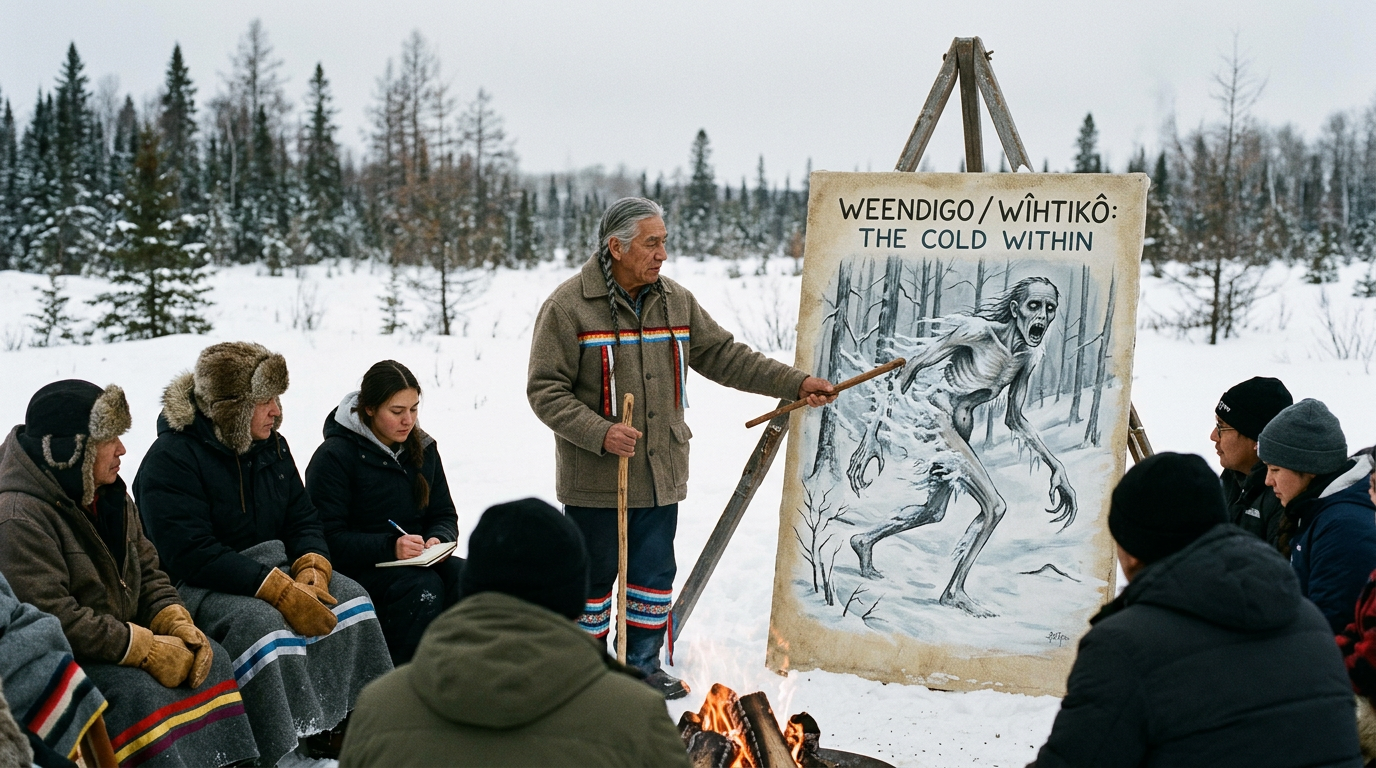
of Famine and Greed Behind the Modern Monster

“It is not a monster of antlers and bone. It is hunger that has learned to walk — the ice-hearted spirit of the winter famine, and of the greed that devours the very people it should have fed.”
An Archival Chronicle Prepared for the Discerning Collector
Compiled by the Archivist of the Unseen
Contents
I. The Cold That Gets Inside
II. A Living and Sacred Tradition: A Note of Respect and Caution
III. Correcting the Record: The Monster That Is Not the Wendigo
IV. Who the Wendigo Truly Is: The Spirit of Famine and Greed
V. The Name and the Peoples It Belongs To
VI. Field Study — The Authentic Descriptions: Ice, Hunger, and the Frozen Heart
VII. An Archival Aside: On the Responsibility of the Outside Observer
VIII. The Moral Heart of the Legend: The Teaching Against Greed
IX. How One Becomes a Wendigo: Transformation and Taboo
X. The Difficult Matter: The Historical Cases and ‘Wendigo Psychosis’
XI. The Appropriation: How the Sacred Became a Costume
XII. The Hunger That Never Ends
Bibliography
I. The Cold That Gets Inside
It is deep winter in the great northern forests — the boreal woodland of what is now Canada and the northern United States — and the cold is the kind that kills. The snow has lain for months; the game has grown scarce; the stores are running low, and the long dark of the season stretches ahead with no certain end. A small community, isolated by the snow, huddles against the cold and the hunger, and every soul within it knows the oldest and most terrible fear of the winter country: not merely that they might starve, but that starvation might drive one of them to the unthinkable — to look upon the others not as kin but as meat.
For that is the true horror at the heart of the winter, and the true nature of the being the northern peoples have long known and feared. It is not, first and foremost, a creature in the woods. It is a transformation that can happen within a person — the moment when hunger, or greed, or the isolation of the long cold, hardens the heart to ice and turns a human being into something that consumes without end and is never filled. The being is called, in one of its many names, the Wendigo; and it is not the antlered monster of the films and the games, but something far older, far more serious, and far more frightening: the spirit of insatiable hunger, of the greed that devours community, of the human capacity to become a thing that feeds upon its own people and cannot stop.
This field study takes as its subject the Wendigo — the being of the Algonquian peoples of the northern forests, one of the most misunderstood figures in all of world folklore — and it undertakes, before anything else, an act of correction and respect. For the Wendigo of popular culture, the tall gaunt monster with the skull and antlers of a deer, is very largely a modern invention, and it has buried beneath it the authentic and profound tradition from which the name was taken. This chronicle sets that invention aside and returns to the real Wendigo: who it truly is in the traditions of the peoples to whom it belongs, what it genuinely means, and why it matters — handled throughout with the care that a living and sacred tradition of living peoples demands.
The pages that follow are prepared for the discerning collector of the misunderstood and the appropriated — the reader who wishes to understand a tradition truly rather than through the distortions of the horror film, and who recognizes that the recovery of an authentic meaning from beneath a pop-culture caricature is a labor worth undertaking with humility and care. The Wendigo is such a tradition. This chronicle is an attempt to see it as it truly is, and to honor the peoples who have always known it.
❧ ❧ ❧
II. A Living and Sacred Tradition: A Note of Respect and Caution
More than with any other subject in this archive, a note of respect and caution must precede all that follows — for the Wendigo is not the folklore of a vanished people, nor a figure that belongs to the common heritage of the world, but a serious, sacred, and living element of the spiritual traditions of specific Indigenous nations, and it must be approached accordingly. This is not an ornament of the macabre to be freely handled, but the genuine belief of living peoples, and the difference governs everything in this study.
The Wendigo belongs to the Algonquian-speaking peoples of the northern forests of North America — among them the Ojibwe (Anishinaabe), the Cree, the Innu, the Naskapi, and related nations — who are living peoples, with living languages, living cultures, and living spiritual traditions, and for whom the Wendigo is not entertainment but a figure of genuine spiritual and moral seriousness. To these nations the Wendigo has been, and for many remains, a real presence in a coherent spiritual worldview: a teaching, a warning, a danger, and a sacred matter not to be invoked carelessly. It is treated by many with the gravity accorded to genuinely dangerous spiritual forces — in some traditions its very name is not spoken lightly, particularly in winter, for fear of drawing its attention. This is a figure held in reverence and dread by the people to whom it belongs, and any account of it by an outsider must proceed with the humility that this fact demands.
This study is offered, therefore, in a spirit of respect and with an explicit acknowledgment of its own limits. It is written from outside the tradition, drawing on the published scholarly and ethnographic record, and it makes no claim to the authority that belongs only to the Algonquian peoples themselves and their own knowledge-keepers. Its purpose is not to appropriate the Wendigo but to correct the appropriation that popular culture has already committed — to strip away the monster-movie caricature and point the reader back toward the authentic tradition and, ultimately, toward the voices of the nations who hold it. Where this chronicle describes the Wendigo, it describes what the ethnographic and scholarly sources report of the tradition, with the understanding that the living tradition is richer, more varied, and more sacred than any outside summary can convey, and that its true keepers are the Algonquian peoples alone. The archive records with respect; it does not claim ownership of what belongs to others. With that understanding fixed as the foundation of all that follows, the chronicle proceeds.
❧ ❧ ❧
III. Correcting the Record: The Monster That Is Not the Wendigo
Artifact: The Modern Invention
Before the authentic Wendigo can be described, the false one must be cleared away — for the popular image is now so dominant that it stands between the modern audience and the real tradition, and it cannot simply be ignored. The single most important correction this study can offer is this: the tall, emaciated, antlered monster with the skull of a deer or elk, which dominates the horror films, the video games, the streaming series, and the vast body of internet art, is not the traditional Wendigo. It is a modern invention, and a relatively recent one.
The authentic Algonquian Wendigo, as the traditional descriptions and the ethnographic record attest, was not depicted with antlers or the skull of a deer. That imagery — the cervine skull, the branching antlers, the skeletal deer-headed humanoid — is a product of twentieth- and twenty-first-century popular culture, spread through horror fiction, film, and especially video games and internet media, until it became, for most modern audiences, simply “what a Wendigo looks like.” It is not. The traditional Wendigo, examined in detail below, was a being of a different character entirely: associated with ice, with gauntness and starvation, with giant size in some accounts, with a heart of ice, with lips torn or eaten away by its own ravenous hunger — but not, in the authentic tradition, an antlered deer-monster. The antlers are an outsider’s embellishment, layered onto the name over the past century, and they have effectively erased the real figure from popular awareness.
Why this matters is worth stating plainly, for it is more than a quibble over appearance. The antlered-monster image does not merely get a detail wrong; it transforms the entire nature of the Wendigo, converting a profound spiritual and moral figure into a generic creature-feature beast. The traditional Wendigo is about hunger, greed, isolation, the failure of community, and the human capacity for a specific and terrible transgression; it is a teaching and a warning as much as a terror. The antlered monster of the films is about none of these things — it is simply a scary animal-headed creature to be fled and fought, stripped of all the meaning that made the original matter. The correction of the image, then, is really the correction of the meaning: to set aside the antlers is to make room for the ice-heart, the famine, and the moral weight that the authentic tradition carries and the pop-culture version discards. The rest of this study concerns that authentic Wendigo — the real one, beneath the invention.
❧ ❧ ❧
IV. Who the Wendigo Truly Is: The Spirit of Famine and Greed
Artifact: The Insatiable
At the center of the authentic Wendigo tradition lies a single, terrible idea, and everything else radiates from it: insatiable hunger — a hunger that can never be satisfied, that grows greater the more it consumes, that is bound inseparably to the winter, to famine, and to the greatest taboo of the northern peoples. To understand the Wendigo is to understand this hunger, in both its literal and its moral dimensions, for the figure operates powerfully on both at once.
In its most literal aspect, the Wendigo is the spirit of winter starvation and of the cannibalism that starvation might drive a person to. The peoples who knew the Wendigo lived in a land of long, lethal winters, where the failure of the hunt and the exhaustion of stores could bring a community to the edge of death by famine — and where, in the most extreme and desperate circumstances, the unthinkable act of eating human flesh to survive was a genuine and horrifying possibility. The Wendigo is bound to this reality at its very root: it is the being associated with the famine winter and with the ultimate transgression that famine might produce. To eat human flesh, in this tradition, was not merely a crime but a spiritual catastrophe — an act that could open the door to becoming a Wendigo oneself, hollowing out one’s humanity and replacing it with the endless, ice-hearted hunger of the spirit.
But the Wendigo is far more than a literal famine-spirit, and its deeper power lies in its moral dimension, where it becomes one of the most sophisticated ethical figures in world folklore. For the hunger of the Wendigo is also the hunger of greed — the insatiable appetite for more, the consuming self-interest that takes beyond need and is never satisfied, the impulse that puts the self’s craving above the survival of the community. The Wendigo embodies the terror of the individual who consumes without limit at the expense of the group — who hoards, who takes more than a share, who feeds the self while others starve. In a culture whose survival through the deadly winter depended absolutely upon sharing, cooperation, and the subordination of individual appetite to collective need, the greedy individual who consumed beyond their share was not merely selfish but genuinely dangerous, a threat to the survival of all — and the Wendigo is the spiritual embodiment of that danger, the figure of what a person becomes when greed and self-interest devour their humanity. This is the Wendigo’s genius as a moral figure: it fuses the literal horror of famine-cannibalism with the moral horror of insatiable greed, making the two one, so that the greedy person and the cannibal become, spiritually, the same kind of monster — the human being who consumes their own community.
The Wendigo, then, is not simply a monster but a concept given terrible form: the personification of consumption without limit, in both its physical and its moral senses, and of the coldness of heart that such consumption requires. It is hunger that has become its own end, appetite that has consumed the humanity of the one who bears it, the self so given over to its own craving that it has become a devouring thing. And it is precisely this conceptual depth — this fusion of famine, cannibalism, greed, and the failure of community into a single figure — that the antlered monster of popular culture so completely discards, and that makes the authentic Wendigo a figure of enduring moral force rather than mere fright.
❧ ❧ ❧
V. The Name and the Peoples It Belongs To
Artifact: The Many Names
The very name of the Wendigo reflects the fact that it belongs not to a single people but to a family of related Algonquian nations, each with its own language and its own form of the name, and understanding this linguistic diversity is the first step toward understanding the figure as the shared but varied inheritance of many peoples rather than a single monolithic legend. There is no one “correct” spelling, because there is no one language — there are many, related tongues, each rendering the being’s name in its own way.
The name appears in the published record in a great many forms, reflecting the different Algonquian languages and the difficulties of transcribing them into English: Wendigo, Windigo, Weendigo, Wiindigoo, Wetiko, Witiko, and numerous others. The form wiindigoo belongs to the Ojibwe language; forms like wetiko or witiko belong to Cree and related tongues. The variation is not error but the natural consequence of a figure shared across a whole language family spread over an enormous territory — from the Great Lakes region across the vast boreal forests of central and eastern Canada. Each nation that knows the being knows it in its own language, with its own particular understandings, its own stories, and its own name; and the popular English “Wendigo,” now the dominant form, is merely one anglicized rendering that has come to stand, somewhat misleadingly, for the whole diverse tradition.
The peoples to whom the being belongs are the Algonquian-speaking nations of the northern forests — a large and diverse language family whose members include, among others, the Ojibwe or Anishinaabe of the Great Lakes and surrounding regions, the various Cree peoples spread across a vast swath of Canada, and the Innu and Naskapi of the northeast. These are distinct nations with distinct cultures, histories, and traditions, united by their related languages and by certain shared elements of belief, of which the Wendigo is one. The discerning reader should therefore resist the temptation to speak of “the” Wendigo legend as though it were a single fixed story; it is, rather, a shared figure understood in many related but varying ways across many nations, and its richness lies precisely in this diversity. What this study offers is a synthesis of the common elements as reported in the scholarly record — the shared core of the tradition — with the understanding that each nation’s own version is fuller and more authoritative than any outside generalization, and that the being belongs to them, in all their variety, and not to the outside world that has so often misused its name.
❧ ❧ ❧
VI. Field Study — The Authentic Descriptions: Ice, Hunger, and the Frozen Heart
Artifact: The True Portrait
Having set aside the antlered monster of popular culture, the discerning reader deserves an account of how the Wendigo was and is genuinely described in the traditions and the ethnographic record — the authentic portrait, which is in its own way far more chilling than the creature-feature version, precisely because it is bound so intimately to the real terrors of the winter country. The traditional descriptions vary across the many nations, but certain powerful and recurring elements compose the authentic image.
Foremost among the authentic traits is the association with ice and cold. The Wendigo is a being of winter, and in many traditions this is expressed in the most visceral way: it is said to have a heart of ice, or to be made of ice within, its very core frozen. This detail is the authentic center of the Wendigo’s physical horror, and it is deeply meaningful — the ice-heart embodies the coldness, the loss of human warmth and human feeling, that the transformation into a Wendigo entails. The being of endless hunger and greed is, fittingly, cold at its core, its human warmth replaced by killing frost. In some traditions the Wendigo’s association with cold is so complete that it is a creature of the winter wind itself, or that a blast of cold accompanies its presence. Where the antlers are a modern addition, the heart of ice is the genuine and ancient horror — and a far more resonant one, for it speaks directly to what the Wendigo means.
The second recurring trait is the imagery of starvation and insatiable consumption written upon the body. The Wendigo is very often described as gaunt, emaciated, skeletal — the very image of starvation, its skin drawn tight over its bones, for it is the spirit of famine and can never be filled. In one of the most haunting and authentic details, the Wendigo is sometimes described as having lips that have been torn or eaten away — in some accounts, chewed off by the being itself in the madness of its endless hunger — leaving the teeth bared in a permanent, ravenous rictus. This detail captures the essence of the figure with terrible economy: a hunger so total that it consumes even the mouth that hungers, an appetite that devours its own bearer. And in many traditions the Wendigo is a giant, or grows ever larger as it consumes — so that it can never eat enough to fill itself, its size increasing with its feeding, its hunger forever outpacing its consumption. The giant that grows with eating is the perfect image of insatiability: the more it takes, the greater its need, the further it is from ever being satisfied.
Taken together, these authentic traits — the heart of ice, the gaunt and starving body, the self-consumed lips, the ever-growing giant size — compose an image of extraordinary and coherent horror, every element of which expresses the figure’s core meaning. This is not a random assemblage of scary features like the antlered monster’s, but a unified symbolic portrait: the being of famine is starved; the being of endless hunger consumes even itself; the being of insatiable greed grows ever larger and hungrier as it feeds; the being that has lost its humanity is frozen at the heart. The authentic Wendigo is a masterpiece of meaningful horror, in which the appearance perfectly embodies the concept — and it is a far more disturbing figure than the deer-skulled monster of the screen, because its horror is not the horror of a strange animal but the horror of what a human being can become, rendered in the pitiless imagery of the killing winter.
❧ ❧ ❧
VII. An Archival Aside: On the Responsibility of the Outside Observer
It is fitting to pause, in the study of this particular figure, upon the responsibility that falls to any archive or observer who would treat the sacred traditions of a people not their own — for the Wendigo, more than most subjects, demands a reckoning with the ethics of the outside gaze, and the honest keeper of such material must acknowledge the difficulty rather than pretend it away. There is a real tension in the very act of an outsider writing about a living and sacred tradition, and it should be named.
The tension is this: that the impulse to learn about, honor, and preserve the traditions of others can shade, all too easily, into the impulse to take them, to use them, to strip them of their sacred seriousness and convert them into material for entertainment or profit — and the history of the Wendigo in popular culture is very largely a history of exactly this taking. The line between respectful study and appropriation is real, and it is not always easy to walk. This archive holds that the line can be walked, but only with certain commitments: that the tradition be treated as belonging to its people and not to the observer; that its sacred seriousness be honored rather than flattened into thrills; that the observer’s own limits and outsider status be acknowledged openly; and that the ultimate authority of the tradition’s own keepers be affirmed. Wicked Dual, in devoting an entry to the Wendigo, does so in this spirit — not to add the being to a collection of macabre curiosities, but to correct a widespread appropriation, to point the reader back toward the authentic tradition, and to insist that the real Wendigo, with all its moral and spiritual depth, deserves to be known truly rather than through the caricature that has obscured it. The keeping of a tradition that is not one’s own is a matter of stewardship, not ownership, and the responsible archive keeps the memory precisely by directing the seeker onward to those who hold the tradition itself.
This is the disposition the chronicle maintains throughout: that the study of the Wendigo by an outsider is legitimate only as an act of correction, respect, and redirection — an effort to undo the harm of appropriation and to honor a living tradition by describing it truly and pointing beyond itself. The discerning reader who is genuinely moved by the Wendigo is encouraged to seek out the voices of the Algonquian peoples themselves — their own writers, scholars, storytellers, and knowledge-keepers — for whom the being is not a subject of study but a living inheritance. The chronicle now turns to the deepest meaning of that inheritance: the moral teaching that lies at the Wendigo’s heart.
❧ ❧ ❧
VIII. The Moral Heart of the Legend: The Teaching Against Greed
Artifact: The Warning
The Wendigo is, at its deepest level, a moral teaching — and it is this dimension, more than any physical horror, that constitutes its true significance and its enduring power. To understand the Wendigo only as a monster is to miss the point entirely; it is, above all, a profound cultural instruction about how to be human, and about the specific dangers that threaten a community’s survival and its soul. The teaching is woven into the very fabric of the figure, and it repays careful attention.
The core of the teaching concerns the supreme values of the cultures that produced it: sharing, moderation, and community, set against the deadly dangers of greed, excess, and isolation. The peoples who knew the Wendigo survived in a harsh and unforgiving land, and their survival depended absolutely upon cooperation — upon the sharing of food and resources, the subordination of individual want to collective need, the maintenance of the bonds that held the community together through the killing winter. In such a world, greed was not a mere vice but an existential threat: the person who hoarded, who took more than their share, who put their own appetite above the group, endangered everyone. The Wendigo embodies this threat in its most extreme and terrible form — the individual whose greed and self-interest have grown so total that they have consumed his very humanity, turning him into a being that literally devours his own people. The Wendigo is what greed becomes when it is followed to its end: not merely selfishness, but the spiritual cannibalism of the community, the self so given over to its own hunger that it feeds upon the very people it should have sustained.
This makes the Wendigo one of the most sophisticated moral figures in all of world folklore, for it renders an abstract ethical danger — the corrosive, community-destroying power of unchecked greed — as a concrete and terrifying spiritual reality. The teaching is not delivered as a dry precept but as a living dread: be greedy, take more than your share, put yourself above your people, and you risk becoming this — an ice-hearted, insatiable thing that devours its own. And the teaching has proven remarkably adaptable and enduring, for the danger it addresses is not confined to the winter forest. In recent generations, Indigenous thinkers and writers have powerfully extended the Wendigo as a metaphor for the destructive greed of the modern world — for the insatiable consumption of resources, the endless appetite of a system that takes without limit and is never satisfied, the ecological and social devastation wrought by a civilization organized around the very insatiability the Wendigo embodies. In this reading, the Wendigo becomes a diagnosis of a whole way of life: the culture of endless growth and endless consumption is, itself, a kind of Wendigo, an insatiable hunger devouring the world that sustains it. The ancient teaching against greed speaks, in this extension, directly to the crises of the present.
The moral heart of the Wendigo is thus the key to everything, and the reason the figure so far transcends the monster-movie version that has obscured it. It is not a random creature of the dark but a considered and profound teaching about the human condition — about the necessity of sharing and the danger of greed, about the bonds that hold community together and the appetite that can destroy them, about what it means to remain human and what it means to lose one’s humanity to insatiable want. To recover the true Wendigo from beneath the antlered caricature is, above all, to recover this teaching — and to recognize that the peoples who created the figure encoded within it a wisdom about greed and community that the world which appropriated its image, and discarded its meaning, would do well to relearn.
❧ ❧ ❧
IX. How One Becomes a Wendigo: Transformation and Taboo
Artifact: The Terrible Threshold
One of the most distinctive and frightening features of the Wendigo tradition — and one that sets it apart from most monster-legends of the world — is that the Wendigo is very often not a separate creature at all, but something a human being can become. The horror is not primarily external, a beast lurking in the woods, but internal and transformative: the terrible possibility that a person, under certain conditions, might cross a threshold and turn into a Wendigo. This transformative dimension is central to the tradition and to its power.
The transformation was understood to come about chiefly through two related paths, both bound to the figure’s core meaning. The first and most direct was the act of cannibalism — the eating of human flesh, particularly under the desperate circumstances of winter starvation. To consume human flesh was, in this tradition, not merely a horror in itself but a spiritual catastrophe that could transform the eater into a Wendigo, hollowing out their humanity and filling them with the insatiable, ice-hearted hunger of the spirit. This belief carried immense weight in the survival culture of the northern forests, where famine was a real and recurring danger and the temptation to the unthinkable was correspondingly real: the taboo against cannibalism was reinforced by the most terrible spiritual sanction imaginable, the loss of one’s very humanity and one’s transformation into a devouring monster. The second path was through the surrender to greed and the isolation of the self from the community — for as the moral heart of the legend makes clear, the Wendigo is greed embodied, and the person who gave themselves over to insatiable self-interest, who cut themselves off from the bonds of sharing and community, was understood to be traveling the same road toward the same transformation.
The transformation could also, in many traditions, be brought about by external spiritual means — through the Wendigo spirit itself, which might possess a person, or through dreams, or through the malice of others; the paths were various across the many nations. But the essential and recurring horror is the internal one: that the Wendigo is a fate as much as a creature, a thing one might become, and that the seeds of that becoming lie within the human capacity for greed, for the abandonment of community, and, in the last extremity, for the unthinkable act. This is what makes the Wendigo so much more frightening than an external monster: it locates the horror within the human being, in the ever-present possibility that hunger or greed or isolation might harden the heart to ice and turn a person into a devourer of their own. The Wendigo is not merely something that might attack you from the woods; it is something you might turn into — and that is a far deeper and more intimate dread.
The traditions also held, in many cases, that the transformation might be resisted or even reversed in its early stages, and that a person showing the signs of becoming a Wendigo might be healed by the community and its spiritual specialists — a reflection of the same communal values the figure teaches, for it is the community, reasserting the bonds of care and belonging, that could draw a person back from the edge of the ice-hearted isolation. But in the tradition’s starkest forms, once the transformation was complete, the Wendigo could not be allowed to remain among the people, for it posed an absolute danger to all — and here the tradition touches upon its most difficult and sensitive dimension, the historical cases in which the belief intersected with real acts and real deaths, to which the chronicle now turns with the caution such matters demand.
❧ ❧ ❧
X. The Difficult Matter: The Historical Cases and ‘Wendigo Psychosis’
Artifact: A Matter Requiring Caution
This chronicle now approaches its most sensitive material, and it does so briefly and with heavy caution, for the historical intersection of the Wendigo belief with real acts, real deaths, and contested psychiatric theory is a matter easily sensationalized and easily misunderstood, and it deserves careful and sober treatment rather than the lurid handling it has too often received. The discerning reader is asked to approach what follows with the same gravity.
The historical record contains cases, particularly from the nineteenth century, in which the Wendigo belief was connected to real events — cases in which individuals, sometimes under the extreme conditions of winter starvation, killed and in some instances consumed others, and in which the belief in Wendigo transformation was invoked, whether by the individuals themselves, by their communities, or by outside observers and courts. The most frequently cited case is that of a Cree man known as Swift Runner, who in the late 1870s, during a winter of hardship, killed and cannibalized members of his own family, and who reportedly invoked Wendigo affliction; he was tried and executed by Canadian authorities in 1879. Other cases exist in the record, including instances in which individuals believed to be becoming Wendigos were killed by members of their own communities acting on the belief that a completed transformation left no alternative and posed a lethal danger to all.
From such cases arose the contested concept of “Wendigo psychosis” — a proposed culture-bound syndrome, advanced by some twentieth-century anthropologists and psychiatrists, in which an individual was said to develop an intense craving for human flesh together with the delusional belief that they were transforming into a Wendigo. The discerning reader must be told plainly that this concept is genuinely and seriously contested among scholars, and that heavy caution is warranted. Some later researchers have questioned whether “Wendigo psychosis” ever existed as a genuine, recurring clinical syndrome at all, arguing that the reported cases are few, often poorly documented, filtered through the distortions of outside observers, sometimes second- or third-hand, and possibly shaped more by the assumptions and sensationalism of the non-Indigenous chroniclers than by any consistent psychiatric reality. The debate is unresolved, and this study takes no position within it beyond insisting upon the caution that the sources themselves demand: the historical cases are real events that occurred, but the framework of “Wendigo psychosis” that has been built upon them is a contested and possibly flawed outsider construction, and it should be treated as such rather than accepted as established fact.
What can be said responsibly is limited, and the limits are the point. The Wendigo belief was, for the peoples who held it, bound up with the genuine and terrible realities of winter famine and the absolute taboo against cannibalism, and it is unsurprising that in a land of such dangers the belief should have intersected, on rare and tragic occasions, with real acts of desperation and real communal responses to them. But the sensational treatment of these cases — the reduction of a profound spiritual tradition to a catalogue of cannibal murders, and the uncritical acceptance of a contested psychiatric label — is itself a form of the appropriation and distortion this study exists to correct. The historical cases belong to the record, and they are acknowledged here; but they are the rare and tragic margin of the tradition, not its heart, and to mistake them for its essence is to repeat the error of the outside gaze that has so consistently misunderstood the Wendigo. The heart of the tradition is the teaching, not the true-crime case; and it is to the enduring life of that tradition that the chronicle finally turns.
❧ ❧ ❧
XI. The Appropriation: How the Sacred Became a Costume
The modern history of the Wendigo is, to a painful degree, a history of appropriation — of the taking of a sacred and serious figure from the traditions of living peoples and its conversion into a piece of generic horror entertainment, stripped of its meaning and often of its very appearance. This process deserves examination in its own right, both because it is the reason the authentic tradition has been so obscured and because understanding it is essential to the respect that this study seeks to model.
The pattern of the appropriation is by now familiar across many Indigenous traditions, but the Wendigo has suffered it with particular thoroughness. The figure was extracted from its cultural and spiritual context, its sacred seriousness discarded, and its name attached to a generic monster to be deployed in horror fiction, films, television, and above all video games and internet media — where it became simply another creature to fight or flee, indistinguishable in function from any other movie monster. In the process, as this study has emphasized, even its authentic appearance was discarded and replaced with the invented antlered-deer-skull image, so that the popular “Wendigo” now bears almost no resemblance to the traditional being in either meaning or form. The teaching against greed, the association with famine and the ice-heart, the transformative internal horror, the sacred weight — all of it was stripped away, leaving only a name and a vaguely spooky monster. This is appropriation in its fullest sense: not merely borrowing, but the hollowing-out of a living sacred tradition and the discarding of everything that gave it meaning, retaining only what could be sold as a thrill.
Why this matters is not a matter of mere pedantry or cultural etiquette, but of genuine harm and genuine loss. For the Algonquian peoples to whom the Wendigo belongs, the casual and disrespectful use of a sacred figure — particularly one whose name, in some traditions, is not to be spoken lightly — is a real injury, a continuation of the long history by which Indigenous cultures have been plundered and misrepresented. And for everyone, the appropriation is a genuine loss, for it has buried a figure of real moral and spiritual depth beneath a shallow caricature, depriving the world of the authentic Wendigo’s wisdom while profiting from its distorted image. The recovery of the true Wendigo — the setting-aside of the antlered monster and the return to the ice-hearted spirit of famine and greed — is therefore both an act of respect toward the peoples who hold the tradition and an act of genuine intellectual and moral recovery, restoring to view a teaching the world needs and had nearly lost. This is the work this study has attempted, in the knowledge that it is a small contribution to a correction that the Indigenous peoples themselves have long been leading, reclaiming their own traditions from the distortions imposed upon them.
The appropriate response, for the discerning reader moved by the authentic Wendigo, is the one this study has urged throughout: to learn the tradition truly, to honor its sacred seriousness, to reject the caricature, and above all to turn toward the voices of the Algonquian peoples themselves, whose tradition it is and who are its only true authorities. The Wendigo does not belong to the horror industry, nor to the outside observer, nor to this archive; it belongs to the nations who have always known it, and the truest respect the outsider can offer is to say so plainly, to correct the record where it has been distorted, and to point the seeker onward toward the people to whom the hunger that walks has always, and only, truly belonged.
❧ ❧ ❧
XII. The Hunger That Never Ends
Beneath the antlered monster of the films and the games — the caricature that has, for most of the modern world, replaced the real thing — there lies a figure of genuine and enduring power: the authentic Wendigo of the Algonquian peoples, the ice-hearted spirit of famine and insatiable greed, one of the most profound moral figures in all of world folklore. This chronicle has attempted to clear away the invention and return to that authentic figure, and to do so with the respect that a living and sacred tradition of living peoples demands. What remains, when the antlers are set aside, is not a lesser thing but a far greater one: a teaching of extraordinary depth, wrapped in a horror of extraordinary coherence, held by peoples who have known it far longer than the outside world has misused its name.
For the true horror of the Wendigo was never the horror of a strange beast in the woods. It was, and is, the horror of what a human being can become — the terrible possibility that hunger, or greed, or the isolation of the self from the community, might harden the heart to ice and turn a person into a devouring thing that feeds upon its own people and can never be filled. It is a horror located within, in the human capacity for insatiable want and the abandonment of the bonds that make us human, and it carries a teaching the world has never needed more: that greed followed to its end consumes not only its victims but its bearer; that the appetite that takes without limit destroys the community that sustains it; that to remain human is to share, to moderate, to belong, and to resist the cold hunger that would make us monsters. The peoples who created the Wendigo encoded within it a wisdom about greed and community and the human soul that the modern world — itself, in the words of Indigenous thinkers, a kind of Wendigo, an insatiable hunger devouring the earth — would do well to learn.
And so the hunger walks still — not the antlered monster of the screen, but the real and ancient thing it has obscured: the ice-hearted spirit of the winter famine and the winter of the human heart, the greed that consumes its own, the appetite that grows greater the more it devours and is never, ever satisfied. It belongs to the Algonquian peoples, who have always known it, and to whom this chronicle returns it with respect; and it stands, for all who would learn its true meaning, as one of the great warnings the human imagination has ever produced — a warning against the cold hunger within, delivered by the peoples of the long winter, who knew better than anyone what it costs to lose one’s humanity to want, and who gave that knowledge the terrible and enduring form of the hunger that walks. To know the true Wendigo is to hear that warning; and to honor it is to heed both the teaching and the people who have kept it, through every winter and every distortion, alive.
❧ ❧ ❧
This field study is preserved as one vestige among many within the haunted archive of Wicked Dual, an artisan boutique devoted to the reclamation of history’s clandestine and misunderstood corners. The true Wendigo of Algonquian tradition — the ice-hearted spirit of famine and greed, recovered from beneath the modern caricature — is presented here with respect for the living peoples to whom it belongs, and to whom its tradition rightfully returns.
Read the written chronicles on the blog, the Wicked Archive: www.wickeddualblog.com
Secure the physical artifacts drawn from these histories at the Wicked Dual boutique: https://www.etsy.com/shop/Wickeddual
We invite you to enter the haunted archive and secure a piece for your private collection; it is a necessary addition for those who curate the darker corners of human history.
— The Archivist of the Unseen
Bibliography
The following works constitute credible ethnographic, historical, and literary literature underlying this field study; readers pursuing formal citation are advised to verify editions and pagination against a library catalogue, and, above all, to seek out the writings and teachings of Algonquian peoples themselves.
Brightman, R. A. (1988). The windigo in the material world. Ethnohistory, 35(4), 337–379.
Johnston, B. (1995). The Manitous: The spiritual world of the Ojibway. HarperCollins.
Smallman, S. (2014). Dangerous spirits: The windigo in myth and history. Heritage House Publishing.
Leave a Reply