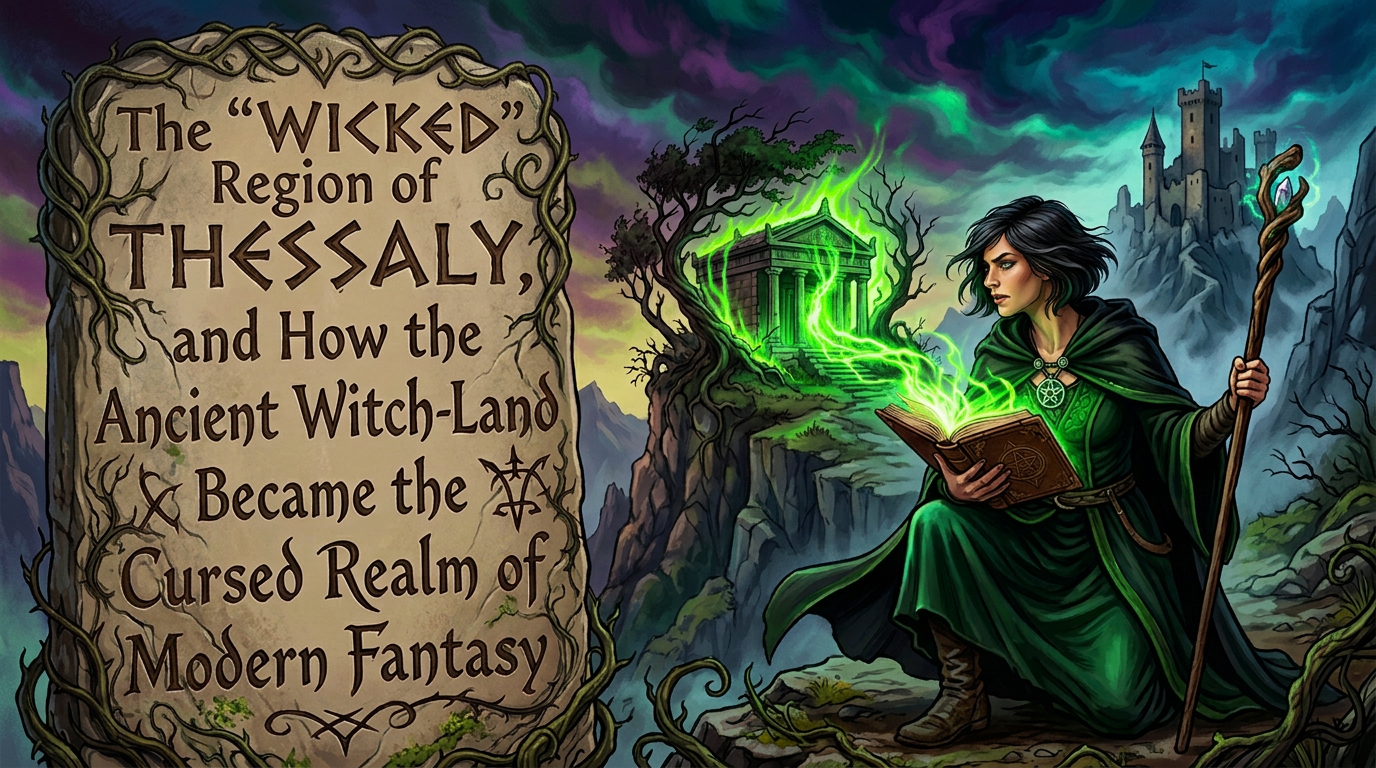
Witch-Land Became the Cursed Realm of Modern Fantasy

“The Romans had a proverb for the impossible act of pulling the moon from the sky: to draw down the moon. They said it was done in Thessaly. An entire province, in the ancient imagination, was simply where the magic was.”
An Archival Chronicle Prepared for the Discerning Collector
Compiled by the Archivist of the Unseen
Contents
I. The Traveler Who Should Not Have Stopped in Thessaly
II. The Trope Defined: An Entire Region Made of Magic
III. Thessaly: The Real Land and Its Dark Reputation
IV. Field Study — The Witches of the Ancient Sources
V. Drawing Down the Moon: The Signature Magic of the Land
VI. Why Thessaly? The Roots of a Region’s Reputation
VII. An Archival Aside: On the Geography of the Forbidden
VIII. The Mechanism of the Trope: How a Place Becomes a Power
IX. The Inheritance — The Cursed Forest and the Haunted Wood
X. The Inheritance — The Wicked City and the Sorcerous Realm
XI. Field Study — Thay and the Modern Nation of Evil Magic
XII. Why the Trope Endures: The Uses of the Forbidden Region
XIII. The Moon Still Falls Over Thessaly
Bibliography
I. The Traveler Who Should Not Have Stopped in Thessaly
You are a young man of the Roman world, traveling on business, and your road has brought you into Thessaly — the northern region of Greece, a place of broad plains and looming mountains. You know its reputation, of course; everyone does. This is the land of witches, the country where the laws of nature are thinnest, where the women can pull the moon down out of the sky and turn men into beasts and call the dead up from their graves to speak. But reputation is one thing and a night’s lodging is another, and you are tired, and so you stop.
You should not have stopped. For in Thessaly the reputation is not exaggeration but understatement. Your host’s wife is a witch of terrible power; the very servant girl dabbles in her mistress’s arts; and through a piece of curiosity you will bitterly regret, you meddle with a magic ointment meant to turn a woman into a bird — and are transformed, instead, into an ass. So begins the most famous novel of the ancient world, and it begins, as such stories so often did, by the simple act of a traveler crossing into the one province where magic was not the exception but the rule.
This is the premise of Apuleius’s Metamorphoses — The Golden Ass — and it rests upon an assumption so familiar to its ancient audience that it needed no explanation: that Thessaly was, quite simply, the place where the magic was. Not a place with a famous witch, or a haunted spot, or a single cursed site, but an entire region saturated with sorcery, a whole province whose defining characteristic in the cultural imagination was that it was witchy. This field study takes as its subject that idea — the concept of an entire land being magical, dangerous, and morally suspect by its very nature — and traces its extraordinary journey from the plains of ancient Thessaly to the cursed forests and wicked cities and sorcerous nations of modern fantasy, from Apuleius and Ovid and Lucan to the haunted woods of Tolkien and the evil magocracies of the tabletop and the page. It is, in the fullest sense, a trope analysis: the biography of an idea that has proven one of the most durable in the whole history of the imagination.
The pages that follow are prepared for the discerning collector of inherited ideas — the reader who understands that the tropes of modern fantasy did not spring from nothing, but descend, often by traceable lines, from the genuine beliefs of the ancient world, and that to find the classical root of a modern convention is to see both more clearly. The “witchy region” is such a convention, and its root is Thessaly. This is the chronicle of how a real Greek province became the ancestor of every cursed land in fantasy.
❧ ❧ ❧
II. The Trope Defined: An Entire Region Made of Magic
Before tracing its history, the trope under examination must be defined with precision, for it is a specific and distinctive device, easily confused with related but different ideas. The trope is this: the designation of an entire geographic region — a land, a province, a forest, a city, a nation — as inherently and pervasively magical, and typically dangerous, morally suspect, or cursed, so that the place itself becomes a character, a source of dread, and a marker of transition from the safe and ordinary world into the realm of the supernatural.
The key word is pervasive. The trope is not the haunted house, the single cursed site, the one witch in her cottage at the edge of the village. It is the scaling-up of the supernatural from a point to a territory — the idea that magic is not an intrusion into an otherwise ordinary place but the very defining quality of a whole region, saturating its air, its people, its ground. To cross the border into such a place is to cross out of the natural world entirely and into a country where different laws obtain. The witchy region is a threshold made vast: not a doorway but a frontier, and everything beyond that frontier belongs to the dark. This is what makes it so powerful a device, and so useful — for it gives the storyteller an entire zone of danger, a place the hero can journey into and, if fortunate, back out of, a geography of the forbidden marked upon the very map of the world.
The trope carries, almost always, a moral charge as well as a supernatural one. The witchy region is not merely magical but suspect — its magic is dark, its people not to be trusted, its very existence an affront to the moral and natural order of the lands around it. And this moral charge points to the trope’s deeper function, which the sections to come will explore: that the witchy region is very often a way of thinking about the Other — the foreign, the marginal, the different, the place beyond the border of one’s own known and ordered world — and of locating danger, transgression, and the forbidden safely elsewhere, in a land that is not one’s own. The witch-land is always somewhere else, across a border, inhabited by others; and this fact, as ancient as the trope itself, is the key to both its origin and its endurance. The trope was born in the way the ancient Greeks and Romans thought about the strange province to their north — and it is to that real place, and that real reputation, that the chronicle now turns.
❧ ❧ ❧
III. Thessaly: The Real Land and Its Dark Reputation
Artifact: The Witch-Province
Thessaly was, and is, a real place — a large region of northern Greece, a land of wide fertile plains ringed by mountains, including Mount Olympus itself on its northern border and Mount Pelion to the east. In the geography of the classical world it was a distinct territory with its own history, its own people, its own character. And in the cultural imagination of the Greeks and especially the Romans, it possessed one overwhelming reputation that eclipsed all the rest: it was the land of witches, the very heartland of sorcery, the place above all others where magic was practiced and where the impossible became possible.
This reputation was not a minor association but a defining one, so thoroughly established that it functioned as a kind of shorthand. To set a story in Thessaly was to signal, at once and without further explanation, that magic would be central to it — exactly as Apuleius does in The Golden Ass, whose hero is transformed precisely because he has wandered into the witch-country and could not resist meddling with its arts. The reputation was ancient and persistent, running through the whole span of classical literature. The Thessalian witch became a stock figure, as recognizable to the Roman reader as any character type — the powerful, dangerous woman of the northern plains, mistress of herbs and spells and the darkest arts, capable of feats that no ordinary mortal could perform. When a Roman poet needed a witch, she was very likely a Thessalian; when a Roman story needed a land of magic, it was very likely Thessaly.
The discerning reader should mark the strangeness and the significance of this. Here was a real, ordinary Greek province — with its farms and towns and unremarkable people going about unremarkable lives — that had been transformed, in the imagination of the wider classical world, into something like a fantasy realm: a whole territory defined by the supernatural, a place one entered at one’s peril, a land where the rules were different. The real Thessalians, one imagines, were as ordinary as anyone; but the Thessaly of the literary and cultural imagination was a place of moonless nights and moon-drawing witches, of transformation and necromancy and dread. This gap — between the real province and its magical reputation — is the very birthplace of the trope, for it demonstrates the fundamental move: the taking of a real, distant, somewhat foreign place and the projection upon it of an entire imagined geography of magic. Thessaly is where a real region first became, in the mind of a whole civilization, a land of witches. And every fictional witch-land since has followed the path that Thessaly first walked.
❧ ❧ ❧
IV. Field Study — The Witches of the Ancient Sources
Artifact: The Literary Record
The reputation of Thessaly was built and sustained by the literature of the classical world, and a survey of the principal sources reveals both the depth of the association and the specific character of the magic ascribed to the region. The Thessalian witch was not a vague figure but a vividly realized literary type, and the sources that created her are among the greatest works of Greek and Roman letters.
The most famous single portrait is that of Apuleius, whose second-century novel The Golden Ass — the only Latin novel to survive in its entirety — is set explicitly in Thessaly precisely to exploit the region’s reputation. Its hero Lucius travels into Thessaly, lodges with a witch and her household, becomes entangled with the servant girl Photis, and through his meddling with magical ointment is transformed into an ass, beginning a long and picaresque ordeal. The novel simply assumes, as common knowledge, that Thessaly is where such things happen; the reputation is the premise on which the whole story rests. But Apuleius was drawing on a tradition already ancient in his day. The Roman poets had long made Thessaly the home of their witches. In Lucan’s epic Pharsalia, the terrible witch Erictho — one of the most horrifying figures in all of Latin poetry, a necromancer who dwells among tombs and reanimates corpses to prophesy — is a Thessalian, and Lucan devotes a long and gruesome passage to the witches of Thessaly and their arts. In the poetry of Ovid and Horace and others, the Thessalian witch and her characteristic magic recur again and again, a fixture of the literary landscape.
The magic ascribed to these witches was of a particular and consistent character, and it defined what “Thessalian magic” meant. It was, above all, magic that violated the natural order at its most fundamental level: the drawing down of the moon from the sky, the reversal of rivers, the transformation of humans into animals, the raising and compelling of the dead. It was herbal and potion-based, drawing on the region’s reputation for powerful plants. It was overwhelmingly the province of women — the Thessalian witch is almost always female, a powerful and dangerous woman operating outside and against the ordered, male, civilized world. And it was dark, associated with the night, the tomb, the underworld, and forbidden knowledge. This was not the benign magic of the wise healer but the terrible magic of the transgressor, the woman who could unmake the very laws of nature. The literary Thessaly, then, was a fully realized magical region, complete with its characteristic practitioners, its signature spells, and its pervasive atmosphere of dangerous, feminine, night-bound sorcery — a template, in every particular, for the witch-lands to come.
❧ ❧ ❧
V. Drawing Down the Moon: The Signature Magic of the Land
Artifact: The Impossible Act
If Thessaly had a signature act of magic — the single feat above all others that defined its witches and marked the region’s reputation — it was the drawing down of the moon: the pulling of the moon itself out of the sky, down toward the earth, by the power of the Thessalian witch. This extraordinary image deserves its own examination, for it captures perfectly the character of the trope and the imagination that produced it.
The phrase became proverbial in the ancient world. “To draw down the moon” was the very type of the impossible magical act, and it was associated specifically and persistently with the witches of Thessaly. The image is one of cosmic transgression: not merely a spell to heal or harm a single person, but a violation of the order of the heavens themselves, the forcing of the moon — that great and remote celestial body, mover of tides and marker of months — down from its appointed place at the command of a mortal woman. It is magic at its most grandiose and most blasphemous, an assertion of human, and specifically female, power over the very cosmos. There is even a poignant tradition that the drawing-down came at a terrible cost to the witch, who might lose something of herself — her sight, her child, her own life-force — in exchange for so vast an exertion of power; the transgression against nature exacting its own natural price.
The drawing-down of the moon reveals the deep logic of the Thessalian trope and of every witch-land that descends from it. What defines such a region is not merely that magic happens there but that the fundamental laws of reality are weaker there — that in this place, and this place especially, the impossible becomes possible, the cosmic order can be overturned, the moon itself can be pulled from the sky. The witch-land is a place where reality is thin, where the barriers that elsewhere hold firm — between human and animal, between living and dead, between earth and heaven — give way. This is why the trope is so powerful and so useful to the storyteller: the witchy region is a zone of ontological possibility, a place where anything can happen because the rules that forbid it elsewhere do not hold. To enter Thessaly, or any of its fictional descendants, is to enter a place where the moon might fall — and that sense, that in this land the deepest laws are suspended, is the essence of what the trope offers and the reason it has never lost its power.
❧ ❧ ❧
VI. Why Thessaly? The Roots of a Region’s Reputation
A natural question arises: why Thessaly, of all places? What was it about this particular Greek province that led the classical imagination to fix upon it as the land of witches, rather than any of the dozens of other regions of the Greek and Roman world? The honest answer is that the reasons are not fully certain — reputations of this kind arise from tangled and partly irrecoverable causes — but scholars have identified several plausible factors, and their interplay illuminates how a real place acquires a magical reputation, a process crucial to understanding the trope itself.
One factor is mythological association. Thessaly was linked, in Greek myth, to several figures of magic and to the origins of witchcraft itself. It was associated with Medea, the greatest witch of Greek mythology, who came to Thessaly (to Iolcus) in the story of Jason and the Argonauts — and there famously worked her terrible magic, including the rejuvenation and murder of the aged Pelias. The region was tied to the origins of magical herbalism, and Mount Pelion, in Thessaly, was the home of the wise centaur Chiron, master of medicine and the healing (and harmful) properties of plants. A land already woven into the myths of magic and the origins of herb-lore was primed to become, in the wider imagination, the land of magic entire.
A second and perhaps deeper factor is the dynamic of the periphery — the way the center of a culture projects its anxieties onto its margins. Thessaly, from the perspective of the great cultural centers of Athens and later Rome, was somewhat peripheral, somewhat backward, somewhat foreign: a region of the northern plains, less urbane, less central, more rural and remote. And it is a persistent pattern across cultures that the sophisticated center imagines magic, danger, and the uncanny to reside in the less-developed periphery — that sorcery belongs to the backward hinterland, the remote province, the marginal folk who have not been fully absorbed into the civilized order. The Athenian or the Roman, secure in the ordered center, located the dangerous and the magical safely elsewhere, in the half-foreign region to the north. Thessaly became the witch-land partly because it was peripheral enough to bear the projection, and this dynamic — the magical periphery, the witchy hinterland — is one that the trope would carry with it ever after.
A third factor may be the land itself and its associations — its reputation for particular herbs and plants, its wild mountainous margins, its distinctive character. But the precise origins matter less, for the purposes of this study, than the pattern they reveal: that a magical region is made by the projection of the imagining culture, by the layering of myth and anxiety and cultural distance upon a real place until the real place disappears beneath its reputation. Thessaly the witch-land was a creation of the Greek and Roman imagination, built upon the real Thessaly through mythological association and the ancient habit of locating danger at the periphery. And this process — the projection of magic onto the marginal, the foreign, the peripheral — is precisely the process by which every fictional witch-land has since been made. The trope did not merely originate in Thessaly; it originated in the way the classical world thought about Thessaly, and that way of thinking is the trope’s true and enduring inheritance.
❧ ❧ ❧
VII. An Archival Aside: On the Geography of the Forbidden
It is worth pausing upon the deep human impulse that the Thessalian trope embodies: the impulse to map the forbidden, to give the dangerous and the transgressive a location, to say that magic and dread live not everywhere and nowhere but there, in that place, across that border. For the witch-land is, at bottom, an act of cartography — the drawing of a map on which some regions are safe and ordered and others are given over to the dark, and this mapping of the forbidden is one of the oldest and most revealing habits of the human imagination.
The discerning collector will recognize that the geography of the forbidden serves a genuine psychological need. To locate the dangerous elsewhere — in the far province, the deep forest, the distant land — is to make the near and the known feel safe by contrast; it is to contain the dread, to give it borders, to know where it lives and therefore where it does not. The map with its witch-land marked is a reassurance as much as a warning: the moon may fall in Thessaly, but not here; the woods may be cursed, but not our fields; the magic is real, but it is over there. And yet the same map is an invitation, for the marked region calls to the adventurous and the curious as surely as it warns the prudent — the very existence of the forbidden zone creating the desire to cross into it, as Lucius crossed into Thessaly, as every fantasy hero crosses into the cursed wood. Wicked Dual exists in sympathy with precisely this cartographic impulse: the conviction that the dark deserves to be mapped rather than merely feared, that the forbidden regions of history and imagination are worth charting and studying and keeping, and that to trace the borders of the witch-land — ancient or modern, real or invented — is to understand something essential about how the human mind has always organized its fears and its desires upon the map of the world.
This is the disposition the chronicle maintains: that the witchy region is not a mere storytelling convenience but the expression of a deep and revealing habit of mind, the mapping of the forbidden that organizes the imagination into the safe center and the dangerous elsewhere. The chronicle now turns to the mechanism by which this ancient habit became a formal literary device, and by which the trope of Thessaly descended into the cursed forests and wicked cities and sorcerous realms of the modern fantastic.
❧ ❧ ❧
VIII. The Mechanism of the Trope: How a Place Becomes a Power
Artifact: The Working Parts
To understand how the Thessalian idea propagated into modern fantasy, one must first understand the mechanism of the trope — the working parts that make the witchy region function as a storytelling device — for it is these functional advantages that have caused the trope to be reinvented, again and again, by storytellers who may never have heard of Thessaly but who arrived independently at the same powerful device. The witch-land endures because it works, and it is worth taking apart to see how.
The first working part is the threshold. The witchy region provides a clear, dramatic boundary between the safe world and the dangerous one, and the crossing of that boundary is an inherently powerful narrative moment — the passage from the known into the unknown, from safety into peril. The border of the witch-land is a threshold the hero crosses, with all the charge that thresholds carry. The second working part is the contained zone of danger. By concentrating the supernatural into a bounded region, the trope gives the storyteller a defined arena for the fantastic — a place where anything can happen — while keeping the rest of the world ordinary and relatable by contrast. The magic is intense but contained, which both heightens it and makes it manageable. The third is atmosphere: the witchy region comes pre-loaded with dread, an entire landscape charged with menace, so that the setting itself does the work of generating fear and wonder without the storyteller having to manufacture it scene by scene. The place is the mood.
The fourth and subtlest working part is the moral and psychological function already noted — the location of the Other. The witch-land allows a story to explore the forbidden, the transgressive, the frightening, while safely locating it elsewhere, in a region that is not the hero’s home and is often coded as foreign, marginal, or alien. This lets the story have its dread and its transgression while preserving the moral order of the familiar world, and it taps into deep and genuine feelings about the foreign and the peripheral. These four working parts — the threshold, the contained zone, the pre-loaded atmosphere, and the located Other — make the witchy region an extraordinarily efficient and powerful device, and they explain both why the ancient world invented it in Thessaly and why the modern world has reinvented it endlessly. Any storyteller who needs a place of concentrated danger, a border to cross, an atmosphere of dread, and a way to explore the forbidden at a safe remove will arrive, sooner or later, at some version of the witch-land — and in doing so will become, whether they know it or not, an heir of Thessaly. The chronicle now traces that inheritance into its two great modern forms: the cursed forest and the wicked city.
❧ ❧ ❧
IX. The Inheritance — The Cursed Forest and the Haunted Wood
Artifact: The Dark Wood
The first great modern descendant of the Thessalian trope is the cursed forest — the dark, dangerous, magical wood that the hero must enter and, if fortunate, survive — one of the most pervasive settings in all of fantasy, and one that carries the full inheritance of the witch-land in a specifically sylvan form. The haunted wood is Thessaly with trees: a bounded region of concentrated supernatural danger, crossed by the traveler at peril, saturated with dread.
The cursed forest is very nearly ubiquitous in the fantasy tradition, and its examples are legion. The most famous in modern literature is perhaps Mirkwood, the dark and perilous forest of Tolkien’s Middle-earth — a wood so dangerous that travelers are warned never to leave the path, filled with giant spiders, enchantment, and dread, a bounded region of the supernatural that the company must cross and barely survive. Tolkien, a scholar of medieval literature, drew the haunted wood from deep roots in Germanic and medieval tradition — the primeval forest of European folklore, examined in another entry of this archive as the domain of Baba Yaga and her kin, the genuinely dangerous wilderness that pressed upon every medieval settlement. But whatever its specific sources, Mirkwood functions exactly as Thessaly functioned: a region defined by its supernatural danger, entered by the traveler with dread, governed by different and hostile laws. The countless cursed forests that have followed in fantasy literature, film, and game — the haunted woods, the enchanted forests, the dark groves where the ordinary rules do not hold — are all variations on the same ancient theme.
The forest is a particularly natural vessel for the witch-land trope, and its suitability reveals something about the trope’s deep logic. The real forest, for most of human history, was a genuine threshold — the edge of the cultivated, ordered, human world, beyond which lay the wild, the unknown, the dangerous. To enter the deep forest was really to leave the safety of the settlement and pass into a place of genuine peril, where one could become lost, be killed by beast or cold, or simply vanish. The cursed forest of fantasy takes this real and ancient dread of the wild wood and gives it supernatural form, transforming the genuine danger of the wilderness into the magical danger of the enchanted wood. It is the witch-land grown from the soil of a real human fear, and this rootedness in genuine experience is part of why it resonates so powerfully. The cursed forest works because the forest was, once, really to be feared — and the trope draws on that ancestral memory even as it clothes it in enchantment. Thessaly gave the idea of the magical region; the primeval forest gave it a body; and the marriage of the two produced the dark wood that haunts the fantastic still.
❧ ❧ ❧
X. The Inheritance — The Wicked City and the Sorcerous Realm
Artifact: The Magic Metropolis
The second great modern descendant of the Thessalian trope is the wicked city or sorcerous realm — the settlement, kingdom, or nation defined by its magic, and typically by its dark or corrupt magic — which scales the witch-land up from a wilderness to a civilization, and in doing so produces some of the most memorable settings in modern fantasy. Where the cursed forest is the witch-land as untamed wild, the wicked city is the witch-land as dark civilization: a place where magic is not merely present in the landscape but organized, institutionalized, made the very basis of a society.
This form of the trope is, in a sense, even closer to Thessaly than the cursed forest, for Thessaly too was an inhabited region — a province with its towns and people, not a mere wilderness — whose magic was woven into its human society. The wicked city and the sorcerous realm take this idea to its fullest development: the entire polity given over to magic, the city or nation whose defining institution is sorcery, whose rulers are mages, whose culture is built upon the arcane. Such places recur throughout fantasy in many forms — the decadent magical metropolis, the sinister mage-city, the kingdom ruled by sorcerer-lords, the nation of dark wizards. They carry the full moral charge of the trope: these are not merely magical places but corrupt ones, their magic bound up with tyranny, decadence, cruelty, and the transgression of natural and moral law. The sorcerous realm is Thessaly’s reputation for dangerous, forbidden, order-violating magic, scaled up to the level of an entire wicked civilization.
The wicked city carries a particular resonance because it fuses two distinct anxieties — the fear of magic and the fear of the corrupt civilization — into a single potent image. The cursed forest represents the danger of the wild, of what lies beyond civilization; but the wicked city represents the danger of a civilization gone wrong, a society that has organized itself around forbidden power and been corrupted by it. It taps into ancient fears of decadence, of tyranny, of the great and sophisticated society that has traded its soul for power — fears that reach back to the classical world’s own anxieties about luxury and corruption and the abuse of arcane knowledge. The sorcerous realm is thus a richer and more morally complex form of the witch-land than the cursed forest, for it is not merely dangerous but fallen, a place that had the capacity for civilization and chose, instead, the dark. And it is in this form — the nation built upon evil magic — that the trope has produced some of its most fully realized modern expressions, to one of which, as a study in the contemporary life of an ancient idea, the chronicle now turns.
❧ ❧ ❧
XI. Field Study — Thay and the Modern Nation of Evil Magic
Artifact: The Contemporary Witch-Land
The clearest modern illustration of the witch-land trope in its “sorcerous nation” form is Thay — a fictional realm within the shared fantasy setting of the Forgotten Realms, the long-running campaign world of the Dungeons & Dragons tabletop game. Thay is the property of its publisher, and this study discusses it not to reproduce its proprietary detail but to analyze it as a contemporary specimen of the trope, a modern Thessaly, in which the ancient idea of the wicked magical region reaches one of its fullest and most influential recent expressions.
In its broad outlines — the outlines that matter for trope analysis — Thay is a nation defined entirely by magic, and specifically by dark and forbidden magic. It is, in the setting’s conception, a land ruled by wizards, an entire country whose defining institution is arcane power and whose reputation, within the fictional world, is one of dread, cruelty, and the practice of the darkest magical arts, including necromancy — the magic of death and the animation of the dead. It functions, within its fictional world, exactly as Thessaly functioned within the classical imagination: it is the place the magic comes from, the land whose very name signals sorcery and danger, the region a traveler enters at peril and that the surrounding lands regard with fear and suspicion. It is a whole nation given over to the arcane and the corrupt — the witch-land as dark magocracy, the sorcerous realm in its fullest modern form.
The parallels to Thessaly are precise and illuminating, and they are almost certainly not the result of direct influence — the creators of such a setting need never have heard of the Thessalian witches — but of the independent reinvention of the same powerful trope, which is itself the most telling evidence of the trope’s deep and enduring logic. Like Thessaly, Thay is a region defined by pervasive magic rather than isolated instances of it. Like Thessaly, its magic is coded as dark, dangerous, and transgressive — above all in the shared association with necromancy, the raising of the dead, which was precisely the signature horror of Lucan’s Thessalian witch Erictho, the tomb-dwelling reanimator of corpses. Like Thessaly, it is the Other — the foreign, threatening realm across the border, against which the more “normal” lands of the setting define themselves. And like Thessaly, it serves the storyteller’s needs perfectly: a ready-made zone of concentrated danger, a threshold to cross, an atmosphere of dread, and a locus for the exploration of the forbidden. Thay is Thessaly reborn in the vocabulary of the modern fantasy game — the ancient witch-province given a new map, a new name, and a new set of players to enter it at their peril.
The example of Thay demonstrates the central thesis of this study with unusual clarity: that the trope of the wicked magical region is not a modern invention but an ancient inheritance, reinvented in each age in the vocabulary of its own storytelling. The tabletop game, the fantasy novel, the film, and the video game have all produced their versions of the witch-land — their cursed forests and haunted woods, their wicked cities and sorcerous nations — and every one of them, whether its creators knew it or not, walks the path that Thessaly first walked two thousand years ago. The moon that the Thessalian witches drew down out of the sky still falls, in the imagination, over every cursed realm the fantastic has produced; and the traveler who enters Thay, or Mirkwood, or any of the countless witch-lands of modern story, is following in the footsteps of Lucius, who should not have stopped in Thessaly, and could not resist.
❧ ❧ ❧
XII. Why the Trope Endures: The Uses of the Forbidden Region
The witch-land trope has survived for more than two thousand years, from Thessaly to Thay, reinvented in every age and every medium — and its extraordinary endurance demands explanation. Why has this particular device proven so durable, when so many storytelling conventions rise and fall with their eras? The answer lies in the confluence of the trope’s practical usefulness with its deep psychological resonance, and understanding it completes this study’s account of the idea.
The practical usefulness has already been analyzed: the trope offers the storyteller a threshold to cross, a contained zone of concentrated danger, a pre-loaded atmosphere of dread, and a way to explore the forbidden at a safe remove. These are perennial needs of storytelling, and any device that serves them so efficiently will be perpetually rediscovered. But the deeper reason for the trope’s endurance is its psychological truth — the way it maps onto genuine and permanent features of the human mind. Human beings do, in fact, imagine the world as divided into the safe and the dangerous, the known and the unknown, the ordered center and the wild periphery; we do locate our fears at the borders of our world; we are drawn, with a mixture of dread and desire, to the forbidden zones we have marked upon our maps. The witch-land externalizes these deep habits of mind, gives them a geography, and lets us explore them in story. It endures because it is true — not literally, but psychologically, as an accurate map of how the human imagination organizes the world into the safe and the fearful.
There is, too, a specifically modern dimension to the trope’s endurance, for the witch-land answers a need that has arguably grown more acute, not less, in an age that has mapped and measured and demystified the entire physical world. The real Thessaly is now a well-documented Greek administrative region; there is no undiscovered province where the moon might fall, no genuine terra incognita left upon the map. And precisely because the real world has been so thoroughly disenchanted, the imagination hungers for the invented witch-lands of fantasy — the cursed forests and sorcerous realms that restore, in fiction, the enchanted geography that the real world has lost. The trope endures, in this sense, because it satisfies a nostalgia for a more magical map, a longing for the days when the world still had its Thessalies, its regions of genuine mystery and dread beyond the edge of the known. The witch-land of modern fantasy is the disenchanted world’s way of remembering, and re-creating, the enchantment it has lost — and as long as that loss is felt, the trope will endure, and new Thessalies will be drawn upon new maps for new travelers to enter at their peril.
❧ ❧ ❧
XIII. The Moon Still Falls Over Thessaly
Two thousand years ago, the people of the classical world looked northward to a real Greek province and imagined it as a land of witches — a whole region where the moon could be pulled from the sky, where men became beasts and the dead rose to speak, where the deepest laws of nature grew thin and the impossible became possible. They could not have known that in doing so they were creating one of the most durable ideas in the history of the imagination: the trope of the wicked magical region, the witch-land, the cursed realm, which would descend through the centuries and flower, in our own age, into the cursed forests and haunted woods and sorcerous nations of modern fantasy.
The line of descent is real, whether or not each inheritor knew of it. From Apuleius’s Thessaly, where Lucius was transformed, to Lucan’s Thessaly, where Erictho raised the dead, to the dark woods of medieval and modern fantasy, to the sorcerous nations of the tabletop and the page — the same idea persists, reinvented in each age’s own vocabulary: that an entire region can be defined by its magic, that the dangerous and the forbidden can be given a location and a border, that there are places on the map where one must not go, and travelers who cannot resist going there. The specific witch-lands change — a Greek province, an enchanted forest, an evil magocracy — but the deep structure endures unchanged: the threshold, the contained danger, the pre-loaded dread, the located Other, the thinning of reality’s laws. Every cursed forest is Thessaly with trees; every wicked city is Thessaly with walls; every sorcerous nation is Thessaly given a government. The province is the ancestor of them all.
And perhaps this is the deepest lesson of the trope’s long life: that the enchantment the modern world believes it has banished has not been banished at all, but only relocated — driven off the real map, where the moon no longer falls and every province is documented and disenchanted, and into the invented maps of the fantastic, where the witch-lands endure in all their ancient power. The moon still falls over Thessaly — not the real Thessaly of the modern atlas, but the Thessaly of the imagination, and all its countless descendants, the cursed and magical regions that the human mind cannot stop drawing upon its maps because it cannot stop needing them. As long as there are stories, there will be a land across the border where the magic is; as long as there are travelers, there will be those who cannot resist crossing into it; and as long as the imagination hungers for the enchantment the world has lost, the moon will keep falling, somewhere beyond the edge of the ordinary, over the witch-land that Thessaly first taught us to imagine.
❧ ❧ ❧
This field study is preserved as one vestige among many within the haunted archive of Wicked Dual, an artisan boutique devoted to the reclamation of history’s clandestine and enduring corners. The witch-province of Thessaly — the ancient land where the moon was drawn from the sky, and the ancestor of every cursed realm in fantasy — is but one chronicle among the collection’s deeper holdings.
Read the written chronicles on the blog, the Wicked Archive: www.wickeddualblog.com
Secure the physical artifacts drawn from these histories at the Wicked Dual boutique: https://www.etsy.com/shop/Wickeddual
We invite you to enter the haunted archive and secure a piece for your private collection; it is a necessary addition for those who curate the darker corners of human history.
— The Archivist of the Unseen

Bibliography
The following works constitute credible classical, historical, and literary literature underlying this field study; readers pursuing formal citation are advised to verify editions and pagination against a library catalogue.
Dickie, M. W. (2001). Magic and magicians in the Greco-Roman world. Routledge.
Spooner, C., & McEvoy, E. (Eds.). (2007). The Routledge companion to Gothic. Routledge.
Leave a Reply