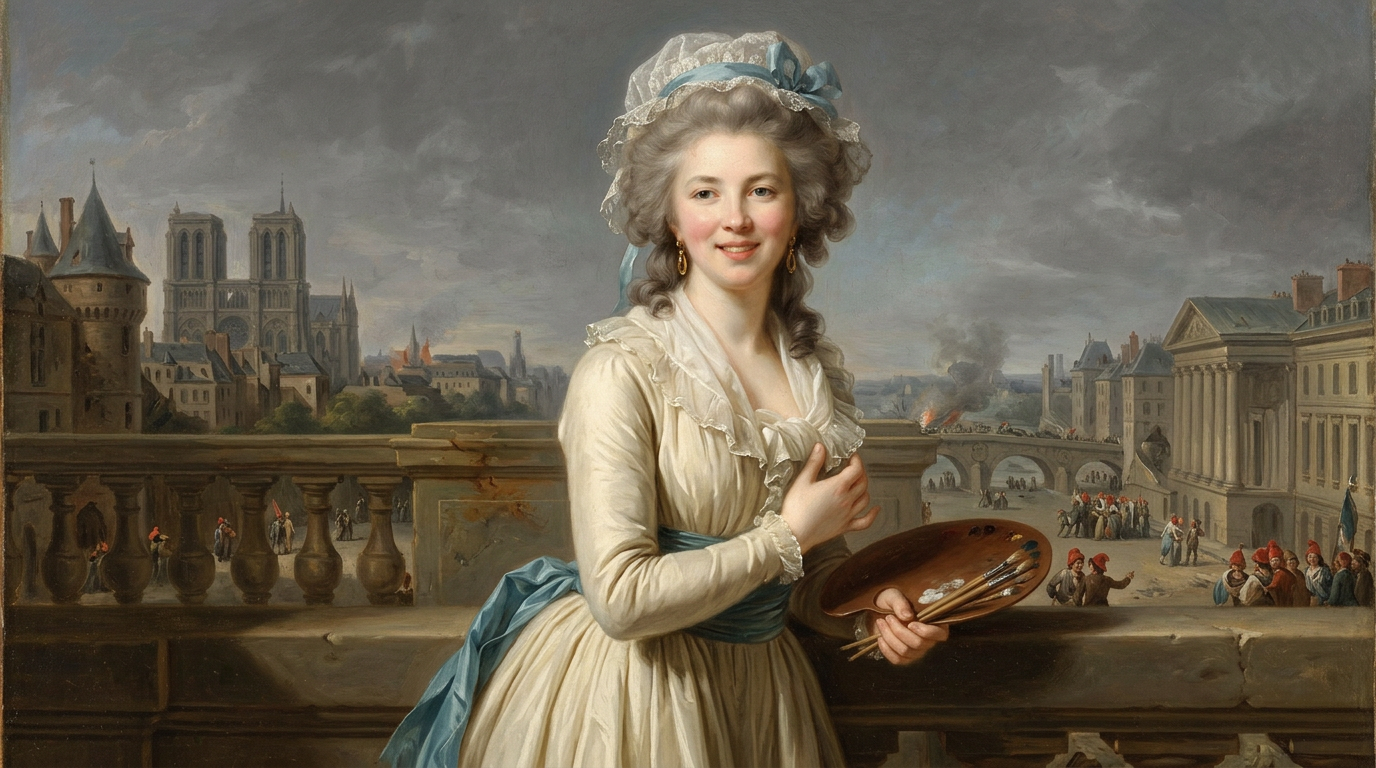

Summary: Élisabeth Louise Vigée Le Brun rose from a hairdresser’s daughter to Marie Antoinette’s portraitist, then fled the guillotine and painted her way across a continent. In an age that barred women from the easel, she conquered ten academies. This is the story of the woman who smiled in defiance of an empire.
The Woman Who Dared to Smile
In 1787, a painting hung in the Paris Salon caused a small scandal — not for nudity, not for blasphemy, but for a smile. In her Self-portrait with her Daughter Julie, the artist had committed the unthinkable: she showed her own teeth. The court gossip-sheet Mémoires secrets sniffed that such an affectation found no precedent among the Ancients, that artists and persons of taste were united in condemning it. A woman, painting herself, joyful and open-mouthed, had broken a rule of decorum stretching back to antiquity.
That woman was Élisabeth Louise Vigée Le Brun, and the smile was the least of her transgressions. Over a career spanning the death of the Ancien Régime, the Terror, the rise and fall of Napoleon, and the restoration of the Bourbons, she would paint some 660 portraits and 200 landscapes, charm queens and empresses on three sides of Europe, win election to the academies of ten cities, and earn comparison — from no less than Sir Joshua Reynolds — with the old Dutch masters. She did all of this in an age when a woman who wished to paint professionally was an anomaly, a suspect, and very often a target.
To understand why her smile mattered, we have to understand the world that frowned at it. And to understand Vigée Le Brun, we have to follow her out of a Paris studio and across a continent in flight — a brush in her hand and a price on her head.
A Life in Pigment and Exile
The Painter’s Daughter
She was born in Paris on 16 April 1755, the daughter of Jeanne, a hairdresser of peasant background, and Louis Vigée, a portraitist and pastellist of modest standing. Her origins matter because they reveal something the later legend obscures: Vigée Le Brun was not born into the aristocracy she would one day immortalize. She climbed into it, brushstroke by brushstroke.
The gift announced itself early. At seven or eight, she sketched a bearded man, and her father, seeing it, declared that she would be a painter if ever there was one. He began teaching her — and then, when she was twelve, he died, from infection following surgery. It was the first of the losses that would punctuate her life. Her mother soon remarried a wealthy, mean-tempered jeweler whom the young Élisabeth despised; in her memoirs, she recalled with cold precision how he wore her dead father’s clothes without even altering them to fit.
What saved her was the city itself. Her mother took her to the galleries of the Palais de Luxembourg, where the works of Rubens and the old masters struck her like a revelation. She copied Van Dyck, Rembrandt, and Rubens; she took advice from established painters like Greuze and Vernet. By her early teens, she was painting portraits professionally — a girl, barely adolescent, earning real money in a profession that scarcely acknowledged women could enter at all.
That contradiction caught up with her quickly. Her studio was seized for practicing without a license. Her response was characteristic: she applied to the Académie de Saint-Luc, which exhibited her works and, in 1774, made her a member. The licensing problem became a credential. It was a pattern she would repeat all her life — turning the obstacles placed before women into the very rungs of her ascent.
A Marriage of Convenience and Regret
In 1776, at twenty, she married Jean-Baptiste-Pierre Le Brun, a painter and art dealer with an unrivaled private collection that she had been all too happy to copy. The marriage tells us much about the constrained choices available even to a successful woman of the period. By her own account, she had never contemplated marrying — her career was flourishing, her income steady, her future secure. She possessed something rare for a woman of her century: independence. Yet she agreed, urged by her mother and desperate to escape her stepfather, and even hesitated on her wedding day.
Her doubts proved prophetic. Le Brun was a gambler and a womanizer who appropriated most of her income and pressed her to take on tutoring to earn still more for him. He kept the marriage secret at first, the better to pursue a lucrative deal with a Dutch dealer to whom he was ostensibly engaged. Here, the gendered arithmetic of the age stands exposed: the most sought-after portraitist in Paris saw her earnings flow, by law and custom, into the hands of a husband who squandered them. Decades later, she would demand the return of her dowry; the marriage would end in a divorce engineered partly to shield property during the Revolution.
The Queen’s Painter
Then came the patron who would define her — and nearly doom her. Marie Antoinette granted Vigée Le Brun her favor, and the artist painted the Queen more than thirty times, becoming in the public eye the official portraitist of the most scrutinized woman in France. The relationship was a double-edged gift. It brought commissions, prestige, and in 1783 — over the objection that her husband was a mere art dealer — full membership in the Académie royale de peinture et de sculpture, secured only because the Queen pressed the King directly. She was one of just fifteen women admitted to that body in the nearly century-and-a-half between 1648 and 1793.
Her portraits of the Queen were acts of image-making in the most literal sense. The 1783 Marie-Antoinette en Gaulle showed the Queen in a simple muslin dress — and provoked outrage at the informality, forcing the artist to hastily repaint it in formal attire. The 1787 Marie Antoinette and her Children was a deliberate rehabilitation, presenting the unpopular foreign queen as a devoted mother, a child gesturing toward an empty cradle to mark a recent loss. Vigée Le Brun locked herself away and prayed for its reception. The strategy reveals how a woman artist’s work could become a political instrument — and how dangerous that instrument could turn when the politics shifted.
Flight
Shift they did. As the Revolution gathered force, the painter so closely linked to Marie Antoinette became a marked woman. Her house was harassed by sans-culottes; her health collapsed under the strain. On the very night of 5 October 1789 — as a crowd of Parisians, mostly women, drove the royal family from Versailles to the Tuileries — Vigée Le Brun’s stagecoach slipped out of Paris at midnight. She and her young daughter, dressed in shabby clothes to avoid notice, crossed the frontier, shadowed by Jacobin spies. She would not see France again for twelve years.
What followed was one of the most remarkable exiles in the history of art. Stripped of her French citizenship, her name placed on the list of émigrés, her property scheduled for confiscation, Vigée Le Brun did not retreat into obscurity. She painted her way across Europe.
In Italy (1789–1792), she studied Correggio in Parma, Raphael in Florence, Michelangelo in the Sistine Chapel, and was elected to the academies of Parma, Bologna, and Rome. She painted Emma Hamilton as a sibyl and a bacchante; her Cumaean Sibyl became her favorite work, one she would carry and display in city after city. In Austria (1792–1795), she spent two and a half years in Vienna, painting Liechtenstein princesses in Neoclassical garments that nodded to the virtuous Roman matron. In Russia (1795–1801), she was received by the nobility, painted the granddaughters of Catherine the Great, and weathered a scandal when a courtier claimed the Empress was offended by the bare arms in the portrait. In Prussia, she charmed a queen who slipped her own bracelets onto the artist’s wrists.
Everywhere she went, she repeated the same arc: arrive as a foreigner, conquer a court, win an academy, move on. The genteel woman who could not legally hold her own earnings in Paris was elected to learned bodies across the continent on the strength of her brush alone. Exile, which destroyed so many émigrés, became the stage for her greatest triumphs.
Return, Restoration, and the Long Twilight
After a sustained campaign by her relatives to clear her name, Vigée Le Brun returned to France in January 1802 to a rapturous welcome — then promptly left again for nearly three years in England, where she painted the Prince of Wales and complained, with her famous sensitivity, about trumpet blasts, screeching birds, and damp lodgings. She toured Switzerland twice, painting Madame de Staël as the heroine Corinne and capturing Alpine vistas that stirred her soul.
Her later years were shadowed by loss. Her estranged husband died in 1813; her beloved daughter Julie, whose marriage had once devastated her and from whom she had become estranged, died of syphilis in 1819, by which time they had reconciled. Her brother died the following year. She settled into a house at Louveciennes, surrounded by nieces she came to regard as daughters, and between 1835 and 1837 — in her eighties — she published her three-volume memoirs, the Souvenirs, part recollection, part epistolary portrait gallery, part instruction manual for young painters. She died in Paris on 30 March 1842, aged 86, and was buried at Louveciennes. Her epitaph reads simply: “Ici, enfin, je repose” — “Here, at last, I rest.”
A Woman With a Brush in a Man’s Academy
To measure Vigée Le Brun’s achievement, set it against the walls built to contain women of her time. The Académie royale, the gatekeeper of artistic legitimacy, admitted only fifteen women across nearly a century and a half — and capped female membership to keep their numbers symbolic. Women were barred from the life-drawing studios where the male nude, the foundation of the prestigious “history painting,” was taught. The hierarchy of genres thus quietly enforced a hierarchy of sex: denied the nude, women were steered toward portraiture and still life, then judged lesser for working in them.
Vigée Le Brun navigated this maze with quiet subversion. For her Académie reception, though not even required to submit a piece, she offered not a portrait but an allegory — Peace Bringing Back Abundance — staking a claim to the elevated territory of history painting. She regarded her Sibyl the same way. She could not enter through the front door of the grand genre, so she smuggled her ambition in through allegory and myth.
And then there was the matter of reputation, the peculiarly gendered weapon wielded against successful women. When her portrait of the finance minister Calonne appeared, rumors swirled that she had been paid extravagantly — or had taken him as a lover. Her husband’s new mansion was whispered to be financed by the minister. An entire defamation campaign pursued her through 1785. The accusations were not about her art; they were about the impossibility, to many minds, that a woman’s success could be honestly earned. Even Simone de Beauvoir, writing in The Second Sex in 1949, dismissed her as narcissistic for never wearying of putting her smiling maternity on canvas — a judgment that says as much about the enduring discomfort with a self-possessed woman artist as about the paintings themselves.
Her style sat on the hinge of art history, and this, too, reflects her moment. Trained in the afterglow of the Rococo, she kept its luminous palette and its charm, yet she chafed at its high fashion, draping her sitters in simple shawls and scarves drawn from Raphael and the antique. As Neoclassicism rose, her portraits absorbed its restraint and its republican Roman allusions. She was a Rococo sensibility evolving toward Neoclassical discipline — a living bridge between the world of Versailles and the world that overthrew it, embodying in pigment the very revolution that drove her into exile.
From the Salon Walls to the Modern Retrospective
During her lifetime, Vigée Le Brun’s work was shown in the great public venues of Paris: the Académie de Saint-Luc in 1774, the Salon de la Correspondance across several years around 1780, and the Salon of the Académie itself in a long sequence stretching from 1783 to 1824. These were the arenas where reputations were made and unmade — where her smiling self-portrait scandalized, where her muslin-clad Marie Antoinette had to be pulled and repainted, where the prices of her work soared after each succès de scandale. The Salon was not a neutral gallery but a battlefield of taste, and she fought on it for decades.
Yet posterity was slow to give her a stage of her own. Despite her vast output and the museums that hold her work today — the Louvre, the Hermitage, the National Gallery in London, the Metropolitan Museum of Art — the first retrospective devoted to her did not come until 1982, at the Kimbell Art Museum in Fort Worth, Texas, fully a hundred and forty years after her death. The first major international retrospective followed only in 2015–2016, premiering at the Grand Palais in Paris before traveling to the Metropolitan Museum of Art in New York and the National Gallery of Canada in Ottawa.
The gap is itself part of the story. That a painter so celebrated in her own century, so prolific, so internationally garlanded, should wait nearly a century and a half for a proper retrospective speaks to the long shadow cast over women artists by the very institutions Vigée Le Brun spent her life outmaneuvering. The recent exhibitions have begun to correct the record, reframing her not as a charming court flatterer but as a major figure who shaped the portraiture of her age and survived the collapse of the world that made her.
The Brush That Outlasted the Throne
There is a temptation to remember Vigée Le Brun only as Marie Antoinette’s painter — the elegant chronicler of a doomed court, swept up in its downfall. But that telling shrinks her. She was a hairdresser’s daughter who taught herself from the old masters; a professional at thirteen; a woman who turned a license seizure into an academy membership and an exile into a continental triumph. She earned fortunes that her husband gambled away, and she earned them again in Rome, Vienna, and Saint Petersburg. She was defamed for her success, condemned for her smile, and denied the genres reserved for men — and she painted on, 660 portraits deep, into her ninth decade.
Her life maps, almost uncannily, onto the great rupture of her age. She carried the grace of the Rococo into the severity of the Neoclassical; she carried the intimacy of Versailles into the courts of monarchs who would soon face their own reckonings; she carried, above all, the stubborn fact of a woman’s genius across a continent that kept insisting such a thing could not exist. When she signed her canvases “Louise Élisabeth Vigée Le Brun,” she was signing a name she had built herself and refused to surrender even in marriage.
History nearly forgot her, as it has nearly forgotten so many women who worked at the highest level of their crafts. The crowded retrospectives of recent years suggest the forgetting is finally being undone. And when we stand before that self-portrait — the one with the daughter on her knee and the unforgivable, radiant, open-mouthed smile — we might read it now not as an affectation the Ancients would have condemned, but as exactly what it was: a woman, in a world built to silence her, insisting on her own joy. At last, she rests. But the smile endures.
Tags: Élisabeth Louise Vigée Le Brun, women artists, French painting, Rococo, Neoclassicism, Marie Antoinette, French Revolution, Ancien Régime, portrait painting, art history, gender studies, Académie royale, eighteenth-century art, émigré artists, Souvenirs, female academicians, Salon, court painters, women in art, Madame Le Brun

References
Baillio, J., & Salmon, X. (2016). Vigée Le Brun. Metropolitan Museum of Art.
Leave a Reply