
A Trunk, a Convent, and a Legend That Refused to Die
Few cities wear their ghosts as openly as New Orleans. Walk the Vieux Carré after dark, and you will pass tour guides gathered beneath wrought-iron balconies, lanterns swinging, voices low, telling tales of the undead. And on nearly every one of those tours, the group will eventually stop before a weathered building on Chartres Street, crane their necks toward its sealed third-floor windows, and listen to the story of the Casket Girls — the young women who, the legend insists, smuggled vampires into the New World inside their luggage.
It is a marvelous story. It is also, for the most part, untrue. But buried within the myth is a real history of real women — frightened, seasick, grieving, and astonishingly brave — who helped build one of America’s most singular cities. To understand why vampire lore clings so stubbornly to New Orleans, we have to peel back the legend and meet the women beneath it: the filles à la cassette, the original mothers of New Orleans.
Who Were the Casket Girls?
The name alone is enough to raise the hair on your arms. “Casket Girls” sounds like the title of a horror film, and that is precisely why it has endured. But the truth is far more mundane and, in its way, far more moving.
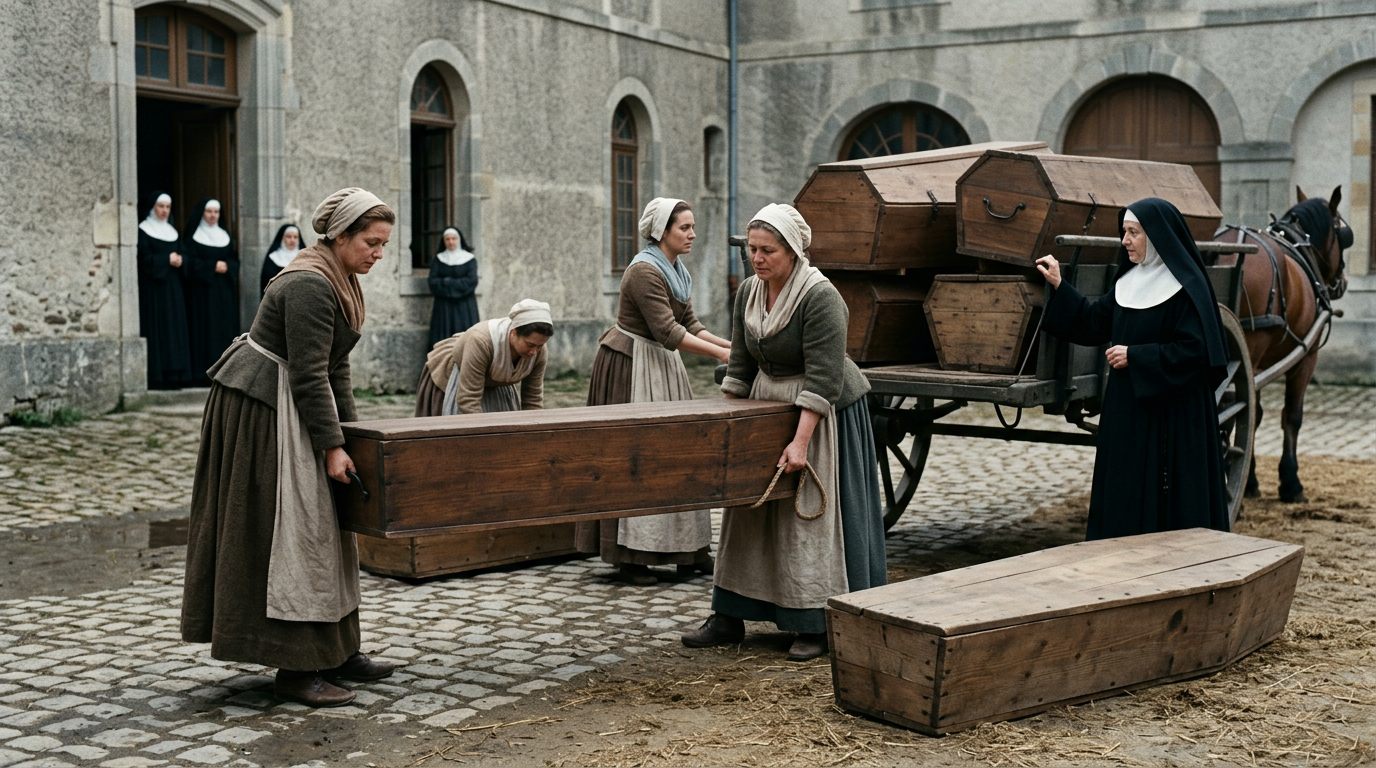
The term comes from the French filles à la cassette — literally, “girls with a small chest” or trunk. These were women who traveled from France to the French colonies in the Americas, carrying their worldly belongings in a modest case or cassier. Over the decades, the word cassette drifted into casquette, and English speakers, hearing something close to “casket,” landed on a word soaked in funereal dread. The luggage became a coffin in the popular imagination, and the women who carried it became something other than human.
The transformation tells us a great deal about how legends grow. The actual cassettes were small — deliberately so, because each woman needed to carry her own without help. They held dresses, petticoats, linens, and the few possessions a young woman might bring to start a new life. Yet later storytellers stretched these humble trunks, in illustration and in imagination, until they were large enough to hold a body. Once a suitcase becomes a casket, the question writes itself: what, exactly, were these young women carrying across the sea?
It is no accident that paranormal fiction writers adore old New Orleans. The city’s heady blend of Catholicism and Voodoo, layered atop African, French, Spanish, British, and Asian cultural influences, makes fertile ground for tales of the uncanny. But before pop culture conscripted them into the ranks of the undead, the filles endured a genuinely harrowing ordeal — one that earned them a permanent place in both the documented history of colonial Louisiana and the folklore of the supernatural.
Empire, Evangelism, and the Problem of Wives
To understand how the Casket Girls came to New Orleans, we have to understand the desperate situation of the early French colonies along the Gulf Coast. New Orleans was founded by explorers, trappers, and traders who established rough encampments along the lower Mississippi. The French planted three principal outposts on the Gulf: Mobile, Biloxi, and — later — New Orleans itself.
These settlements shared a glaring imbalance. The early colonists were overwhelmingly male, and Catholic clergy in the region grew alarmed. Without wives, without families, without the domestic scaffolding of Christian marriage, the entire project of evangelizing French territory seemed doomed. A colony of bachelors does not perpetuate itself, and it certainly does not raise the next generation of Catholic settlers.
The first solution was, by any measure, a failure. Appealing to bishops and mayors of French port cities, colonial authorities found those officials all too happy to empty their jails and brothels and ship the women they deemed “undesirable” across the Atlantic. But former prisoners and sex workers, pressed into colonial marriage against their will, did not make the stable domestic partners the priests had envisioned. The plan backfired.
So the clergy sought a different kind of woman. They appealed to King Louis — the source material names Louis IV, though the monarch of this era was Louis XV, then a boy-king under regency — who in turn tasked the Bishop of Québec with reaching out to the convents and orphanages of France. There, they sought “virtuous” young women: girls of good character who could be contracted to sail to the colonies and become wives to colonial men. These contracted young women were the Casket Girls, recruited not from prisons but from the cloister and the orphanage, carrying the church’s hopes for a respectable colonial future in their small trunks.
Brides by Contract: The Waves of Arriving Women
The shipments of marriageable women arrived in stages over several decades. The first group sailed to Mobile in 1704 aboard the merchant vessel Pelican — which is why, to this day, Mobile fondly calls its filles à la cassette the “Pelican Girls.” Over time, a number of these women migrated from Mobile to the growing city of New Orleans.
A second consignment of prospective brides reached Biloxi in 1719. A third arrived in New Orleans beginning around 1728, when the young city was barely a decade old. The timing matters, because the year before — in 1727 — Ursuline nuns had arrived from Rouen, France, charged with educating the colony’s women and evangelizing the indigenous population. It was these nuns who took the newly arrived filles into their care. The young women lived with the sisters, under their protection and instruction, until they were married off to the men of the colony.
This arrangement — convent first, marriage second — is the seed from which the entire vampire legend would later grow. The convent housed the women; the convent stored their trunks; and the convent, with its sealed upper floor, would become the haunted heart of the myth.
A Crossing of Months and Mortal Danger
The path that carried a young Frenchwoman to Louisiana was long, uncertain, and frequently fatal. It usually began in the convent, school, or orphanage where she lived, often with nuns who were themselves eager to reduce the number of girls in their care. A woman would enter into a marriage contract with a colonial man who arranged and financed her passage. From there, she traveled to a French port city — Le Havre was a common point of departure — and waited to board a ship bound for America.
The waiting could be its own ordeal. Ships sailed only when full, and a woman who arrived at port too early might languish for months before a vessel was ready to depart. Once aboard, the Atlantic crossing itself consumed months more. Ships typically called at Cap-Français — today’s Cap-Haïtien, on the northern coast of Haiti — to take on supplies and fresh drinking water before pressing onward into the Gulf of Mexico.
The voyage was brutal. Confined to cramped quarters, exposed to contaminated water and the diseases that thrived in such conditions, many of the women never reached Louisiana at all. Yellow fever and other travel-borne illnesses claimed lives throughout the journey. The women who stepped ashore in the colony were the survivors of a crossing that had already killed some of their companions — which lends a grim irony to the later legend that they arrived looking like death itself.
New Orleans in the 1720s: An Outpost on the Crescent
The New Orleans that greeted the Casket Girls bore little resemblance to the city we know. When these women arrived, Biloxi served as the capital of French-occupied North America — a vast territory called Louisiana, or La Louisiane, that stretched from parts of the Caribbean islands all the way up into present-day Canada. New Orleans was still a frontier outpost, raw and unfinished.
The colony’s governor, Jean-Baptiste Le Moyne de Bienville, worked to extend French control over the Gulf Coast, ordering surveys and plans for the land cradled in the great crescent of the Mississippi. The settlement grew outward from Fort St. Charles, near what is now Esplanade Avenue at the river. As in most colonial settlements, civilians raised their homes outside the fort’s walls, clustered around a parade ground for the troops and a parish church beside it. The French Quarter as we recognize it today existed only as lines on a surveyor’s paper.
Life in this place was almost certainly far less romantic than the filles had dared to hope. Most of the Casket Girls saw remarkably little of the husbands they had crossed an ocean to join. These women — accustomed to the structured rhythms of convents and orphanages — now found themselves running entire households on their own. The colonial men of the 1720s and 1730s were fur trappers and traders, occupations that kept them away from home for long stretches. Trappers vanished into the wilderness for months to gather pelts for export; traders carried European-manufactured goods out to the scattered farms, plantations, and outposts to sell.
The climate demanded its own painful adjustment. The heat and humidity of the Gulf Coast bore no resemblance to the temperate weather of France, and the clothing the women had so carefully packed in their trunks was ill-suited to their new subtropical home. Yet adapt they did. They established households, raised children, and quietly became the founding mothers of a city that would one day turn them into monsters.
The Ursuline Sisters and the Oldest Building in the Valley
No institution is more entangled with the Casket Girls than the Order of St. Ursula. The Ursulines founded a school almost immediately upon their 1727 arrival, and many of the Casket Girls — along with other women of the colony — studied there until they married. The sisters were teachers, guardians, and chaperones to a generation of young women navigating an unfamiliar and often hostile world.
The city built the order’s first convent in 1734. That structure was replaced by the convent that still stands today, completed in 1751 — now recognized as the oldest building in the entire Mississippi Valley. Its survival is partly an accident of geography: when the great fire of 1788 swept through New Orleans, the convent’s distance from the blaze, which began nearer Canal Street, spared it. (Those drawn to the city’s legends should seek out the story of Our Lady of Prompt Succor, patron saint of Louisiana, another tale woven around this very convent.) The building was raised close to Fort St. Charles, on the eastern, downriver edge of the Vieux Carré.
The Order of St. Ursula has never abandoned its founding mission. The sisters continue to educate the women of New Orleans to this day. Though Ursulines once staffed elementary schools such as St. Angela Merici in Metairie, the order now concentrates its efforts on its high school campus uptown — an unbroken thread of purpose stretching back three centuries to the nuns who first took the filles à la cassette under their wing.
How the Casket Girls Became Vampires
With the documented history in hand, we can finally turn to the legend — and trace how a story of frightened immigrant brides curdled into a tale of the undead. Nearly every vampire version of the filles à la cassette fixates on two elements: the “caskets” and the convent. And the most enduring of these stories centers on the sealed third floor of the 1751 convent building, which remains a fixture on almost every haunted-history tour in the city.
The legend begins at the moment of arrival. When the colonial men gathered to meet their promised brides, they were said to be unsettled by how unnaturally pale the women appeared — so pale that their skin reddened and blistered beneath the subtropical sun within moments of exposure. (A pallor easily explained by months belowdecks on a disease-ridden ship, but legends rarely pause for such explanations.) The women lived among the Ursuline nuns until their marriages, but King Louis’s hope that these convent-bred girls would prove better wives than the prisoners and sex workers before them was, the story claims, dashed. Many Casket Girls were forced into unwanted marriages and mistreated by their husbands; those left unwed reportedly turned to prostitution to survive. Upon hearing of their suffering, the king is said to have ordered the women to be returned to France.
Here, the tale takes its supernatural turn. In preparation for the women’s departure, their cassettes — packed once more with all their belongings — were carried up to a storage room on the convent’s third floor. That floor had long stood sealed, its windows shuttered. So imagine the nuns’ horror when they returned to retrieve the luggage and found the trunks completely empty. A thorough search of the entire third floor turned up nothing. The possessions had simply vanished.
Convinced something supernatural was at work, the nuns took drastic measures to ensure that nothing — and no one — could ever enter or leave that room again. Some versions claim the shutters were nailed shut with nails blessed by a pope, a detail that collapses under the gentlest scrutiny: Pope John Paul II was the first pontiff ever to visit New Orleans, and that was in 1987. For the convent’s eighteenth-century nails to have been papally blessed, someone would have had to ship them to Rome and back across the Atlantic — a charming impossibility.
The vampire element itself is even more recent. Whether the legend casts the Casket Girls as vampires, or imagines their casquettes as the vessels that ferried vampires across the sea, the supernatural overlay is a modern embellishment grafted onto a centuries-old historical kernel. The holes in the story are obvious. And yet the tales remain irresistible — proof that a good legend cares far more for atmosphere than for evidence.
Why Vampire Lore Took Root in New Orleans
It is worth asking why this particular legend found such fertile soil in this particular city. The answer lies in everything that makes New Orleans unlike anywhere else in America. The city was built at the meeting point of Catholic France and Spain, of West African spiritual traditions carried by enslaved people, of Caribbean Voodoo, and of countless other cultural currents flowing through a busy port. Catholicism brought a deep vocabulary of the sacred and the damned — saints and relics, blessed nails and consecrated ground, the body and the blood. Voodoo brought its own potent relationship with the dead and the unseen. Layered together, these traditions created a city perpetually aware of the thin membrane between the living and the departed.
Add to this a landscape that seems designed for the gothic. New Orleans buries its dead above ground in stone tombs because the water table sits too high for graves, so the dead are quite literally housed among the living in “cities of the dead.” Disease swept through the colonial city in recurring waves, making mortality a constant companion. The humid air, the moss-draped oaks, the crumbling plaster, the long shadows of the French Quarter — all of it lends itself to stories whispered after dark.
Into this atmosphere, the Casket Girls fit perfectly. They arrived pale and exhausted from a deadly crossing; they carried trunks that language itself transformed into coffins; they lived behind the shuttered windows of an ancient convent that still stands. A storyteller could hardly ask for better raw material. The legend endures not because anyone truly believes vampires sleep on the third floor, but because the story captures something the city has always felt about itself — that here, more than anywhere, the past has never fully died, and the dead are never entirely gone.
The Women Behind the Myth
Strip away the blessed nails and the empty trunks and the blistering pallor, and what remains is a story arguably more remarkable than any vampire tale. The filles à la cassette were young women — many barely more than girls — who left everything they knew, endured a months-long crossing that killed some of their number, and stepped ashore into a sweltering frontier outpost to marry men they had never met. They ran households alone while their husbands vanished into the wilderness for months. They raised children, adapted to a climate that punished them, and helped lay the human foundations of New Orleans.
That the city repaid them by recasting them as monsters is, perhaps, the strangest twist of all. But it is also a kind of immortality. Three centuries later, their trunks still rest in the popular imagination on a sealed convent floor, and their story is told and retold to wide-eyed visitors on lantern-lit streets. The legend keeps their memory alive, even as it obscures who they really were.
So the next time you find yourself in the French Quarter, walk down Chartres Street to the Old Ursuline Convent. Look up at those shuttered third-floor windows. Take one of the haunted-history tours if you like, and let the storyteller spin the tale. But as you listen, remember the women beneath the myth — the brave, frightened, exhausted survivors who carried their whole lives across an ocean in a single small trunk. They were never vampires. They were something rarer: the original mothers of New Orleans.

Powell, L. N. (2012). The accidental city: Improvising New Orleans. Harvard University Press.
Leave a Reply