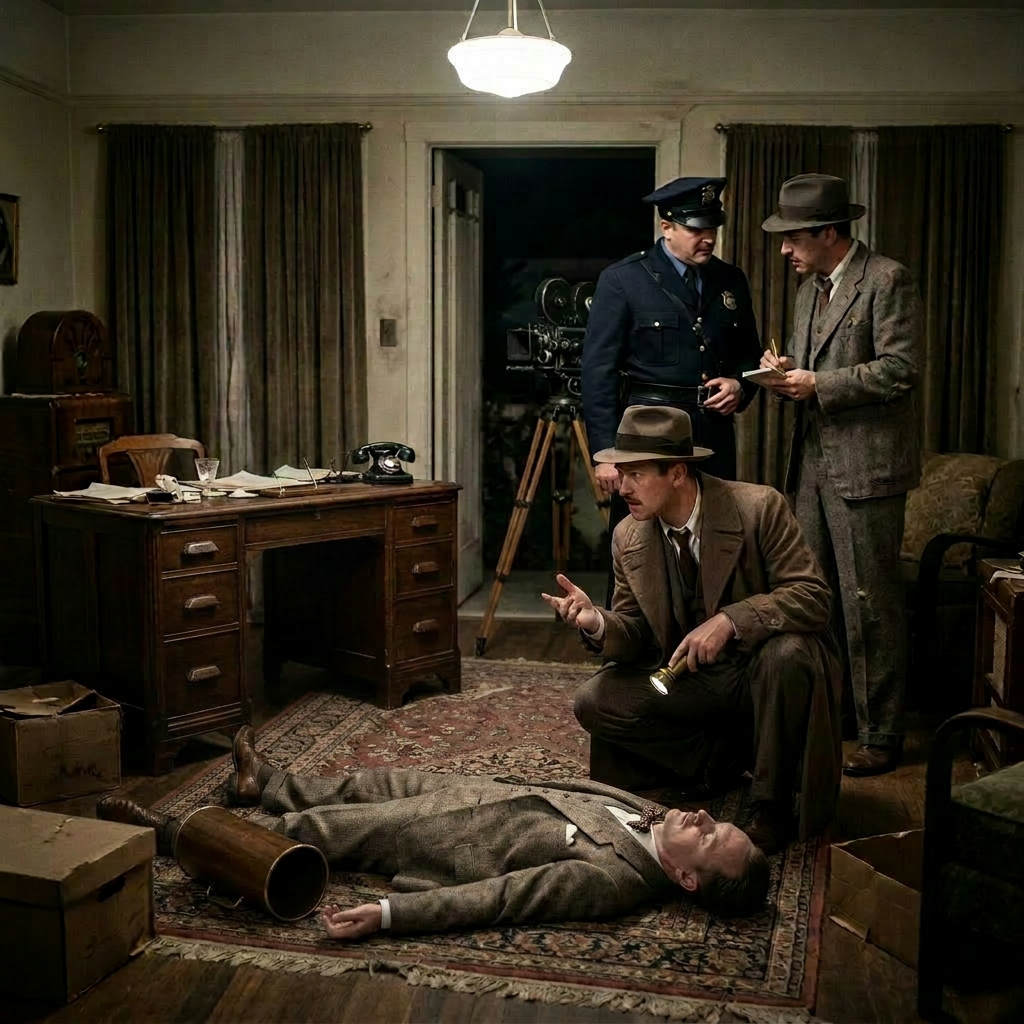

The year is 1922. The place is the sprawling, sun-drenched dream factory of Los Angeles, a city still masquerading as a frontier town while secretly building an empire of celluloid and stardust. But beneath the veneer of glamour, a shadow looms. On a quiet February morning, the celluloid dream turned into a waking nightmare.
William Desmond Taylor, a man of refinement, an Anglo-Irish gentleman who had climbed the ranks of the nascent motion picture industry to become one of its most celebrated directors, was found lifeless in his Westlake bungalow. The scene was ripped from the pages of a penny dreadful: a locked room, a missing fortune, a cadre of starlets, and a trail of secrets that led straight to the heart of the studio system.
Grab your magnifying glass. As we step into the parlor of history, we find a case that would baffle even the most astute Belgian detective. This is not just a biography; it is a cold case, a whodunnit that, a century later, remains the ultimate Hollywood mystery.
Early Life: The Man Behind the Mask
Before he was the toast of Hollywood, he was William Cunningham Deane-Tanner. Born in 1872 into the Anglo-Irish gentry in Carlow, Ireland, he was a creature of pedigree and privilege. Yet, the life of a gentleman did not suit his restless spirit. By 1891, he had traded the rolling hills of Ireland for the rugged plains of Kansas.
He was a man of many lives. He was a ranch hand, an antiques dealer in New York, a husband to Ethel May Hamilton, and a father. But he was also a man haunted by “mental lapses”—or perhaps just the crushing weight of his own secrets. In 1908, he vanished, leaving his family behind like a discarded script. His wife obtained a divorce in 1912, unaware that her husband had simply stepped off the stage of his old life to begin a new act under the name William Desmond Taylor.
Hollywood: The Rise of a Star
By 1912, Taylor had arrived in San Francisco, reinvented and ready for the spotlight. He was a man of “personal culture, education, and refinement,” as his former fiancée Neva Gerber would later recall. He entered the film industry at the perfect moment, acting in silent pictures before finding his true calling behind the camera.
He directed 59 films, working for industry giants Pallas Pictures and Famous Players–Lasky. He was a director of prestige, helming projects with stars like Mary Pickford and his own protégée, the young Mary Miles Minter. He had even served in the Canadian Expeditionary Force during the Great War, returning to Los Angeles as a decorated, respected figure. To the outside world, Taylor was the picture of success. But behind the closed doors of his Alvarado Court bungalow, the plot was thickening.
Career as Director: A Legacy in Celluloid
Taylor’s filmography reads like a catalog of the silent era’s golden age. From the serial thrills of The Diamond from the Sky to the literary adaptations of Anne of Green Gables and Tom Sawyer, he understood the language of the screen. He was a master of the “photoplay,” a craftsman who could elevate a simple story into something that resonated with millions. His final works, such as The Green Temptation and The Top of New York, were released posthumously, serving as silent monuments to a career cut tragically short.
Murder: The Final Scene
On the morning of 2 February 1922, the silence in the Alvarado Court Apartments was shattered. Taylor was found dead, shot in the back. The initial scene was a chaotic tableau of incompetence. A stranger posing as a doctor arrived, declared the death a result of a stomach hemorrhage, and vanished into the ether.
When the truth finally surfaced—that the director had been murdered—the police found a scene that defied logic. A wallet containing $78 remained in his pocket. A diamond ring sat on his finger. Yet, a substantial amount of cash he had been seen with the day before was gone. It was not a robbery gone wrong; it was an execution.
Investigation: A Web of Suspects
In the wake of the crime, the investigation became a circus of misinformation and studio interference. Los Angeles law enforcement, warned by the industry to “lay off,” found themselves navigating a labyrinth of red herrings.
- Edward F. Sands: The former valet with a history of forgery and embezzlement. He had burgled Taylor’s bungalow before and vanished immediately after the murder. Was he a thief returning to the scene of the crime, or a convenient scapegoat?
- Henry Peavey: The new valet who found the body. He was subjected to bizarre “ghost” interrogations by ambitious reporters, yet the police eventually ruled him out. His later decline into illness only added to the tragic aura surrounding the case.
- Mabel Normand: The comedic star and the last person known to have seen Taylor alive. They were close, and Taylor had reportedly been trying to help her overcome a cocaine addiction. Was he killed by the very suppliers he threatened to expose?
- Mary Miles Minter: The young starlet whose infatuation with the much older director was laid bare by the discovery of her love letters. The press crucified her, destroying her career and her reputation.
- Charlotte Shelby: Minter’s mother, a woman known for her manipulative grip on her daughter’s life. She owned a gun of the same caliber used in the murder and was long suspected by investigators and writers alike. She spent years fleeing the country to avoid the law, yet no district attorney ever brought her to trial.
- Margaret Gibson: A dark horse in the investigation. Decades after the fact, it was reported that this actress, who had worked with Taylor, confessed to the crime on her deathbed.
Aftermath: The Fall of the Dream Factory
The murder of William Desmond Taylor was the catalyst for a moral reckoning in Hollywood. The press, sensing blood, compared the film colony to the decadence of ancient Rome. Calls to “Destroy Hollywood” echoed in newspapers across the country.
The industry, fearful of losing its audience and its profits, responded by introducing “morality clauses” into contracts. The era of the wild, untamed frontier of silent film was ending, replaced by the sanitized, studio-controlled machine. The Taylor case became the ultimate cautionary tale, a reminder that in Hollywood, the most dangerous stories are the ones that never make it to the screen.
Conclusion: The Unsolved Mystery
One hundred years later, the murder of William Desmond Taylor remains an official cold case. The files have vanished, the witnesses are long dead, and the truth has been buried under layers of sensationalist ink and cinematic myth. Like an Agatha Christie mystery where the detective is absent, we are left with only the clues—the letters, the missing money, the vanished valet, and the whispered confessions.
Perhaps the true mystery is not who pulled the trigger, but why the truth was so systematically dismantled. In the end, William Desmond Taylor became exactly what he had spent his life creating: a character in a story that no one could quite finish.

St. Johns, A. R. (1969). The honey-comb. Garden City, NY: Doubleday.
Vidor, K. (1968). A tree is a tree. New York, NY: Harcourt, Brace & World.
Leave a Reply