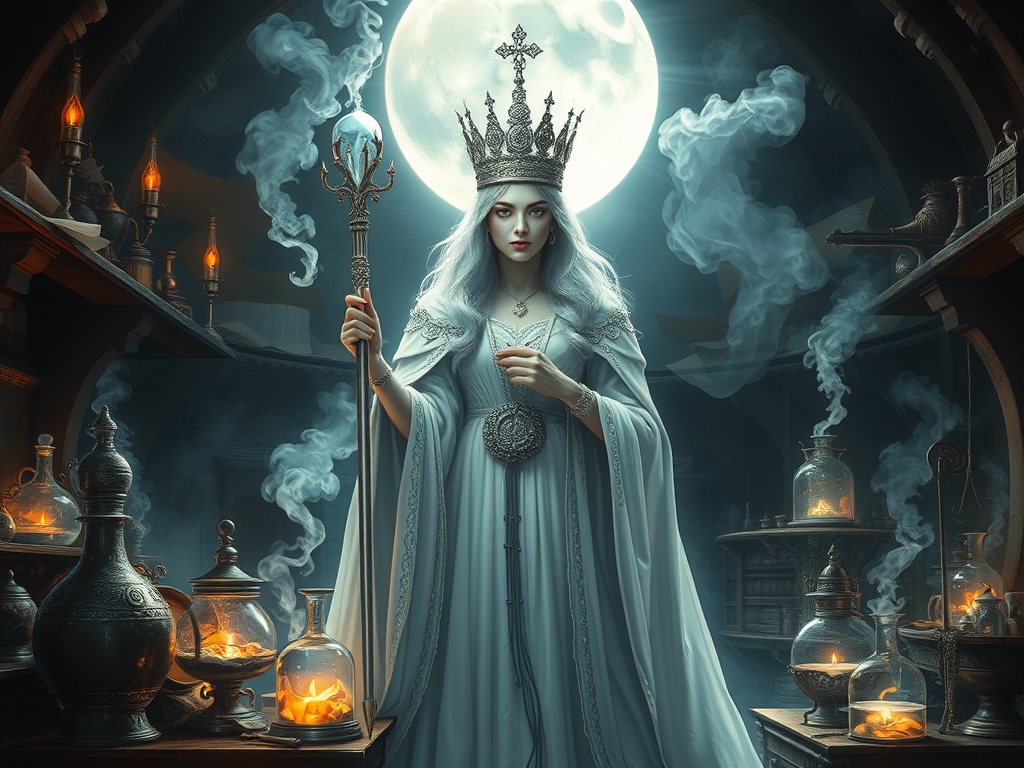

Introduction: The Vision in the Alchemist’s Laboratory
Imagine a dimly lit medieval workshop, cluttered with alembics, parchments, and jars of mysterious powders. Here, an alchemist toils over a flask, seeking the Magnum Opus—the transformation of base matter into gold. As fumes rise, a figure materializes: a radiant woman cloaked in white, crowned with silver, holding a scepter of crystal. She is the White Queen (Regina Alba), a symbol shrouded in paradox, embodying purity, transformation, and the elusive secrets of alchemy. Who was she, and why did her presence haunt the dreams of medieval mystics?
This post unravels the White Queen’s role in medieval alchemy, tracing her origins in cryptic texts, her ties to ancient myth, and her enduring legacy in psychology and mysticism.
The White Queen in Alchemical Lore: From Lead to Light
The White Queen emerges most prominently during the albedo (whitening) stage of the alchemical process, a phase symbolizing purification, ascension, and the union of opposites. Medieval texts like the Rosarium Philosophorum (15th century) depict her as the celestial counterpart to the Red King (Rex Rubrum), representing the sulfur-mercury dichotomy central to alchemical theory.
Key Attributes:
– Lunar Sovereignty: Her white robes and silver crown align her with the moon, a symbol of reflection, intuition, and cyclical transformation.
– Mercurial Essence: As a personification of argent vive (quicksilver), she embodies fluidity and mediation between realms.
– The Sacred Marriage: Her union with the Red King (coniunctio oppositorum) signifies the fusion of soul and spirit, a prerequisite for creating the Philosopher’s Stone.
In the Aurora Consurgens (attributed to Thomas Aquinas), she appears as Sapientia (Divine Wisdom), guiding the alchemist through spiritual illumination. Yet her role is ambiguous: Is she a divine emissary, a psychological archetype, or a coded chemical formula?
Mythological Roots: Isis, Diana, and the Eternal Feminine
The White Queen’s imagery borrows from pre-Christian goddesses and mythic heroines, reflecting alchemy’s syncretic nature.
– Isis Unveiled: Egyptian texts describe Isis as a “mistress of alchemy” who resurrects Osiris—a metaphor for reviving inert matter. Her lunar crescent crown mirrors the White Queen’s iconography.
– Diana’s Chastity: Medieval grimoires link her to Diana, the virgin huntress, whose purity parallels the albedo’s untainted state.
– Gnostic Sophia: In Gnosticism, Sophia (Wisdom) falls from the Pleroma (divine realm) and must be “purified” through ascension—a narrative echoed in the alchemist’s quest.
These layers reveal the White Queen as a bridge between pagan mysticism and Christianized alchemy, her duality embodying the tension between heresy and revelation.
Jungian Psychology: The Queen as Anima
Carl Jung reinterpreted the White Queen through the lens of depth psychology, identifying her as the anima—the feminine unconscious within the male psyche. In Psychology and Alchemy (1944), he argues that her whitening symbolizes individuation: confronting shadows to achieve wholeness.
Jungian scholar Marie-Louise von Franz later noted her resemblance to the “silver maiden” in fairy tales, a guide through existential darkness. Yet critics like Stanton Marlan caution against reducing her to metaphor, stressing her roots in lived mystical experience.
Controversies and Censorship: Why Was She Marginalized?
Despite her centrality, the White Queen rarely dominates alchemical narratives. Medieval scribes often minimized feminine symbols, reflecting the Church’s suspicion of goddess worship. Texts like the Mutus Liber (1677) depict her passively, subordinate to the Red King.
Feminist scholar Tamara Albertini argues this erasure mirrors broader societal anxieties about female authority. Yet in coded illustrations, such as those in the Splendor Solis (1530s), her presence persists—a silent rebellion against orthodoxy.
Legacy: From Renaissance Labs to Modern Mysticism
Today, the White Queen resurfaces in unexpected places:
– Feminist Alchemy: Modern practitioners like Jennifer M. Rampling reclaim her as a symbol of divine femininity and ecological balance.
– Pop Culture: She inspires characters in Neil Gaiman’s The Sandman and Game of Thrones’ Melisandre, blending ancient archetypes with contemporary storytelling.
– Neo-Pagan Rituals: Wiccan traditions invoke her during moon ceremonies, honoring her as a guardian of transformation.
The Queen’s Unfinished Transformation
The White Queen remains an enigma—a mirror for alchemy’s unanswered questions. In a world yearning for synthesis, her legacy challenges us to embrace paradox: decay and renewal, shadow and light.

As the alchemists whispered: “What is below is like what is above, and what is above is like what is below.” The White Queen, ever elusive, still beckons.

– Jung, C. G. (1944). Psychology and Alchemy (R. F. C. Hull, Trans.). Princeton University Press.
– Abraham, L. (1998). A Dictionary of Alchemical Imagery. Cambridge University Press.
– Von Franz, M.-L. (1997). Alchemical Active Imagination. Shambhala.
Leave a Reply