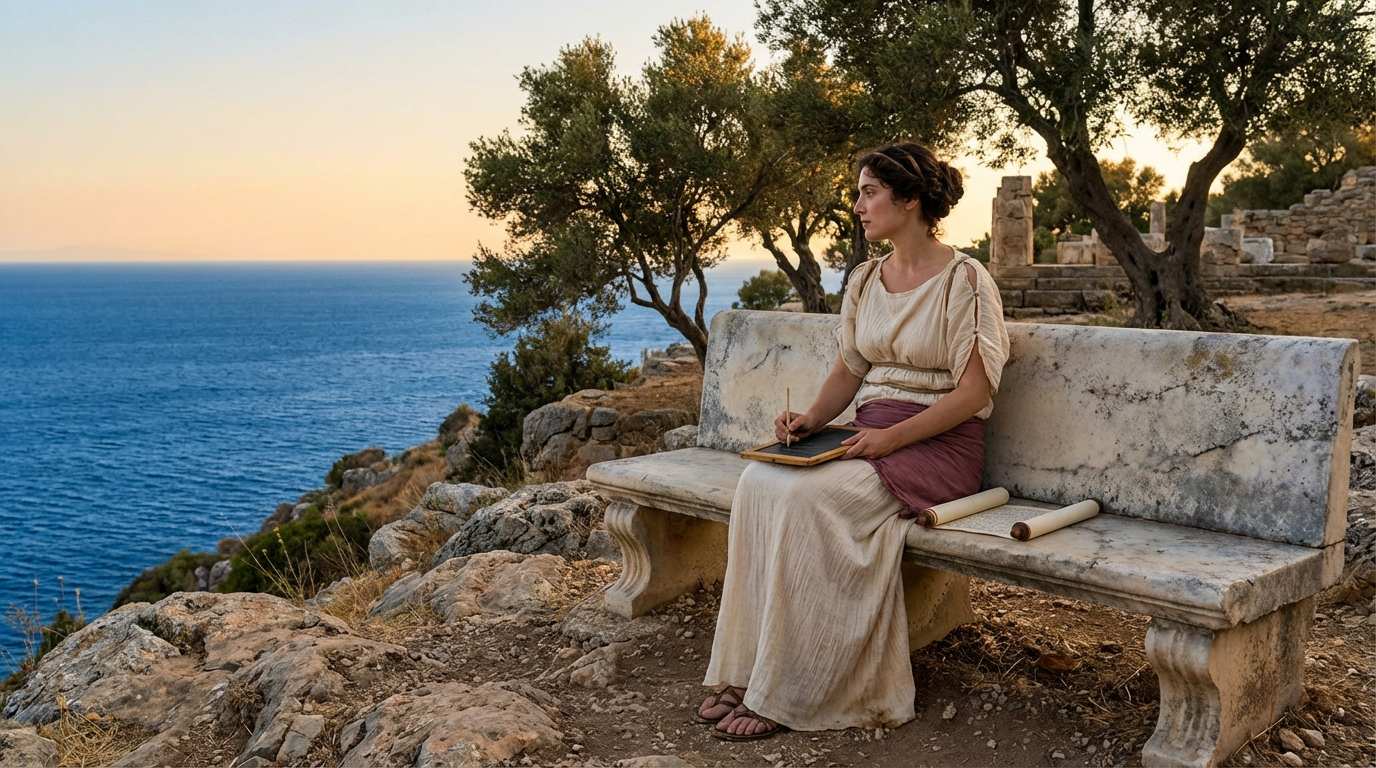


A Voice from the Ashes: An Introduction to the Sapphic Enigma
Imagine a poet so revered that ancient critics placed her among the celestial Muses, yet so mysterious that her life story is woven from whispers, legends, and the scattered remnants of her own songs. This is Sappho. For scholars of lyric poetry and Hellenistic studies, she is both a cornerstone and a conundrum. From the island of Lesbos in the late 7th century BCE, she crafted verses of such intense, personal emotion and technical mastery that they reshaped Greek literature. Yet today, we possess only one complete poem. The rest survives in fragments—a handful of lines on a tattered papyrus, a single phrase quoted by a later grammarian, a new piece miraculously recovered from the wrapping of an Egyptian mummy. To study Sappho is to become a literary archaeologist, sifting through ruins to reconstruct a lost world of female experience, ritual, and desire. Her name birthed the terms “sapphic” and “lesbian,” but her true story is far richer and more elusive than any modern label. This is an exploration of the poet behind the legend, guided by the fragments she left behind.
The Shadow and the Statue: What Ancient Sources Tell Us (And What They Invent)
Our portrait of Sappho is a palimpsest, written over by generations of admirers, comedians, and moralists. The earliest contemporary evidence is her own poetry, but its first-person voice is a literary device, not a straightforward diary. The next layers are problematic. Centuries after her death, biographers like the anonymous author of the Oxyrhynchus Life (2nd/3rd century CE) and the Byzantine Suda encyclopedia (10th century CE) constructed narratives often inferred from—or blatantly misread—her poems.
These later sources are a mix of local Lesbian tradition and Athenian comic invention. From the 5th century BCE onward, Athenian playwrights caricatured her as a promiscuous, heterosexually crazed figure, a stock character for laughs. The infamous story of her suicidal leap from the Leucadian cliffs for love of the ferryman Phaon, later immortalized by Ovid, likely stems from this comedic tradition, merging two separate myths about Aphrodite. As classicist André Lardinois notes, such tales often served to “reassure ancient audiences of Sappho’s heterosexuality,” a concern that reveals more about later anxieties than her reality.
Even earlier, more sober historians like Herodotus (5th century BCE) mention her, but tangentially, using her brother Charaxos’s affair with a courtesan as a colorful anecdote. The challenge for modern scholars is to peel back these accumulated layers, distinguishing plausible tradition from ideological projection and comic slander to glimpse the historical artist.
The Life in the Fragments: Lesbos, Exile, and a Circle of Women
Firm biographical facts are scarce. She was born around 630 BCE, a contemporary of the poet Alcaeus and the statesman Pittacus. She belonged to the aristocratic elite of Mytilene, as suggested by her brother Larichos serving as an official cupbearer. The Brothers Poem, discovered in 2014, confirms this familial context, showing her expressing concern for her sibling Charaxos’s seafaring ventures. She likely had a daughter named Cleïs, a point of tenderness in the fragments, though some scholars controversially suggest the term pais could indicate a youthful beloved.
A significant historical clue is the Parian Chronicle, which records her exile to Sicily around 600 BCE, probably due to the intense political strife that engulfed Lesbos’s aristocracy. This experience of displacement may echo in the themes of separation and longing that permeate her work. The notorious “marriage” to Kerkylas of Andros is almost universally dismissed by scholars as a later punning joke (kerkos = penis; andros = of a man).
Crucially, her poetry sketches a vivid social milieu: a world of close-knit female companions with names like Atthis, Anactoria, and Gongyla. The poems depict shared rituals, education, remembrance, and the piercing pain of separation. Whether this circle was a formal thiasos (a religious or educational association for girls), an informal aristocratic salon, or a poetic fiction remains one of the central debates in Sapphic studies. What is clear is that this female-centered community provided the essential emotional and performative context for her art.
The Architecture of Loss and Discovery: Sappho’s Works
Sappho was prolific, composing an estimated 10,000 lines. The Alexandrian scholars of the Hellenistic period (3rd-2nd century BCE) canonized her, compiling her work into probably nine books arranged metrically. The first book alone contained 1,320 lines of poems in the “Sapphic stanza,” her signature meter. Then, the great vanishing act occurred. The dialect of Aeolic Greek in which she wrote grew obscure. The shift from papyrus scrolls to parchment codices was costly, and demand for archaic lyric waned. By the Middle Ages, her voice was largely silent, preserved only in quotations by other authors.
The modern era has been a story of breathtaking rediscovery. Since the late 19th century, archaeological digs, especially at Oxyrhynchus in Egypt, have unearthed papyrus fragments. Each new find sends ripples through the academic world. The 2004 publication of the “Tithonus poem” (Fragment 58) on a 3rd-century BCE papyrus gave us a profound meditation on old age. The 2014 announcement of the “Brothers Poem” and other new fragments fundamentally altered our understanding of her thematic range, showing a greater emphasis on family and community alongside the famous love lyrics.
Her style is characterized by devastating clarity and immediacy. She employs direct speech, vivid Homeric imagery repurposed for personal emotion (comparing a beloved woman to the moon outshining stars), and a powerful “lyric I.” In her most famous fragment (31), she masterfully catalyses the physical symptoms of desire—tongue broken, fire under the skin, ears roaring—creating a timeless blueprint for describing jealous love.
Within the Women’s Rooms: The Social and Ritual Context
The question of where and why Sappho performed her poetry is paramount. Rejecting the anachronistic 19th-century view of her as a “schoolmistress,” contemporary scholarship proposes several plausible, overlapping contexts rooted in the social and religious life of archaic Lesbos.
A leading theory posits that she composed for the rituals surrounding female transition, particularly marriage. Her epithalamia, or wedding songs, are among her best-preserved choral works. Poems like the evocative “Like the sweet apple” (Fragment 105a) metaphorically depict a bride’s separation from virginity and integration into a new community. In this role, Sappho may have been a chorus leader or trainer, guiding young women through song and ritual as they prepared for marriage.
Other fragments suggest a context of cultic worship, particularly of Aphrodite. The complete “Ode to Aphrodite” (Fragment 1) is a powerful hymn invoking the goddess’s aid in matters of the heart. The setting could have been a religious festival or a more private devotional gathering. The shared language of these poems—references to garlands, anointing with perfume, and sacred precincts—paints a picture of a rich, ritualized female society. Her poetry likely served to strengthen the bonds within this group, celebrating their shared experiences and mourning their inevitable partings.
The “Great Sappho Question”: Sexuality, Eros, and Modern Labels
No aspect of Sappho’s reception is more charged than the question of her sexuality. The ancient evidence is tantalizingly ambiguous. While classical Athenian comedy portrayed her as hypersexual with men, Hellenistic-era biographers directly referenced accusations of her being a “woman-lover.” The Suda later claimed she was “slanderously accused” of relations with her pupils.
Her poetry itself is the primary source. The erotic charge in poems addressed to women is undeniable. Fragment 31 describes a man’s bliss at being near a woman who leaves the speaker physically devastated. In Fragment 94, she comforts a departing lover, reminiscing about their intimate moments: “and on soft beds… you satisfied your desire.” For scholars in sexuality studies, this presents a complex hermeneutic challenge.
As Page duBois and others argue, applying the modern, identity-based category of “lesbian” or “homosexual” to the 6th century BCE is anachronistic. Ancient Greek sexual mores were structured more around active/passive roles and social status than gender of object choice. However, to deny the homoerotic nature of her desire is equally untenable. Melissa Mueller offers a productive path by advocating for a “queer” reading that acknowledges the palpable female-centered desire in the texts without forcing it into a modern identity box. Ultimately, Sappho’s poetry celebrates eros in all its forms—joyful, jealous, consoling, divine—between women. This celebration, not a definitive biographical label, is her revolutionary literary legacy.
Conclusion: The Tenth Muse’s Enduring Song
Sappho’s journey from the aristocratic circles of archaic Lesbos to a 21st-century icon of queer love is a testament to the irresistible power of her fractured genius. She was a technical innovator who helped define lyric poetry, a keen observer of the human heart, and a poet who centered the emotional lives of women in a literature dominated by masculine epic and political strife.
The scholarly quest to understand her—through papyrology, historical contextualization, and literary theory—is ongoing. Each new fragment, like those in 2014, forces a reevaluation. She resists easy categorization: a poet of both personal longing and public ritual, of divine hymns and worldly gossip, of exquisite joy and profound sorrow.
Her true legacy lies not in the sensationalized myths of her death, but in the breathtaking survival of her voice across millennia. In a handful of lines about the moon’s light, the ache of separation, or the memory of a soft bed, she continues to speak with a immediacy that feels utterly contemporary. Sappho remains, as she was in antiquity, the Poetess—a voice that, even in fragments, defines the art of expressing what it means to desire, to lose, and to remember.

Lobel, E., & Page, D. (Eds.). (1955). Poetarum Lesbiorum fragmenta. Clarendon Press.
Voigt, E.-M. (Ed.). (1971). Sappho et Alcaeus: Fragmenta. Athenaeum Polak & Van Gennep.
Budelmann, F. (Ed.). (2009). The Cambridge companion to Greek lyric. Cambridge University Press.
Burnett, A. P. (1983). Three archaic poets: Archilochus, Alcaeus, Sappho. Harvard University Press.
duBois, P. (1995). Sappho is burning. University of Chicago Press.
Greene, E. (Ed.). (1996). Reading Sappho: Contemporary approaches. University of California Press.
Lefkowitz, M. R. (2012). The lives of the Greek poets (2nd ed.). Johns Hopkins University Press.
Prins, Y. (1999). Victorian Sappho. Princeton University Press.
Robbins, E. (2013). Sappho, Aphrodite, and the Muses. The Classical World, 106(4), 615-623.
Yatromanolakis, D. (2007). Sappho in the making: The early reception. Harvard University Press.
Skinner, M. B. (2005). Sexuality in Greek and Roman culture. Blackwell Publishing.
Williamson, M. (1995). Sappho’s immortal daughters. Harvard University Press.
Leave a Reply