
The Gadfly’s Sting: An Introduction to Philosophy’s Greatest Ghost
Imagine a man so influential that twenty-four centuries after his death, we still teach his methods, debate his ideas, and shudder at his execution. Yet this same man never wrote a single word, was described by contemporaries as physically ugly, and deliberately lived in poverty. This is the enduring paradox of Socrates, the Athenian philosopher who stands as the foundational figure of Western philosophy. More than just a historical individual, Socrates is an intellectual spectre—a presence constructed from the sometimes-contradictory reports of his students and critics. To study Socrates is to grapple with the very nature of knowledge, virtue, and the purpose of a human life. His story is not merely an account of an ancient thinker; it is the origin story of critical inquiry itself, culminating in a state-sanctioned death that forever changed what it means to seek wisdom.
Through a Glass, Darkly: The Socratic Problem and Our Fragmented Sources
We know Socrates only through a fractured mirror. The man himself authored no texts, leaving no direct testament of his thoughts. What remains are posthumous portraits, each painted with its own biases and literary ambitions. This fundamental dilemma is known as the Socratic problem: how can we reconstruct the philosophy of a man we only know through others?
Our primary lenses are his students, Plato and Xenophon. Plato’s extensive body of Socratic dialogues presents a brilliant, ironic, and relentlessly questioning figure who uses the elenchus (a method of cross-examination) to expose the ignorance of his interlocutors. For Plato, Socrates is the dramatic vehicle for exploring profound metaphysical and ethical ideas. However, scholars debate where the historical Socrates ends and Plato’s own philosophical voice begins. Many posit that Plato’s earlier dialogues (like Apology and Crito) likely reflect a more authentic Socrates, while later works (like Republic) use “Socrates” as a mouthpiece for Plato’s mature theories.
Xenophon, a military historian and man of action, offers a different Socrates in works like Memorabilia and his own Apology. His Socrates is more practical, a dispenser of straightforward moral advice on topics like household management and friendship, lacking the deep philosophical edge and ironic wit of Plato’s version. As philosopher W.K.C. Guthrie noted, Xenophon’s portrait can seem one of “intolerable smugness.”
Further complicating the picture is the comic playwright Aristophanes. In his comedy The Clouds, Socrates is caricatured as a foolish sophist, running a “Think-o-rama” where he teaches students to make the weaker argument appear stronger and worships the clouds as new gods. This portrayal, while exaggerated for satire, suggests how Socrates was perceived by the Athenian public: as a subversive natural philosopher and a corrupter of traditional values.
These contradictory accounts—the philosophical martyr, the practical counselor, and the buffoonish intellectual—make it impossible to arrive at a single, definitive historical Socrates. Rather, the “Socratic problem” forces us to engage in a triangulation of sources, acknowledging that the real Socrates is, in a sense, the productive tension between these portrayals. As philosopher Gregory Vlastos argued, we must sift these layers, often prioritizing Plato’s earlier works while recognizing the composite nature of our subject.
The Barefoot Sage: The Life and Character of Socrates
Socrates was born around 470 BCE in the Athenian deme of Alopece. His father, Sophroniscus, was a stonemason or sculptor, and his mother, Phaenarete, was a midwife—an occupation Socrates would later metaphorically adopt for his philosophical method, helping ideas to be “born.” As a citizen, he received a standard Greek education and fulfilled his military duties with notable courage. He fought in the Peloponnesian War at the battles of Potidaea, Delium, and Amphipolis, where he was praised for his endurance and cool-headedness.
His physical appearance was memorably unconventional: a stout figure, a broad, flat nose, bulging eyes, and a perpetual barefootedness. He was famously indifferent to material comforts, wearing a single shabby cloak year-round and showing little interest in money, luxury, or even basic hygiene. He was married to Xanthippe, who is traditionally portrayed as a shrewish wife, though this may be a later comic trope. They had three sons.
Socrates spent his days not in the assembly or the gymnasium, but in the Athenian agora (marketplace). He engaged anyone—young aristocrats, visiting sophists, politicians, craftsmen—in conversation. His central mission, as he would later declare at his trial, was spurred by a pronouncement from the Oracle of Delphi, which stated no one was wiser than Socrates. Perplexed, he set out to find someone wiser than himself, interrogating those with reputations for knowledge. He concluded that while others thought they knew, he alone was aware of his own ignorance. This “Socratic wisdom”—knowing that one does not know—became the starting point for all genuine inquiry.
The Unjust Verdict: The Trial and Death of Socrates
In 399 BCE, at the age of seventy, Socrates was brought before a jury of 501 Athenian citizens on two formal charges: impiety (asebeia) and corrupting the youth of Athens. The political context was tense. Athens had recently lost the Peloponnesian War to Sparta, and a brutal oligarchic coup known as the Thirty Tyrants had briefly ruled the city. Although Socrates had refused an order from the Thirty to arrest an innocent man, several of his former associates (like Alcibiades and Critias) were linked to the oligarchy or the city’s defeat. The democratic restoration brought with it a mood of vengeance and insecurity.
The prosecution, led by Meletus, Anytus, and Lycon, argued that Socrates introduced new divinities (referring to his personal daimonion, an inner divine voice that warned him against mistakes) and failed to acknowledge the city’s gods. The charge of corrupting the youth stemmed from his influence over young men from powerful families, whom he taught to question Athenian traditions and authorities.
Plato’s Apology (meaning “defense speech”) purports to be Socrates’s address to the jury. It is a masterpiece of defiant philosophy, not a legalistic plea for mercy. Socrates denies being a sophist or a natural philosopher like those in Aristophanes’s play. He explains his divine mission as Athens’s “gadfly,” stinging the complacent “great and noble steed” of the state into moral self-examination. He famously declares, “the unexamined life is not worth living.”
When found guilty by a narrow margin, Athenian custom allowed the defendant to propose a counter-penalty to the prosecution’s demand for death. Socrates provocatively suggested that as a benefactor to the city, he deserved free meals for life at the public’s expense—an honor reserved for Olympic champions and distinguished citizens. Eventually, he offered a modest fine. The jury, insulted by his lack of contrition, voted overwhelmingly for the death penalty.
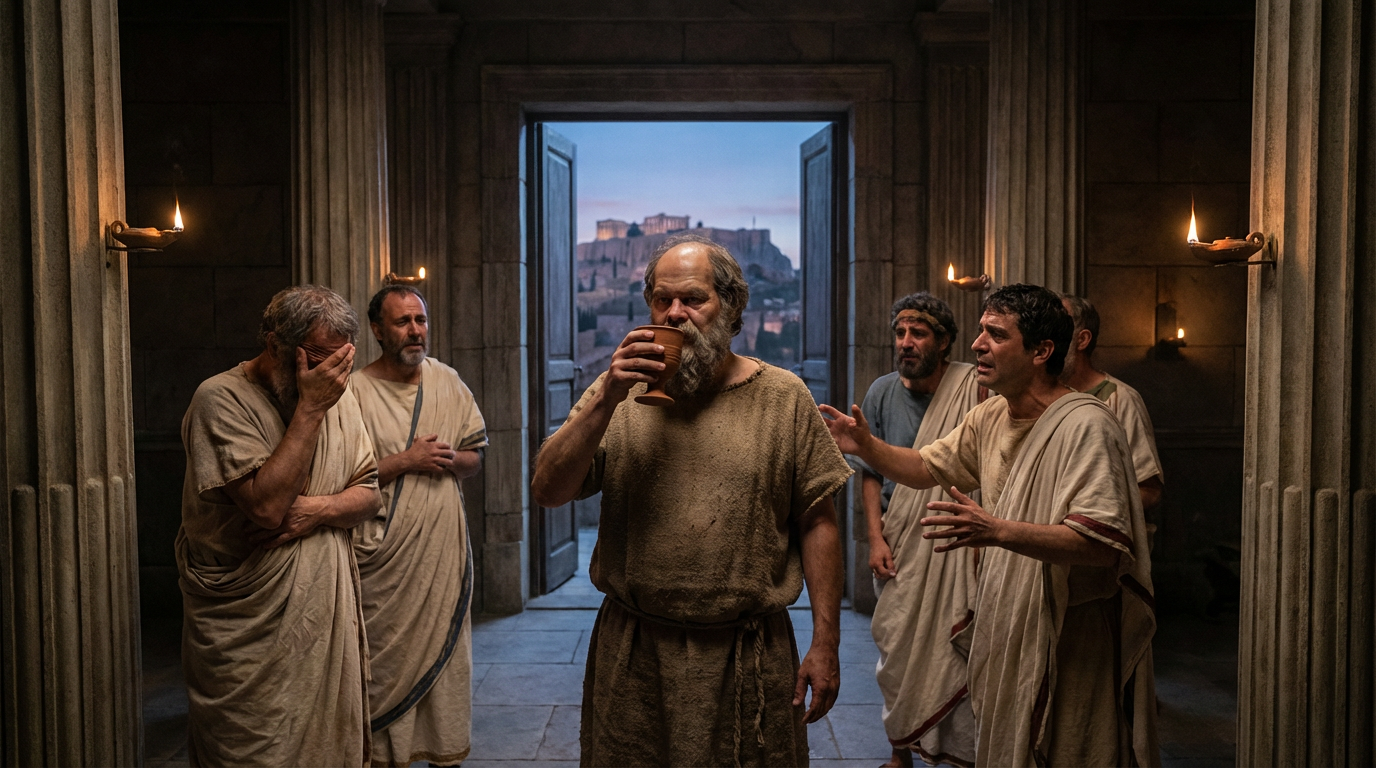
Awaiting execution after a religious delay, Socrates refused a plan orchestrated by his friend Crito to escape from prison. He argued that to flee would be to violate the Laws of Athens, which had nurtured him, and would destroy the principled stance of his life. He died by drinking a cup of poison hemlock, calmly discussing the immortality of the soul with his friends until the numbness reached his heart.
The Examined Life: Core Tenets of Socratic Philosophy
While we cannot systematize a “Socratic doctrine,” several core methods and themes emerge consistently from the portraits, particularly Plato’s early dialogues.
- The Socratic Method (Elenchus): This is not a means of imparting knowledge but a dialectical technique for exposing inconsistency. Socrates would ask for a definition (e.g., “What is piety?” in Euthyphro). Through a series of short questions, he would show that his interlocutor’s beliefs were contradictory, leading not to a final answer but to aporia—a state of productive perplexity. The goal was to clear away arrogant false knowledge to make room for genuine inquiry.
- Socratic Ignorance: The famous declaration “I know that I know nothing” is the cornerstone. This is not simple skepticism but an intellectual humility that recognizes the difficulty of defining essential ethical concepts. It is the necessary precondition for wisdom.
- Ethical Intellectualism: Socrates tightly linked knowledge, virtue, and happiness. He held that no one errs willingly. If people truly know what is good, they will inevitably do it. Evil action, therefore, is always a product of ignorance, a mistake in moral calculation. From this flows the unity of virtue: courage, piety, and justice are all forms of knowledge about the good.
- The Care of the Soul: For Socrates, the primary concern of life is not wealth, reputation, or the body, but the psyche (soul). Virtue is the soul’s health, and vice is its disease. Philosophical dialogue is the therapy.
- The Daimonion: This personal “divine sign” was an inner voice that only ever dissuaded Socrates, never positively directed him. It represents an intuitive, non-rational check on his actions, complicating the view of him as a pure rationalist.
- Politics and Religion: Socrates was critical of Athenian democracy’s reliance on rhetoric and mass opinion, favoring rule by knowledge. His religious views were unorthodox; he prioritized moral reasoning over ritual, suggesting in the Euthyphro dilemma that the gods love piety because it is good, not that piety is good simply because the gods love it.
The Immortal Gadfly: The Enduring Legacy of Socrates
Socrates’s death was the birth of his legend. His immediate disciples founded influential schools: Antisthenes inspired the ascetic Cynics; Aristippus founded the pleasure-oriented Cyrenaics; Plato established the Academy, from which Aristotle (Plato’s student) would later derive his own philosophy. The Stoics revered him as a model of ethical fortitude.
In the medieval world, Islamic scholars like Al-Kindi adapted Socratic thought within a monotheistic framework. During the Renaissance, humanists like Marsilio Ficino saw in Socrates a pre-Christian sage.
Modern philosophy is deeply engaged with his legacy. Kierkegaard wrote his dissertation on Socratic irony, seeing him as an existential figure who lived his truth. Nietzsche, conversely, blamed Socrates for inaugurating a life-denying rationalism that crippled Western culture. In the 20th century, thinkers like Karl Popper saw in Socrates the champion of the “open society” and critical individual, while Leo Strauss delved into the political tensions in his thought.
Beyond academia, Socrates remains the archetype of the thinker who stays true to his principles at the cost of his life, the teacher who questions everything, and the martyr for free speech and conscience. His silhouette is recognizable in art, from Jacques-Louis David’s neoclassical painting The Death of Socrates to modern references in law and education.
Conclusion: The Ghost That Haunts the Western Mind
Socrates is the ghost that haunts the Western mind. He is not a philosopher we can summarize with a list of tenets, but an activity—a relentless, discomforting, and vital activity of questioning. He turned philosophy “from the study of the heavens to the study of human affairs,” and in doing so, gave us a tool for navigating the moral complexity of existence. The trial of Socrates is not merely a historical miscarriage of justice; it is the dramatic encapsulation of the eternal conflict between the questioning individual and the conformist state, between established dogma and disruptive inquiry. He drank the hemlock, but his method of challenging assumptions, his insistence on defining our terms, and his courage in facing the consequences of his intellectual integrity remain the most potent antidotes to intellectual laziness and moral complacency. To engage with Socrates is to accept his gadfly’s sting, and to begin, however tentatively, to examine a life.

Aristophanes. (423 BCE/1998). Clouds (P. Meineck, Trans.). Hackett Publishing.
Brickhouse, T. C., & Smith, N. D. (1994). Plato’s Socrates. Oxford University Press.
Guthrie, W. K. C. (1971). Socrates. Cambridge University Press.
Plato. (c. 399-347 BCE/1997). Complete works (J. M. Cooper, Ed.). Hackett Publishing.
Popper, K. R. (1945). The open society and its enemies, Vol. 1: The spell of Plato. Routledge.
Strauss, L. (1989). Studies in Platonic political philosophy. University of Chicago Press.
Vlastos, G. (1991). Socrates: Ironist and moral philosopher. Cornell University Press.
Leave a Reply