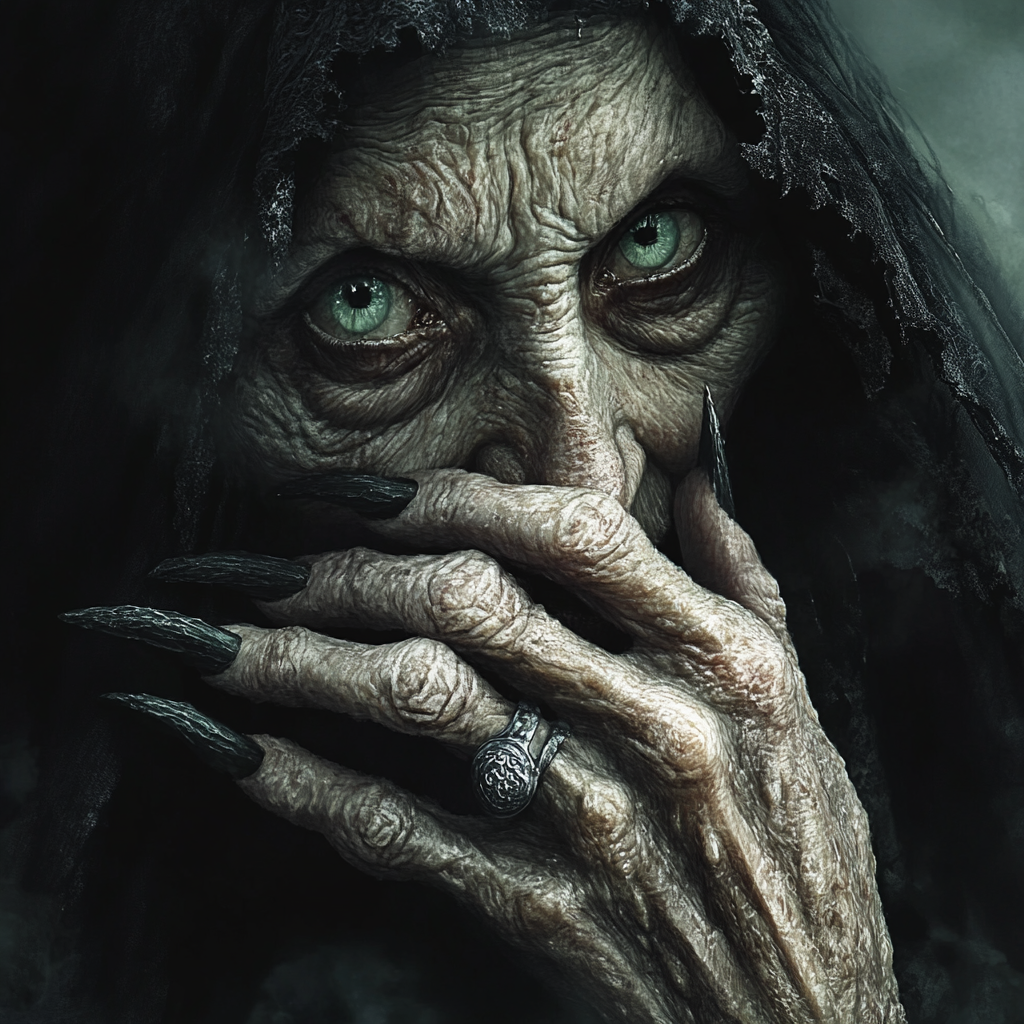

Her talons rip the soil she thrust to her nose, a heap of viscous dirt.
The scent is fresh.
She rips at the moist silt as black water surges into the hallow. Nestled amongst the taupe flesh is a small vessel, like a pearl.
Her gnarled hands quiver, stroking the moss on her withered fingers.
It has been too long.
She places the tiny object into her cloak and treks towards a modest cabin concealed by vines. Mustering strength to place the key into the void, she sits by the hearth for a stage, thinking of the preparations.
“So much work,” she mutters.
She looks down at the aged hands slathered in liver spots and burns, imagining them as delicate, cool porcelain. Rising, her legs collapse beneath the weight of rot and pumice, gripping the edge of a cupboard. Between thick, dusted urns, she grabs her grimoire.
She rifles through yellow-stained pages of brews for malice, greed, and avarice, stopping upon a page written by Kaida herself, the destroyer. “Desire is the drink of Hemlock” is written in red ink. Scribbles.
“Woe to be a God–never ripe for the fickle taste of Death’s tongue,” her husband once remarked.
The copper pot’s rabid sputter alarms her, and she runs to pull it from the small fire.
No drop must be wasted.
The opal jar, still covered by sod, sits on the top rack. She reaches for the precious thing, longing to kiss it. So dear is this item hidden within stone.
She clasps the lid in her hands and twists until a muffled pop signals her success.
The almsgiver wrapped the small black lock of hair in a scrap of white linen, which she unwraps carefully. She hobbles towards the russet pot and drops the cuttings of hair into the rumbling porridge. The ambrosial spice of youth fills her nostrils and tingles her slow-moving blood.
Would it work?
Nothing would be certain until Juniper has a taste. There is a green tinge to the mixture she has not seen in some time, but she musters to fight back that deceptive emotion–hope.
Was this the color of triumph?
The sludge ripens and darkens to a forest green that matches her saggy flesh. She rubs the tops of her hands, stopping and feeling foolish.
When has sin wiped away so easily?
She prepares to travel with her cooling stew, tripping over a besom of dried pungent herbs. Horror, anger, and rage were slung at the soulless object. The pot falls from her hands and splashes upon the newly laid rushes.
Her scream is primal—raw. She falls to her knees, which shoots a sharp pain along her crooked spine, but it does not match this sting of defeat. She reaches for the pot and prepares to toss the empty cauldron upon the bowing shelf when, to her delight, a fair amount of serum is left in the copper pot.
This could work.
She wipes away her tears with her hand, grabbing onto anything that will help her to her feet. The sun is setting.
I must hurry.
There was so little time that she did not bother to lock her door—a dangerous decision considering the reputation of these woods. She had no choice. She was sure she was too late—that she would come upon a fossil of a tree—crumbling ash. She is sure she would hear the mocking laugh of her stepmother Isaura or the manic groan of Pesta.
Even in light, this forest is dark. The old woman trips and stumbles on vines and upturned roots. She is paranoid. That is her birthright, believing that it is her stepmother who pulls and pokes at her.
Under her breath, the old woman curses her father and abhors the witch. She curses the madness that destroyed her family and annihilated her siblings.
A great moan startles her, and she looks to find the source.
Juniper.
Juniper sleeps and creates such a noise that some would believe it is the winds barreling down from the eastern gorge.
“Hello, my dear,” she whispers. Pressing her lips against the trunk of the tree.
She hovers the porridge beneath a small notch in the thick wood and watches as red almond eyes emerge from the bark. Juniper flutters to life.
“I have brought you something–nourishment.”
The reply was only a whimper as the tree shut her eyes.
The old woman presses the cauldron to her crackled lips, urging Juniper to partake.
“Please.”
Juniper drops blackened fruit from her drooping limbs, rancid figs with the face of the former donor. “Look how weak you have become?”
Juniper peaks from her wooden folds. Her mouth opens.
“You must drink it all, and then you will be strong, and I will be strong.” Juniper drinks. The old woman strokes the bark, urging the tree to drink more, anticipating the change. Yet nothing happens.
Could I have been deceived once more?
She thinks to purge the village with fire. She seethes with hate, imaging crushing the high wall said to be impenetrable. I would show them impenetrable–unyeilding might. This feeling festers until she remembers something. Small, yet significant. The words. The words. “How foolish can I be?” She says with a slight cackle.
She stood before Juniper, raised her hands towards the gods no longer there, and spoke the words.
Little precious, little one
Nimble tooth and olive tongue
Fankle wart and garlen goose
Finder’s keepers, lips be loose.
The old woman witnessed rotten fruit transformed into succulent figs—ripe, dried branches coarse with enticing greenery. Each held the engraved face of the donor, though each was slightly different from the next. Some had hair as red as blood, others blond, brown, or black as night. The same could be said for the eyes—all colors except for that peculiar shade of emerald green, a color that would have given her away.
“So many choices,” she mused. Finally, deciding not to stray from the looks she had grown accustomed to, she plucked the fruit with eyes of amber and hair of pitch and devoured it. She dropped the pit upon the floor, and the earth consumed it. Her hands became a smoky tinge of first light, a shade of luna, so smooth were they.
If only this could last.
A grackle sat on a broken oak branch at the edge of her sight. Its eyes set upon her–so cold–so green. The bird opens her mangy wings, leaps from its perch, and ascends before the old woman can notice. “Daughter–daughter–what has become of you?”
The voice startles her, not because of its volume but of its owner. It is Titus, her father. Titus was the King of Cronus, an empire for the gods, but now he was, as she was, a wanderer, an avenger, an outcast. Twice, he calls her, and twice, she plunges deeper into the thickets. The old woman peers behind the scented leaves of her beloved Juniper. Her father neared, so close was he that vines withered above her. Death followed him, for he was death.
Panic overcame the old woman.
If he were to touch her–Juniper–then it was finished–she would be finished.
The crone would leave, transform into a jay, but she knew he would find her. He would not give up. The curse Isaura placed upon him was his burden of falling in love with the old woman’s mother and bearing children.
*
Titus, King of the Gods, had the will of a god and the soul of a man. He chased sirens in Porrus and
stalked yews for bare-breasted dryads. He sat by temples adorned to his wife, disguised himself as a penitent, a widower, a returning soldier. He lured in the kind and foolish, seducing them, returning them as disgraced former maids.
He didn’t care.
When his will to hunt had passed, he would saunter down the long gilded hall, encrusted with rubies– emeralds and diamonds, picked by the prisoners sentenced to serve the fickle whims of the immortals. The beasts growled at him, which brought a defiant smirk upon his face.
One touch and I could kill you, he thought. The two beasts sat at the end of the hall, guarding the Queen’s quarters. They were a present to her. A gift to ease his last indiscretions. She had noticed them, newly born at the home of his younger brother, who wished to get rid of the ugly things, as he called them. At the time, Titus, disgusted to harbor anything his brother had touched, said with a scowl–” No.
That was that,” he snapped at his wife, both knowing that it was never so. She would wait until he faltered, and she would have her prize.
Both these creatures, still infants, had the heads of majestic lions. The mane of a pack leader, the devourer of the most significant portion. Their coat was a rich auburn that covered the extremity of a bear. Its muscles were easily seen beneath the slick mound of fur as they watched the god pose in front of the scalloped door. His hand hovered before knocking. He swallowed harshly, unable to rid himself of the taste of mercury lingering in his mouth. Titus attempted to back away–to leave, which made one of the beasts let out a growl–a warning shot–to step no further.
Titus gave the creature that submitted to a kitten a long look.
He rapped upon the iron door and waited till the doors would open. He knew that it would be a minute before this action would occur. The Queen desiring to have her husband be reminded where the true power lay. By law, he was in charge–his wife was to submit to her lord, but for anyone married to be bound for a sentence of eternity to a scornful wife seemed unformidable.
Slowly, the door opens by the hands of white-haired nymphs. The blue of their skin sparkled under the low hum of a few burning candles. They coyly dodged the quick, playful glances of the returning King. At her desk, Isaura pulls the bronze brush from her lady’s hands and strokes her long green tresses. She hears his entrance, slightly turning, tilting her head in the direction he stands. With each moment of silence that passed, he felt smaller and smaller. He wished she would yell at him–subscribe to the dance they had always danced–so he could be back to more–pressing matters. She lifted her hand in the air–a sign that her maidens may leave. The last one–new to the court, blushed heavily as the King gave a quick wink upon the realization she studied him. The sound of the door closing with a small click–instantly brought Isaura to action. She threw her brush at him. He dodged, picking it up. “Leave it,” she shouted. He would not be counseled as a boy, not entirely. He placed the brush in front of her–as she continued to stare into her mirror. “Say something, woman.”
She swerved in her seat, folding her arms. “What must I say that I have not said to you so many times before?”
He shook his head, a false sense of defeat and remorse. He hoped this would be enough. He bowed his head, glad that no others were to see the King upon trial. “I-am-sorry-love–”
“Love? Love? Don’t dare use the words you speak to your whores. No, I am your Queen–“
“I am sorry, my queen–I cannot help myself–these women–they tease me–torment me–underneath this crown lies a feeble heart for love–women.”
“Is that your excuse–you are weak?”
“I did not say I was weak–I said I am weak when it comes to women–.”
“Then you are weak–easily swayed by any fleck of interest. A woman can fawn upon you and cut your throat in your sleep, but you can be comforted you died for love.” She laughed.
“Gods cannot die–.”
“You know that is not entirely true. What if I were to find it? Kaida’s dagger-soaked by her blessed blood. Would you sleep so well at night? Would you go about the city-states lurking for whores so quickly, or would you be afraid–fearful that anyone of these doe-eyed maidens has been prompted by me–tell them your weakness. Love him. Love him till he is insatiated in it, and as you all sleep–wrapped so deep in his strong, viral arms–take the dagger that I have given you and kill the god.” She laughed a great laugh–that enraged him. He grabbed her wrist.
“You will not threaten me.”
She pulled away from him—she was stronger than he imagined. “I will do as I like—and I do not threaten,” she stared into her polished bronze. “Cross me again and see that you have sealed your fate.” She was a snake—a poisonous asp. Titus knew not to poke at such a creature. The prodigal husband fell to his knees, pleading for forgiveness. Isaura refused to look at him. It was certain the Queen knew this to be a lie, and she would act accordingly. She once told her servants, “The King’s vows were written in ice— mine in stone.”
*
Harolde’s curse hung over King Arron’s family name—Attaria, like a slow-tightening noose.
Long ago, before they were kings and sang the songs of their warriors, the Attarian clans were simple farmers and shepherds.
Here in this land were two brothers named Harolde and Artur. They were shepherds. One day in “The Season of Emergence,” the brothers saw a great light in the sky. Then a crash. At the center was a small bird. On closer observation, a blue jay. Suddenly, the bird transformed into a woman. She bore the tattoo of Cronus on her right hand. It was Seris. Goddess of the moon. First born of Titus. Startled, she woke up quickly, stepping back from the two men who bowed in fear and reverence.
Seris transformed by holding her hand above her head and slowly bringing it down the full of her figure. She was dressed in the crown of the moon encased by the gilded horns of the sacred bull. Her navy hair was separated and twisted, secured by ribbons of gold. She wore a tight-fitting tunic made from gold and silver cloth.
There was no time for the goddess to explain the incoming danger, for heavy footsteps were heard. Looking up, the men saw the image of a large living statue made of jade walking from the sky on an unseen staircase.
“Hold on to me, ” she ordered with the voice of an echo. The fearful youth did so, and the group of three appeared in a cavern. Seris’s body created light in the darkness.
The giant walked the earth for three days, anxiously looking for his missing daughter. On the third night, Seris made the two men fall asleep with her singing. She came to Artur in his dream. “Artur, you must wear the pelt of the sheep. My father will think you are one of the sheep that graze your land and devour you whole. Inside his stomach, you must piece his heart with this blade. It is Kaida’s blade. The only thing that can destroy a god. Duty-bound Artur created a cloak made from the wool of his sheep and waited in the field.
Artur held his breath as he heard the footsteps stop frightfully near.
The giant picked up the man in sheep’s clothing and threw him into the pit of his stomach. He listened to the beat of Titus’s heart echo around the darkness. He followed the beat in the blackness that grew louder. There he beheld it, the large mass of throbbing flesh. By faith and for the love of the goddess, he dug deep into Titus’s heart. A loud scream erupted. Artur felt around the jagged walls and began to stab and cut away at the jade.
Finally, he began to see stretches of light appearing through the god’s wounds. Artur’s environment quickly turned into stone. When he had made a big enough opening, he pushed from the stomach of the jade king.
The giant—the King of Cronus, the father of Seris—Titus fell where he stood. The great stone of the slain god created a gorge. Upon hearing the news, Isaura, the goddess of the sky and the wife of Titus began to cry in despair. Her tears fell as rain filled the gorge where the King lay. This gorge became the river Sil, and Artur, now King, erected a temple where all sovereigns are crowned to this day.
As years passed, Harolde wondered why the goddess had not chosen him for the task and why he was not King.
Harolde wondered many things.
Artur decided that the two should rule together, against Seris’s warning. Whose green eyes flashed with a rage that made the young king gulp in fear. Yet Artur would not listen.
Now, in the depths of the blackest of nights, Harolde dismissed King Artur’s guards and, for a moment, watched his brother sleep. He took a pillow from his brother’s bed and smothered him.
When Seris learned what King Harolde had done, she cursed the bloodline for eternity, swearing that the end of the world would come by the sign of Kaida, the goddess of destruction. Death will come by the child of jade,” Seris hissed before leaving the murderous King.
The King. The new King, Harolde, sought that no such child would reside within the realms of his kingdom. Not a single child was seen with such eyes in years. Through deeds, other deeds, not to mention, Harolde made sure of this. And yet little did one know a child existed, a child of jade. And Seris, the castoff goddess, was determined to find her.
Leave a Reply