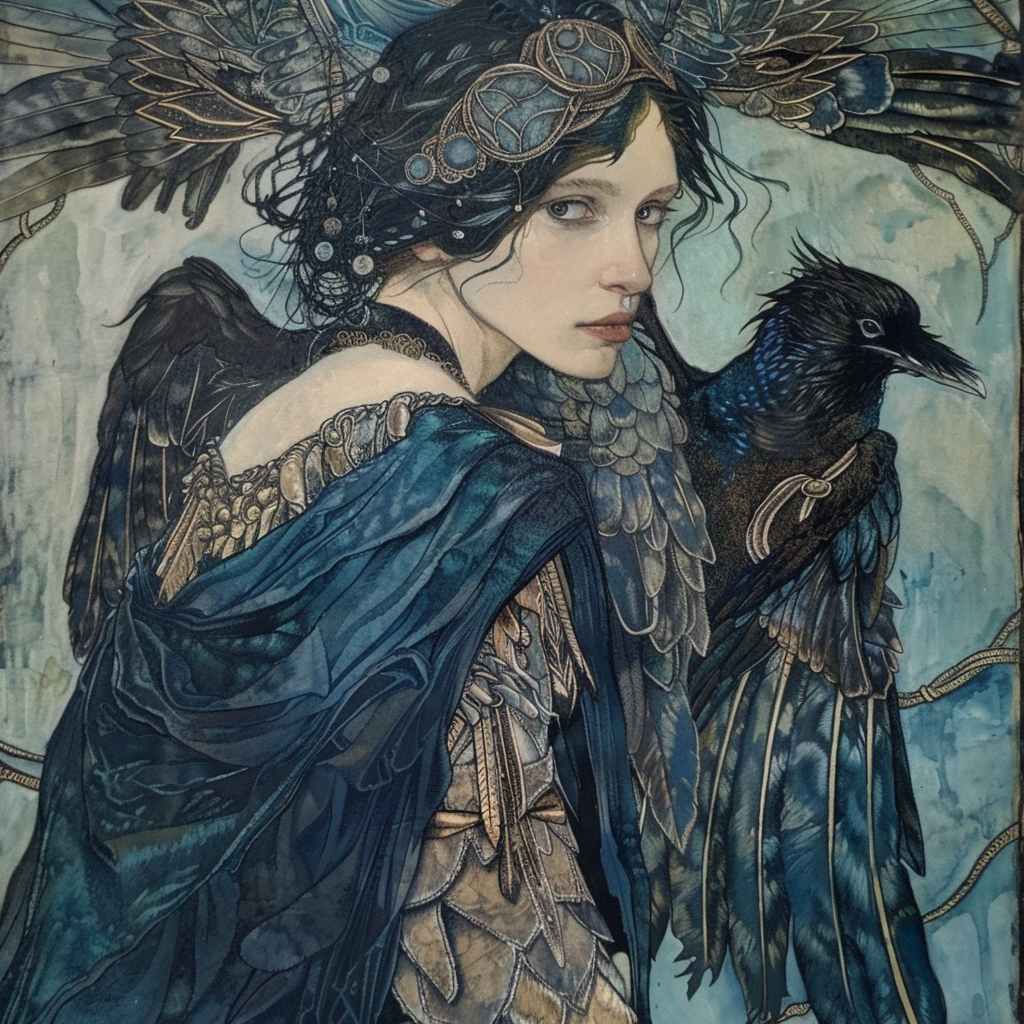

In shadows deep, the Morrigan does arise,
Goddess of power, with fierce and ancient eyes.
Her form takes flight, a raven dark and wise,
Guiding warriors with destinies she implies.
In battle’s midst, her presence weaves,
Veil of fear, where bravery perceives,
She tests the brave, their worth she retrieves,
For only the worthy, her favor she conceives.
Transformation is her mystic art,
From crow to hag, her essence does impart,
Life’s cycles she weaves, from end to start,
The Morrigan, a goddess, forever in our heart.
Sovereignty she holds within her gaze,
Divine right to rule, in her majestic ways,
Her judgment fair, in the land she surveys,
The Morrigan, embodiment of Celtic praise.
Oh, enigmatic Morrigan, goddess of old,
In Celtic myths and lore, your tales are told,
Power, transformation, battles unfold,
May your spirit forever be strong and bold.
The Bard of the Morrigan

The Morrígan or Mórrígan, also known as Morrígu, is a figure from Irish mythology. She has been called the “great queen,” “nightmare queen,” “queen of the dead,” or the “phantom queen.” The dispute over her name’s meaning comes from the location of the accent mark called fada. Unfortunately, with the irregularity of Old Irish spelling, her name mor could mean “phantom” or “great, immense.”
I first heard of the Morrigan in Marian Zimmer Bradley’s The Mists of Avalon, Book 1. Set against the misty lands of Avalon, the Morrigan is a mysterious being that colors the actions and choices of the heroes and heroines of Camelot. The author suggests a connection between Morgan le Fay, who is depicted as King Arthur’s half-sister, and the Celtic goddess the Morrigan. Connecting the Morrigan and Morgan le Fay is not new. Scholars, for some time, have attempted to make the connection, primarily through the proximity in names. Morgan le fay, known as Morgan the fairy, first appears in literature in Geoffrey of Monmouth’s 12th-century Vita Merlini. Here, she has no blood ties to Arthur. As a goddess-like figure, she takes to her ethereal land of Avalon following his mortal wound in a battle. In some Arthurian texts, such as Sir Gawain and the Green Knight, Morgan is portrayed as a hag whose actions set a bloody trail of events that lead the hero into numerous instances of danger. Morgan is also depicted as a seductress, much like the older legends of the Morrigan, and has innumerable lovers whom she might even abduct for this purpose (as in some stories of Lancelot and Ogier the Dane, among others). The character is frequently depicted as wielding power over others to achieve her own purposes, allowing those actions to play out over time to the benefit or detriment of other characters.
If my research stopped there, I would be convinced that the Morrigan and Morgan from Arthurian legend were identical. However, there is compelling evidence that this is likely not the case. The evidence starts in the name. The etymology of “Morgan” in Welsh is derived from root words associated with the sea. While the “Morrígan” has its roots in Old Irish, meaning “terror” or possibly it means “greatness.”
A little nugget of oversharing: While researching this ancient goddess, I began to have strange things happen to me. I went to my favorite taco shop to pick up a few breakfast tacos when a giant crow tried to land on my shoulder. It scared me for sure. And yes, my logical mind is saying coincidence—yes, but part of me. For a moment, I thought, the Morrigan? One form associated with this goddess is the form of a blackbird, primarily a crow. I will go further on this topic, but let’s return to my next thought. For me to understand the goddess. I had to strip away contemporary versions of her and go back in time. The earliest sources for the Morrigan are glosses in Latin manuscripts and glossaries (collections of glosses).
O’Mulconry’s Glossary, written in the 7th century, says that Macha is one of the three morrígna. In Celtic mythology, a goddess is often represented by a trio. Thus, she was known as Ernmas, Delbeath’s daughter, and Macha and Badb’s sister. And also as part of a sovereignty trio of Eriu, Fotla, and Banba. According to the Lebor Gabala Erenn: “Ernmas had other daughters, Badb, and Macha, and Morrigu, whose name was Anand.” Another version says, “Delbaeth… has three daughters, the famous war furies Badb, Macha, and Morrigu, sometimes called Anand or Danand. Modern forms of the names are Anu and Danu. Some believe the goddess Áine is Macha in disguise. However, there is little evidence that this is the case, aside from the close spelling of Anu and Áine.
The Morrigan is said to be the wife of the Dagda and has one son, Mechi. The Dagda is not the father; however, the father is unknown. According to the Dinshenchas, Mac Cécht killed him on the River Barrow because it was revealed that he had three hearts. Within each heart, each possessed a serpent, which could have caused disaster for Ireland if they were not stopped. Mac Cécht burned him and threw the ashes into the river.
Sources vary on the number of offspring the Morrigan had. One version states that she had a daughter named Adair with the Dagda. Other sources say she had 26 daughters and sons, all warriors.
This next part will become confusing, but bear with me. Several trios of goddesses have been titled the Morrigan. Thus, the Morrigan name is used as a title rather than a name throughout several regions. Here are a few examples, the Morrigan had two sisters, also called Morrigan. Remember the trio of Morrigu, Badb, and Macha? As mentioned earlier, according to the Sanas Cormac, this trio was known as the three Morrigans. In addition, the goddesses Fea and Nemain are also called Morrigan. Which can be interchanged with the previous names.
The Morrigan is famous for being a shape-shifter and has appeared in several necessary forms. The Morrígan is mainly associated with war and fate and is often interpreted as a “war goddess.” In the first, Cath Maige Tuired the Morrigan in the form of three sisters smite the Fir Bolg and the Fomorians with magic, raising pillars of fire on the battlefields to aid the Tuatha Dé Danann. The Banshenchus calls her “Morrigan, powerful in sorcery.” This is undeniable, given the claims that she weakened the Fomorian King Indech in the Cath Maige Tuired. She is also recognized as a seer. At the end of the great battle, she gave two prophecies, one of good things to come and doom. Her premonitions typically were associated with the violent, untimely death of a soldier. Some say that she even revels in the deaths. Others say she merely gives omens of those who have died. Thus, the connection with the banshee appears. Folklorist Patricia Lysaght writes, “In certain areas of Ireland, this supernatural being is, in addition to the name banshee, also called the badhb.” Soldiers awaiting their fates on blood-soaked fields spoke of seeing a crow flying overhead. For some, it was a sign of hope. The fearsome fighter, once asked by Lugh what she would contribute to the fight, replied, “Not hard to say…’I have stood fast; I shall pursue what was watched; I will be able to kill; I will be able to destroy those who might be subdued.” Others who witnessed the sight of the crow may think of the woman. The woman on the battlefield washing bloody armor foretelling imminent death.
Although the Morrigan is known more as a war goddess, Máire Herbert argues that “war per se is not a primary aspect of the role of the goddess.” Herbert suggests that “her activities have a tutelary character, the overseer of land, stock, and society. Her shape-shifting expresses her affinity with the whole living universe.” This notion is highlighted in the Cath Maige Tuired, where the Morrigan is “a protectress of her people’s interests.”
The earliest narrative depictions of the Morrigan appear in stories of the Ulster Cycle. It is interesting to note that she is depicted as an individual. She has a love-hate relationship with the hero Cúchulainn. In the Táin Bó Regamna (“The Cattle Raid of Regamain“), Cúchulainn notices a woman driving a heifer from his land. He does not realize it is the Morrigan. In anger, he insults her, preparing to attack, but instantly, she transforms into a blackbird and rests on a nearby tree. He realizes this is the goddess and attempts to apologize. Noting had he known it was she, he would not have acted in such a manner.
Insulted by his lack of honor towards her and not recognizing her sovereignty, she replies with an omen. He will die in the next battle. She tells him, “It is at the guarding of thy death that I am and shall be.” The next battle is depicted in the story Táin Bó Cúailnge (“The Cattle Raid of Cooley“); Queen Medb of Connacht launches an invasion of Ulster to steal the bull Donn Cuailnge; Cúchulainn defends Ulster against Medb’s warriors. Between combat, the Morrigan appears to him as a beautiful woman, offering her love and aid. He rejects her, and in retaliation, she appears in three forms in the next battle. First, as an eel that trips him, then as a wolf who stampedes cattle across the ford, and lastly, as she predicted, as a white, red-eared heifer leading the stampede. However, the story’s hero, Cúchulainn, defeats her each time.
Defeated, she appears to him as an old woman bearing the three wounds when in animal form. She now milks a cow. She gives Cúchulainn three drinks of milk. He blesses her with each drink, and her wounds are healed. Realizing the old woman is the Morrigan, he is enraged. Regretting that he gave her his blessing. “She gave him milk from the third teat, and her leg was healed. ‘You told me once,’ she said,’ that you would never heal me.’ ‘Had I known it was you,’ said Cúchulainn, ‘I never would have.’” Once more, she gives the omen of his impending death.
At the final battle, she is seen in dream visions by the leaders of the armies, chanting incitements. Cúchulainn rides to meet his enemies and meets the Morrigan as a hag. She washes his bloody armor, a death omen. As the story progresses, he is mortally wounded. While his entrails hang from his body, he ties himself to a standing stone so he may die upright. Not until a crow lands on his shoulder do his enemies believe he is dead.
The Shape-Shifting Goddess
The Morrigan is a shape-shifting goddess who appears in many forms. The most common form is that of a crow or raven, as shown in the stories of The Ulster Cycle. Other slightly less-known forms include a beautiful young woman, a hag, a wolf, an eel, or even a cow. She appears as a red-haired woman dressed in red riding in a chariot pulled by a single-legged red horse. Then, another time, as a naked gray-haired old woman at the battle of Mag Rath, she flew over the battlefield. Balancing on spears and the shields of soldiers on the battlefield.
The Morrigan has many locations in Ireland that are associated with or named after her. These sites can be visited to this day. Places such as the river ford, known as the “Bed of the Couple.” It’s named after the Samhain tryst she had with the Dagda from the Cath Maige Tuired. The Gort na Morrigna, the field of the Morrigan, in County Louth, and Fulacht na Morrigna, Morrigan’s Hearth, in County Tipperary, are named after her. In the Bóyne valley, the Mur na Morrigna, a mound of the Morrigan, and Da Chich na Morrigna, the Paps of the Morrigan, are more places known after the goddess. One of the places particularly associated with the Morrigan is the cave of Cruachan, also called Uaimh na gCait or Oweynagat (cave of cats). The place is mistakenly thought to mean the Cave of Cats, although it has nothing to do with cats. “Cath” is the Irish word for “battle,” so it should be called the battle cave. The Morrigan emerges from every Samhain’s darkness, driving out beasts before her. Young men used to descend into the cave to prove their manhood by challenging the Morrigan.
The cave has collected many names over thousands of years: the way of the fairies, the Sidhe-mound, and the entrance to the Otherworld. Monks named it the “Gates of Hell” during the medieval ages. On the beam reads an Ogham inscription, “Fraech son of Medb.” It speaks about Queen Medb, whose fort lies nearby and who strove so mightily with Cú Chulainn, but that is the story for another time.
The Morrigan, well, she is many things. War goddess. Battle siren, death omen. The shadow portion of our world. Yet, she is a complex goddess. That also lives in light, the mystery and wonder of this world. Victory, magic, and perhaps even sovereignty. This last part is still ambiguous due to conflicting etymologies and stories lost in time. The Celts told their stories orally. Passing tales of the Morrigan and other goddesses around the burning fires of Samhain. When the stories were finally put to pen, they were written through the lens of prejudice and ignorance from different cultures. They wrote the stories in their own way for many reasons and agendas.
Today, modern Pagans honor her in many ways and for many reasons. Some seek her wisdom for prophecy and magic. While others connect to her warrior side through hardship or the need for strength. Still, witches may look for her magic and the knowledge she holds.
While writing this post, I remembered a small memory I had forgotten. I was a military brat and moved often. At one particular school, they had one of the best libraries I had ever witnessed. I remember my eyes landing on this small, slightly worn hardback book. A great book was always home for me—my one constant. I read through the pages so quickly–too quickly. So soon that I paused. Put it away, subconsciously tying the reading of that book with my time in this new school. Then I got the message that, once again, we were moving. I took that book, handing begrudgingly the book I never got to finish. I remember the librarian handing it back and telling me to keep it. That was over thirty years. I have brought it with me at every move. Every new place. I have yet to finish reading. I smiled. Picking up my old friend, the smell of old ink and pages. Maybe that raven that frightened me was not the omen of fear but the siren of my past. To not tuck it away to be forgotten. To open it. Explore and embrace it. This blog has brought me back to that place. That old tattered book–titled “The Hounds of the Morrigan.”

The Mist of Avalon
In Marion Zimmer Bradley’s masterpiece, we see the tumult and adventures of Camelot’s court through the eyes of the women who bolstered the king’s rise and schemed for his fall. From their childhoods through the ultimate fulfillment of their destinies, we follow these women and the diverse cast of characters that surrounds them as the great Arthurian epic unfolds stunningly before us. As Morgaine and Gwenhwyfar struggle for control over the fate of Arthur’s kingdom, as the Knights of the Round Table take on their infamous quest, as Merlin and Viviane wield their magics for the future of Old Britain, the Isle of Avalon slips further into the impenetrable mists of memory, until the fissure between old and new worlds’ and old and new religions’ claims its most famous victim.
13.10 USD — Buy Now

The Morrigan: Celtic Goddess of Magick and Might Paperback
“She is the spirit of fury and peace, power and destruction, joy and terror,” writes author Courtney Weber. “She is warrior, queen, death omen, mother, murderer, lover, spy, conspirator, faery, shape-shifter, healer, and sometimes the living earth itself. A captivating contradiction: a demonic female who both haunts and heals; benevolent in one moment, ghastly the next, and kind the moment after that.”
The Morrigan is one of Pagan Ireland’s most famous—and notorious—goddesses. Her name translated as “phantom queen” or “great queen,” the Morrigan is famous for being a goddess of war, witchcraft and death, protection and retribution. This book also explores her patronage of motherhood, healing, shapeshifting, and the land. Classified among the Sidhe (fairies), the Morrigan dates back at least to Ireland’s Iron Age, but she is as modern as she is ancient―enjoying a growing contemporary and global following.
14.95 USD — Buy Now

Priestess of The Morrigan: Prayers, Rituals & Devotional Work to the Great Queen
Journey with the Great Queen to Deepen Your Devotion
Build a more personalized devotional practice and strengthen your relationship with the Morrigan using this profound book on enhancing your spiritual path. Through stories, prayers, and rituals for both groups and solitaries, Priestess of the Morrigan shows you how to better understand and serve the Great Queen―regardless of your gender.
Explore the true nature of the Morrigan, discover what it means to channel her voice, and learn about her role in prophecies and curse work. Create your own unique tradition with this book’s ritual-building advice and guidelines for developing a yearly cycle of celebrations. Stephanie Woodfield, a devotee to the Great Queen for over twenty years, uses her personal triumphs and challenges as beacons for your journey. This extraordinary book provides everything you need to deepen your spirituality and find victory and fulfillment along your path.
19.57 USD — Buy Now

Leave a Reply