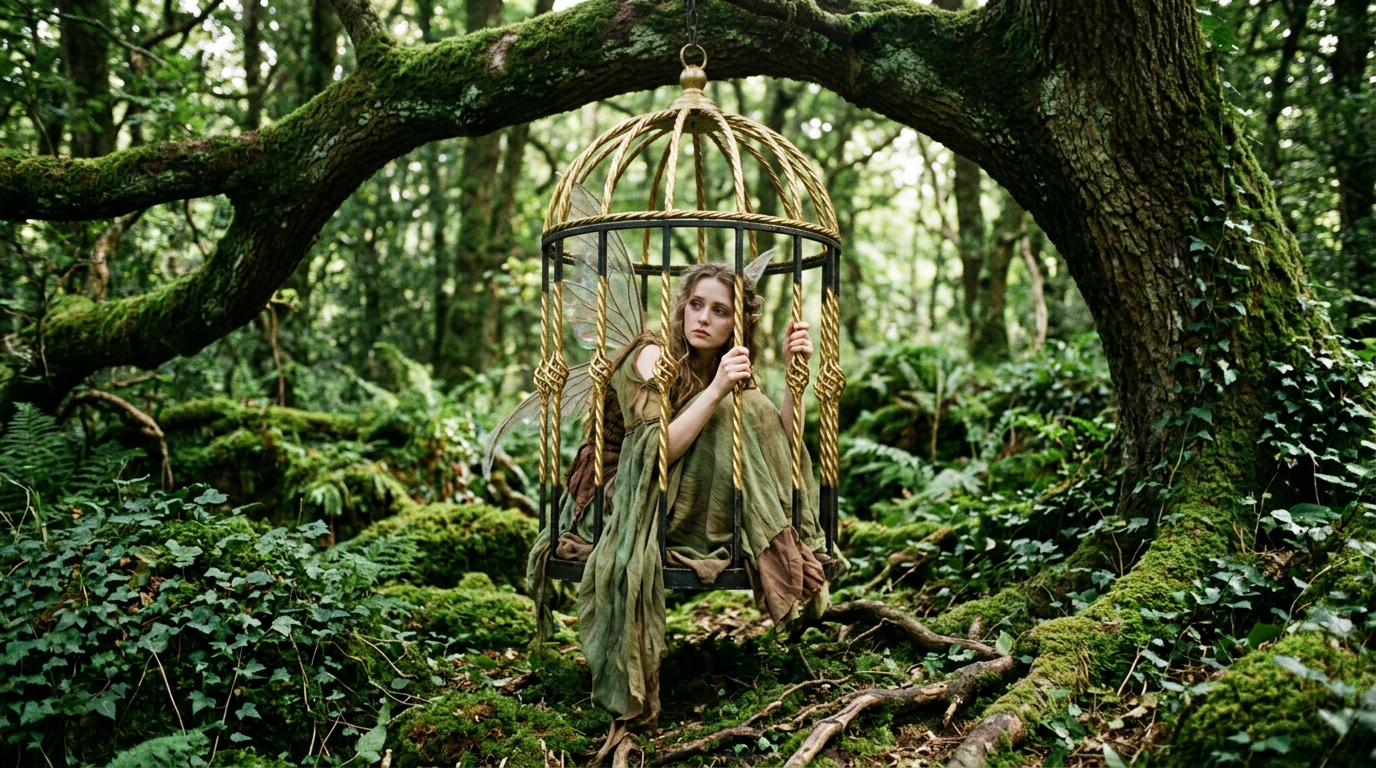
An archival study in the anthropology of the vanishing folk

There is a particular quality to the silence that gathers at the edge of a wood at dusk—a hush that is not the absence of sound but its withholding, as though the trees themselves have agreed to keep a secret. For the greater portion of human history, that silence was populated. It was understood to be inhabited by presences neither wholly benevolent nor entirely malign, beings older than the churches and the plows and the property lines, whose favor was courted and whose wrath was feared in equal and trembling measure. That these presences have since been reduced to a saccharine figurine hovering above a plastic castle, wings aglitter, is one of the more remarkable acts of cultural taming in the Western imagination. This field study examines it.
The discerning reader is invited to consider the fairy not as a whimsy but as an artifact—a vestige of belief that has been handled, worn smooth, repainted, and repackaged across some two thousand years of continuous human anxiety. To trace the arc of the fae from primordial being to the winged sprite of the nursery is to trace, in miniature, the entire history of how humanity has related to what it cannot see, cannot control, and cannot quite bring itself to disbelieve.
The Etymology of Fate
Before the fairy was a creature, it was a condition. The word itself carries the fingerprints of its origin, and those fingerprints lead backward, unerringly, to the concept of destiny.
The English fairy descends through Old French faerie, which denoted not an individual being but a state or realm—the enchantment itself, the quality of the otherworldly—derived from fae or fay. This, in turn, traces to the Latin fata, the plural of fatum, “that which is spoken,” and, by extension, fate. The Fata were the Fates, those three grim spinners who measured and severed the thread of every mortal life: Nona, Decuma, and Morta in the Roman conception; the Moirai—Clotho, Lachesis, and Atropos—among the Greeks. The connection is not incidental ornamentation. It is the load-bearing wall of the entire edifice. The earliest conceptual ancestor of the fairy was not a delicate thing with gossamer wings. It was the personification of the inescapable. To speak of the fae, in the deepest etymological sense, is to speak of the powers that determine when a child shall be born, whether the crops shall fail, and how a man shall die.
This inheritance explains a great deal about the character of the folk as they appear in the older strata of belief. The fairy of the medieval and early modern imagination retained the moral neutrality—that is, the terrifying indifference—of fate itself. These beings operated by laws that predated human ethics and owed nothing to human comfort.
The Deep Ancestry: Gods Unseated and Dead Unburied
Anthropologists and folklorists have long proposed several competing, and not mutually exclusive, theories for the ultimate origin of fairy belief. Each carries the melancholy weight of something displaced.
The first and most enduring is the demoted deity theory. As Christianity advanced across the pagan territories of Europe, it did not so much erase the old gods as demote them. The bright divinities of the pre-Christian pantheons—the Tuatha Dé Danann of Ireland foremost among them—were not permitted to survive as objects of worship, but neither did they entirely die. They were driven underground, quite literally, into the sídhe: the ancient burial mounds and hollow hills that dot the Irish landscape. The Tuatha Dé Danann, that resplendent race of god-like beings who had ruled Ireland before the coming of the Milesians, were, according to the mythological cycles, defeated and consigned to the subterranean world. There they became the aos sí, the people of the mounds—the very same beings later English speakers would flatten into the diminutive “fairies.” A god unworshipped does not vanish. He merely grows strange, and hungry, and resentful of the memory that abandoned him.
The second theory locates the fairy among the dead. Across a vast swath of folk belief, the distinction between the fairy realm and the land of the departed is so porous it disappears. The fairy hills were burial mounds. The fairy host that rode through the night sky—the Sluagh of the Scottish Gaelic tradition—was understood in many districts to be composed of the restless dead, the unforgiven souls who could find rest in neither heaven nor hell. To be “taken by the fairies” was, in more than one regional understanding, a euphemism for death itself, or for that liminal state between living and dying in which a person wasted away while their true self was spirited elsewhere. This association lends the fae their profound melancholy. In this reading, they are the ache of every unburied grief, the presence felt in the room after the mourners have gone home.
The third theory, more rationalist and championed by certain nineteenth- and early twentieth-century scholars, proposed that fairy belief preserved the folk memory of a diminutive aboriginal people—a smaller, earlier population driven into hiding by taller invaders, surviving in the wild places and remembered, over centuries, as a secretive race of small folk who stole and traded and worked metal in the dark. This “pygmy theory,” most notably associated with the folklorist David MacRitchie, has fallen from scholarly favor, yet it retains a haunting plausibility as an explanation for the fae’s persistent association with the margins, the hidden, and the underground.
What unites these theories is a common atmosphere: the fairy is always a remnant. It is always what remains after something greater has passed—a god, a people, a beloved dead. The fae are the residue of loss, and this is why, for all their later trivialization, they never entirely relinquish their grip on the melancholy imagination.
The Terrible Neighbors: Fairy Belief in the Age of Faith
To the medieval and early modern mind—and this must be stated plainly, for the modern reader is inclined to condescend—fairies were not a matter of pleasant fancy. They were a genuine and pressing danger, woven into the practical fabric of daily existence with the same seriousness accorded to disease, weather, and the machinations of one’s living enemies.
Consider the vocabulary of avoidance. Across the Celtic and Germanic worlds, one did not speak of the fairies directly. To name a thing is to summon it, and to summon the fae was to invite catastrophe. Thus the elaborate architecture of euphemism: the Good Neighbors, the Good Folk, the Gentry, the Fair Family, Daoine Sídhe, Tylwyth Teg—”the Fair Family” in Welsh. These were not terms of endearment, but of propitiation, the nervous flattery one offers a powerful and unpredictable lord whose lands one is obliged to cross. The naming taboo reveals the true relationship: not affection, but wary and perpetual negotiation.
The practical consequences of this belief were extensive and grim. The failure of milk to churn into butter, the sudden lameness of livestock, the wasting illness of a healthy child—all could be attributed to fairy malice or fairy theft. Iron was hung above cradles and doorways, for cold iron was anathema to the folk, a bulwark of the human agricultural world against the older powers of the wild. Rowan and salt, the turning of a garment inside out, the recitation of prayers—these constituted a genuine defensive technology, a folk science of survival in a cosmos shared with beings of superior power and inscrutable motive.
Nowhere is the darkness of this belief more evident, or more tragic, than in the phenomenon of the changeling. The conviction that fairies stole human infants and left in their place a sickly fairy substitute—a changeling—provided a folk explanation for the sudden decline of a child who had seemed healthy, for congenital illness, for the developmental conditions that the pre-modern world had no other language to describe. The consequences were sometimes monstrous. To recover the “true” child, the changeling was to be tested, tormented, or driven out, and the historical record preserves instances in which suspected changelings—which is to say, ill or disabled human children, and sometimes adults—were subjected to cruelties that ended in death. The most notorious of these, the burning of Bridget Cleary in County Tipperary in 1895, occurred within living memory of the twentieth century, a testament to the sheer tenacity of the belief. Here the fairy is no gilded ornament. Here it is the shape grief, ignorance, and terror assumed when confronted with the inexplicable, and the price was paid in human flesh.
This, then, is the fairy in its mature and terrible form: a being of the borderlands, of dusk and dawn and the crossroads and the threshold, of Samhain and May Eve when the veil between worlds grew thin. A being who might reward the respectful with prosperity and blight the careless with ruin. A being whose realm ran on stolen time, where a night of dancing might consume a mortal century, and from whose feasts one dared not eat lest one be bound there forever. This last motif—the peril of fairy food—finds its most famous literary distillation in the pomegranate seeds of Persephone, and its echo across every tradition that warns the traveler to accept nothing from the hands of the Good Folk.
The Courts and Their Sovereigns
As fairy belief accreted over centuries, it developed an elaborate internal architecture, a sociology of the unseen that mirrored and inverted the human world. The perceptive collector will note that the fae were never a formless mass; they were a society, hierarchical and ceremonious, with sovereigns and subjects, courts and codes.
The division of the fairy world into the Seelie and Unseelie Courts, drawn primarily from Lowland Scottish tradition, most clearly expresses this structure. The Seelie Court—from an older word cognate with “blessed” or “happy”—comprised those fae inclined toward benevolence, or at least toward a rough reciprocity: they might aid mortals who treated them well and were slow, though not incapable, of taking offense. The Unseelie Court was another matter entirely: malevolent by disposition, they required no provocation to harm, descending upon the unwary traveler with the appetite of predators. Yet even this division resists the modern impulse toward clean moral categories, for the Seelie were quick to avenge slights, and no fairy of any court could be trusted to reason as a human reasons.
Above these courts presided figures of genuine grandeur. The Fairy Queen—whether the Irish Áine or Clíodhna, the medieval romance figure of the Queen of Elfland who spirited away Thomas the Rhymer for seven years, or the Mab and Titania later crystallized by literary hands—held a station of real sovereign power. Her king consort, Finvarra in the Irish tradition, ruled beside or beneath her. These were not delicate creatures. The Queen of Elfland who claimed True Thomas was a figure of overwhelming allure and danger, and her gift to him—a tongue that could not lie—was as much a curse as a blessing, for what society has ever welcomed the man who cannot flatter?
The Turning: How the Terrible Became the Tender
Here the chronicle reaches its central transformation, the great diminishment, and it is worth pausing to note that this was not a sudden event but a slow erosion, a wearing-away accomplished across three centuries by the combined agencies of literature, science, and commerce.
The first significant instrument of change was the Elizabethan stage. When Shakespeare turned his attention to the fae, he inherited a folk tradition of genuine dread and refashioned it for the entertainment of a sophisticated urban audience. In A Midsummer Night’s Dream, composed in the mid-1590s, the fairies of Oberon and Titania’s court retain traces of their older power—they command the weather, meddle in mortal love, and preside over a realm of genuine enchantment—yet they have been substantially domesticated, rendered ornamental and comedic. Puck, or Robin Goodfellow, descends from the genuinely feared household spirit of folk belief, a being who soured milk and led travelers astray, but Shakespeare’s Puck is mischievous rather than menacing, a source of merriment rather than terror. Most consequentially, Shakespeare’s Mercutio, in Romeo and Juliet, describes Queen Mab as a being “no bigger than an agate-stone,” and with this stroke the diminution—the literal shrinking—of the fairy begins in earnest. The fae had always been able to alter their size, but the fixing of them as small by default was a literary innovation with enormous consequences.
The seventeenth-century poets accelerated the process. Michael Drayton’s Nymphidia (1627) rendered the fairy court as an elaborate miniature, a realm of insects and flower-petals and gossamer, deliberately precious and self-consciously charming. The fairy was becoming a subject for wit and delicate description rather than for propitiation. The terrible neighbor was being reupholstered as a decorative conceit.
The second great instrument was, paradoxically, the advance of reason. The Enlightenment and the spread of literacy, scientific explanation, and agricultural and medical understanding steadily dismantled the practical function of fairy belief. When the failure of the butter could be attributed to bacteria and the child’s wasting to identifiable disease, the fairy lost its explanatory power. It was demoted from a working hypothesis about the operations of the cosmos to a quaint survival, a matter of superstition to be studied, collected, and gently patronized. The antiquarians and early folklorists who fanned out across the countryside in the eighteenth and nineteenth centuries to record fairy belief were, by the very act of recording it, embalming it. One does not collect what is still alive.
The Victorian Reclamation and the Gilded Cage
If the Enlightenment killed the fairy as a matter of belief, the Victorians resurrected it as a matter of taste—and in doing so, completed its transformation into the creature the modern world recognizes.
The nineteenth century witnessed an extraordinary efflorescence of fairy imagery, a phenomenon scholars have termed the fairy painting movement. Artists such as Richard Dadd—who painted his masterwork, The Fairy Feller’s Master-Stroke, while confined in the Bethlem and Broadmoor asylums after murdering his father—and Joseph Noel Paton and John Anster Fitzgerald produced canvases of hallucinatory density, teeming with tiny winged figures. It is a peculiar and telling irony that even at the height of the fairy’s sentimentalization, the genre attracted the disturbed and the visionary, as though the old darkness could not be entirely painted over. Dadd’s fairies, executed by a parricide in confinement, retain something of the uncanny that the age otherwise labored to suppress.
The wings, it must be noted, were largely a Victorian imposition. The fae of folk tradition did not, as a rule, possess insect wings; they flew, when they flew at all, by enchantment, by riding on stalks of ragwort or on the fairy wind. The gauzy butterfly and dragonfly wings that now seem inseparable from the fairy image were an artistic convention popularized in this period, borrowing from the era’s fascination with entomology and botanical illustration. The fairy was being crossed, aesthetically, with the butterfly—a creature of beauty, fragility, and above all, harmlessness.
Victorians also decisively relocated the fairy to the nursery. As childhood itself was being reconceived as a protected garden of innocence, the fairy was recruited as its guardian and ornament. The flower fairies, the tooth fairy, the fairy godmother of the sanitized fairy tale—these are Victorian and post-Victorian constructions, the fae rendered safe for children’s consumption. The being that had once been kept at bay with iron and salt was now invited to hover benevolently over the crib it had formerly threatened to plunder.
The culmination of this domestication, and its most enduring monument, arrived in 1904 with J. M. Barrie’s Peter Pan, and the character of Tinker Bell. Here the transformation reaches its terminus. Tinker Bell is a fairy reduced to a “spot of light,” a being so small she can express only one emotion at a time, a creature whose very existence depends on children’s belief and who will die if that belief falters. She is jealous, yes, and capable of malice—Barrie retained that much of the old character—but she is fundamentally a servant of the human story, an ornament to the adventures of a boy. She mends pots and kettles, hence her name: the fairy as tinker, as domestic laborer, as charming appliance. The primordial being that was once the personification of fate, the demoted god, the stealer of children, the rider with the restless dead—had become a jealous little light that mended crockery and required applause to survive.
The subsequent absorption of Tinker Bell into the machinery of twentieth-century commerce, her fixing as a corporate emblem and her endless reproduction upon merchandise, represents merely the final commodification of a process centuries in the making. The fairy had completed its journey from the numinous to the negotiable.
The Persistence of the Dark
And yet—and here the archivist must insist upon nuance—the diminishment was never total. The tamed fairy is a surface phenomenon, a bright skin stretched over something that has never stopped breathing beneath.
The Cottingley Fairies affair of 1917, in which two young Yorkshire girls produced photographs of what appeared to be fairies and thereby convinced no less a mind than Sir Arthur Conan Doyle of the reality of the folk, demonstrates that even in the age of the camera, the will to believe endured. Doyle, the creator of the supremely rational Sherlock Holmes, staked his reputation on the authenticity of these images—a poignant testament to the fairy’s enduring hold even upon the modern, educated intelligence.
More significantly, the darker fae never left the deeper currents of the culture. The twentieth and twenty-first centuries have witnessed a sustained reclamation of the fairy’s original terror. The fiction of the fantastic has repeatedly returned to the sources, reaching past Tinker Bell to the Aos Sí, to the Unseelie Court, to the beings of dread and negotiation. In the popular imagination, alongside the winged sprite, there persists the knowledge—half-buried but never extinguished—that the folk are not to be trusted, that their gifts carry hooks, that their beauty is a lure, that to deal with them is to gamble with one’s soul and one’s sanity. The current cultural fascination with the “dark fae,” with the fairy as an erotic and dangerous other, represents nothing so much as the return of the repressed: the primordial being reasserting itself against two centuries of enforced daintiness.
This is perhaps the most instructive lesson the fae have to teach the student of cultural history. Belief is not destroyed; it is transformed, submerged, and stored. The terrible neighbor did not die when the Enlightenment declared him fictional. He put on wings and moved into the nursery and waited, patient as only the immortal can be, for the culture to grow weary of its own sweetness and come looking, once more, for the dark at the edge of the wood.
Coda: The Artifact and the Ache
To hold an object associated with fairy belief—a piece of cold iron once hung above a cradle, an image of the Good Folk rendered before the Victorian sweetening, a token from the old defensive technology of salt and rowan and turned garments—is to hold a fragment of the longest continuous conversation humanity has conducted with its own dread. The fairy is a measuring instrument, a gauge of how each age has chosen to relate to the unseen, the uncontrollable, and the lost. In the fae we may read the demotion of gods, the memory of the dead, the terror of the vulnerable child, the melancholy of every displaced and forgotten thing. And in the strange, persistent refusal of the fairy to remain safely diminished, we may read something hopeful and something chilling in equal measure: that the human capacity for wonder, and for fear, cannot finally be domesticated, however brightly we gild the cage.
The silence at the edge of the wood remains populated. It has only been waiting for us to remember how to listen.

The chronicle you have just read is drawn from the same wellspring that supplies our collection. For those who have followed this history to its shadowed conclusion, the record does not end upon the page. The physical vestiges of these old beliefs—the tokens, the images, the artifacts of humanity’s long negotiation with the unseen—await your inspection at Wicked Dual (www.wickeddualblog.com) and within our curated Etsy repository. We invite you to enter the haunted archive and secure a piece for your private collection; it is a necessary addition for those who curate the darker corners of human history.

Barrie, J. M. (1911). Peter and Wendy. Hodder & Stoughton.
Bown, N. (2001). Fairies in nineteenth-century art and literature. Cambridge University Press.
Briggs, K. M. (1967). The fairies in tradition and literature. Routledge & Kegan Paul.
Bourke, A. (1999). The burning of Bridget Cleary: A true story. Viking.
Evans-Wentz, W. Y. (1911). The fairy-faith in Celtic countries. Oxford University Press.
Henderson, L., & Cowan, E. J. (2001). Scottish fairy belief: A history. Tuckwell Press.
Narváez, P. (Ed.). (1991). The good people: New fairylore essays. Garland Publishing.
Yeats, W. B. (1888). Fairy and folk tales of the Irish peasantry. Walter Scott.
Leave a Reply