William Morris and the Botanical Melancholy of the Arts and Crafts Movement

Summary: An archival meditation on William Morris and his botanical design philosophy, tracing his roots in the Pre-Raphaelite Brotherhood, his founding of the Arts and Crafts movement, and the moral and aesthetic convictions that transformed English hedgerows and native flora into enduring patterns of quiet rebellion against the industrial age.
I. The Archive’s Threshold
There are men whose names outlive their bodies not through conquest or coin, but through the persistence of pattern—the stubborn survival of a line, a leaf, a bird caught mid-theft among the strawberries. To enter the archive of William Morris is to step into a dim, wood-panelled room where the wallpaper itself seems to breathe, where acanthus leaves curl in perpetual twilight, and jasmine meanders across surfaces that have outlasted the century that made them.
Morris belongs to that peculiar order of Victorians who looked backward to move forward, who saw in the machine not liberation but a kind of spiritual impoverishment. He was a man of contradictions: a bourgeois who preached against luxury, a businessman who despised commerce, a poet who dyed wool with his own indigo-stained hands. His botanical designs—those tendrils and blossoms that still adorn the walls of the discerning—were never merely decorative. There were arguments. They were, in the fullest sense, a moral philosophy rendered in vegetable dye and hand-cut woodblock.
This archive concerns itself with the origins and afterlives of that philosophy: with the gardens that shaped it, the brotherhood that nurtured it, and the strange, enduring melancholy of a man who believed that beauty was not a privilege but a birthright, and that the humblest hedgerow held more wisdom than all the greenhouses of the industrial age.
II. The Boy Who Walked in Epping Forest
William Morris was born on the twenty-fourth of March, 1834, in Walthamstow, then a village on the fringe of Essex, into a family of considerable comfort. His father, a bill broker, had grown wealthy through fortunate investment in Devon copper mines, and the young Morris passed his childhood amid the ease that such wealth affords. Yet it was not the wealth that shaped him. It was the garden.
The Morris estate was surrounded by expansive grounds, and beyond them lay Epping Forest, that ancient stretch of woodland where the boy would ride his pony in a miniature suit of armour, imagining himself a knight of some vanished age. This early immersion in both cultivated garden and wild forest planted in him a fascination with growing things that would never leave him. He learned the names of plants, observed the turning of the seasons, and absorbed a sensibility that fused the natural world with the romance of medieval chivalry—a fusion that would define his life’s work.
Morris was educated at Marlborough College and afterward at Exeter College, Oxford, where he had intended to enter the Church. Oxford, however, redirected him. There he encountered the writings of John Ruskin, whose chapter “The Nature of Gothic” in The Stones of Venice struck him with the force of revelation. Ruskin argued that the beauty of medieval architecture lay precisely in its imperfection—in the visible evidence of the human hand, free and joyful in its labour, unlike the deadening uniformity of machine work. This idea became the cornerstone of Morris’s entire aesthetic and social vision.
By the time he died on the third of October, 1896, Morris had become one of the most influential figures in European design. His physician, asked the cause of death, is said to have replied that the disease was simply “being William Morris, and having done more work than most ten men.” He was poet, translator, printer, dyer, weaver, designer, and socialist agitator. But above all, he was the man who taught a mechanised century to look again at a leaf.
III. The Brotherhood of Dreamers
To understand Morris, one must first understand the fellowship of dreamers into whose orbit he fell at Oxford. The Pre-Raphaelite Brotherhood had been founded in 1848 by a small band of young painters—Dante Gabriel Rossetti, John Everett Millais, and William Holman Hunt chief among them—who rebelled against the academic conventions of the Royal Academy. They took their name from their admiration for the Italian art that preceded Raphael, the “primitive” painters whose work possessed, to their eyes, a sincerity and vividness that later, more polished art had lost.
The Pre-Raphaelites sought truth to nature above all: the meticulous rendering of every leaf and petal, the luminous colour, the refusal to idealise according to received formulas. They painted with an almost obsessive fidelity to the observed world, and they drew their subjects from medieval legend, from Shakespeare and Dante and the Arthurian romances that so enraptured the Victorian imagination.
Morris did not belong to the original Brotherhood—he arrived a generation later—but he fell deeply under its spell through his lifelong friendship with the painter Edward Burne-Jones, whom he met at Oxford. Together, the two young men abandoned their clerical ambitions and resolved to devote themselves to art. Through Burne-Jones, Morris came into the circle of Rossetti, the charismatic and mercurial elder statesman of the movement, who exerted a powerful influence over both young men.
Under Rossetti’s tutelage, Morris briefly attempted painting, though he found the medium ill-suited to his restless, tactile temperament. His single completed easel painting, La Belle Iseult (1858), depicts Jane Burden—the striking, melancholy-featured woman who would become his wife—as the tragic queen of Arthurian legend. Yet Morris’s genius lay not in paint but in pattern, in the applied and decorative arts that the fine-art hierarchy of his day disdained. What he took from the Pre-Raphaelites was not their easel technique but their reverence for nature, their medievalism, and their conviction that art must be honest, felt, and deeply observed. These principles he would carry from the canvas to the wall, the carpet, and the printed page.
IV. A House, a Garden, a Manifesto
The founding myth of the Arts and Crafts movement is domestic rather than heroic, though it carries its own quiet grandeur. In 1859, Morris married Jane Burden, and the couple required a home. Dissatisfied with everything the market offered—for the wares of the mid-Victorian interior struck him as shoddy, over-ornamented, and dishonestly made—Morris resolved to build and furnish a house entirely according to his own convictions.
The result was the Red House at Bexleyheath in Kent, designed by the architect Philip Webb. Built of warm red brick and set within a garden conceived as an extension of the dwelling itself, the Red House became a laboratory of the new aesthetic. Morris and his friends—Burne-Jones, Rossetti, Webb, and others—painted its walls, designed its furniture, embroidered its hangings, and stained its glass. The house was a collaborative act of creation, and it revealed to Morris a vocation: if the world would not furnish a home honestly, he would do it himself, and for others besides.
From this domestic experiment sprang, in 1861, the firm of Morris, Marshall, Faulkner & Co.—“Fine Art Workmen in Painting, Carving, Furniture and the Metals.” It traded from 1875 under the name by which it became famous: Morris & Co. The firm’s guiding principles crystallised into what would become the Arts and Crafts movement, a loose but passionate confederation of designers and craftsmen united by a shared creed.
That creed held that art and craft should not be divorced; that the maker should take joy in the making; that decoration should be honest, handcrafted, and drawn from close observation of the real world rather than from mechanical imitation or ornamental excess. The movement rejected the machine production of textiles and furnishings, positioning itself deliberately against the tide of industrialisation and its logic of mass production. It sought to revive the traditional British crafts—weaving, dyeing, embroidery, printing—that had languished since the Middle Ages and the Renaissance, when the guild and the workshop had given way to the factory.
Morris’s most celebrated dictum captures the movement’s essence: one should have nothing in one’s house that one does not know to be useful or believe to be beautiful. It was a democratic vision wrapped in medieval nostalgia, and it would shape the interiors of houses and churches throughout the English-speaking world into the early twentieth century, while inspiring the founders of the Continental Art Nouveau—the German Jugendstil among them—who found in Morris a prophet of the new decorative age.
V. The Leaves That Refused to Wither
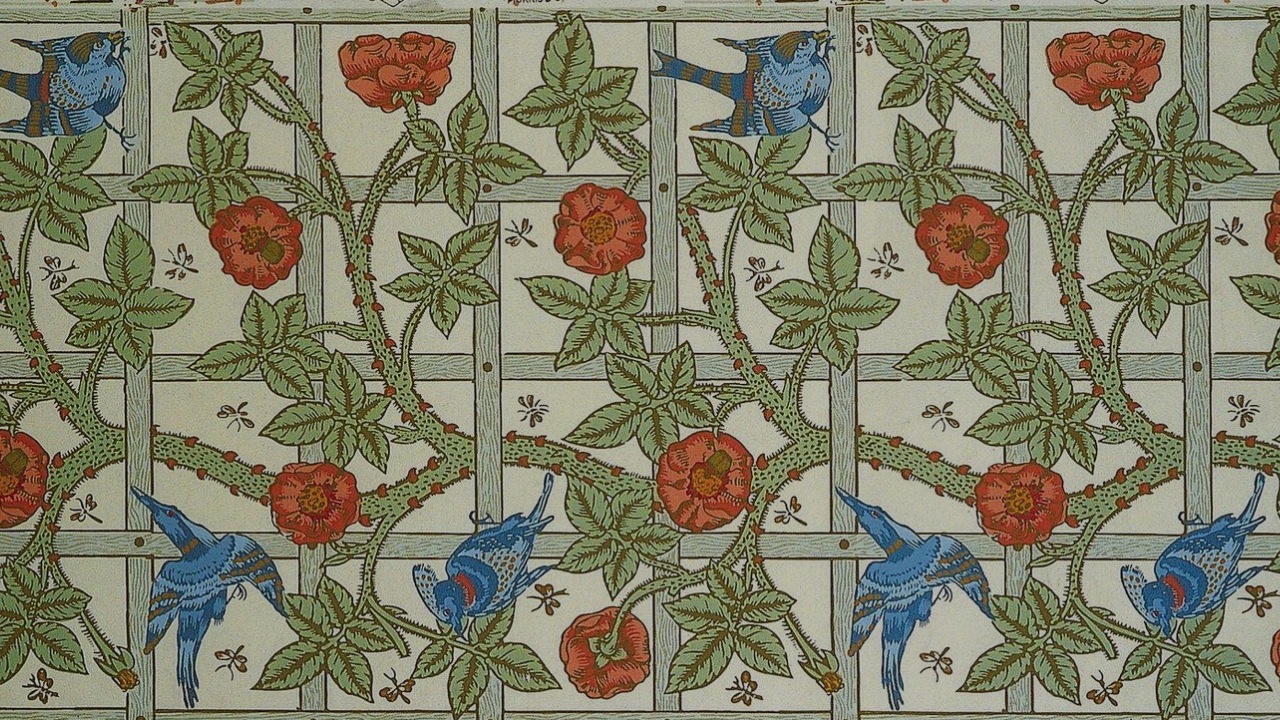
The wallpapers and textiles that made Morris’s name emerged from this workshop philosophy with astonishing rapidity. The firm produced furniture first, then turned to woven carpets, and from 1862 onward to the wallpapers that would prove his most enduring legacy. Trellis, designed in 1862, was his first wallpaper: a lattice of climbing roses, ordered into geometric structure and enlivened by birds, drawn directly from the rose trellises of the Red House garden.
What followed across the succeeding decades constitutes one of the richest bodies of botanical ornament in the history of design. Jasmine (1872) wove hawthorn leaves and meandering jasmine into a romantic, playful tangle. Larkspur, of the same year, and Willow (1874) offered lush, leafy tendrils that seemed to grow across the wall of their own accord. Marigold (1875) demonstrated Morris’s characteristic technique of overlaying a principal pattern upon a smaller, restrained background motif, and was produced both as wallpaper and as printed fabric during his lifetime.
The 1870s and 1880s saw Morris move toward grander, more opulent conceptions. Acanthus marked the beginning of a period of large-scale designs, its characteristic curves and superimposed layers of foliage producing a three-dimensional effect of remarkable depth. Pimpernel employed the mirror symmetry of wildflower heads stirred by the wind. Chrysanthemum (1887) joined the ranks of world-renowned classics.
Perhaps the most beloved of all is Strawberry Thief, designed in 1883, which depicts thrushes stealing fruit against a ground of floral vines and leaves—a scene drawn from Morris’s own vexation at the birds pilfering strawberries in the kitchen garden at Kelmscott Manor. First employed as an upholstery fabric, it soon migrated to the wall, where its orderly ornamental structure and lively narrative continue to delight. Honeysuckle & Tulip, another early textile design of interwoven foliage and blossom, likewise found its way onto walls, notably in the Honeysuckle Bedroom at Wightwick Manor. Alongside these grand designs, Morris also produced finer, quieter patterns—Scroll (1871), with its gently meandering leaves and marigolds set against a ground of twigs and inspired by medieval book illustration—reflecting the movement’s parallel reverence for simplicity and clarity.
Almost all of these designs were printed by hand from carefully cut woodblocks, the colourants derived, where possible, from plants: indigo for blue, madder for red, weld for yellow. The technique was laborious, exacting, and utterly opposed to the mechanised printing of the age—which was, of course, precisely the point.
VI. The Honesty of a Flat Surface
The distinguishing quality of Morris’s botanical work—the source of its enduring fascination—lies in a paradox of representation. His plant patterns are not lifelike botanical drawings, not the exacting specimens of a naturalist’s plate. Rather, he worked through subtle, stylised allusion to natural form. Branches, tendrils, flowers, and leaves dissolve into flowing lines, elegant swirls, and disciplined symmetries. The plant is present and absent at once: recognisable in its essence, transfigured in its execution.
He drew his inspiration from gardens, hedgerows, fields, and native English plants, which gave the movement its profound connection to nature and local materials. This was a deliberate ideological choice. While the horticultural fashion of the later nineteenth century ran to exotic, tropical species cultivated in garish colours within the new greenhouses of iron and glass, Morris turned resolutely toward the traditional English garden. At the Red House, and later in the gardens of Kelmscott Manor, he and Jane planted native species long under cultivation—lilies, delphiniums, tulips, roses—and fenced their beds with wattle in the manner of medieval enclosures. Morris brought nature to the very threshold of his studio, studying its colours and forms and translating them into design.
The symbolic weight of this choice runs deep. Morris’s designs reflected a moral and aesthetic reaction against the overly ornate, mass-produced wallpapers of the period—those factory-printed confections that imitated, cheaply and dishonestly, the appearance of hand-work and natural form. Against this, Morris posed a doctrine of truth: decoration must not pretend to be what it is not. A flat wall should not masquerade as a window onto a three-dimensional bower; a pattern should acknowledge the surface it adorns even as it evokes the living world. His stylisation was thus not a limitation but a principle—an honesty of ornament that refused illusion.
There is, too, a temporal melancholy embedded in these patterns. The native English flora Morris favoured were plants under cultivation for centuries, bearing the memory of medieval gardens and vanished ways of making. To fill a room with Morris’s wallpaper was to be surrounded by a botanical nostalgia, a green mourning for a pre-industrial England that existed as much in longing as in fact. The colours reinforced this mood: calm, clear, and predominantly dark shades of green and brown, drawn from plant dyes and steeped in the muted light of the old world. In this sense, the patterns are elegiac—gardens preserved against the withering advance of the machine.
VII. The Garden That Would Not Be Buried
That Morris’s designs should have survived the century of their making would have gratified their creator, who cared little for fashion and everything for endurance. Wallpapers and fabrics based on his patterns remain in production under the Morris & Co name, which now belongs to the Sanderson Design Group, a British manufacturer of high-quality wallpapers. The designs revolutionary in the 1870s retain their singular effect, employed today both for dramatic accent walls and, in more subtle recolourings, for entire rooms.
The archive continues to yield its secrets. The Morris & Co holdings still contain designs never issued as wallpaper in the designer’s lifetime, and collections such as the Emery Walker’s House range have brought these to light. The Bird wallpaper draws upon a tapestry Morris made in 1878 for his own parlour; the Wallflower design of 1890, absent from the range for decades, has returned; the Bower floral has likewise been re-released. Such collections, mingling first-time publications, reissues, and contemporary recolourings, constitute a living dialogue between the nineteenth century and our own.
Morris’s motifs were also carried forward by his successors. John Henry Dearle, trained by Morris himself, modified many designs and produced new ones in the master’s spirit—Bird & Pomegranate, inspired by Morris’s Fruit and combined with illustrations of thrushes, and Golden Lily, which takes up Morris’s principle of diagonal order in its intertwined blooms. Morris & Co continues to issue his motifs in new colour variations, such as the Blackthorn wallpaper, while independent labels such as the English house House of Hackney reinterpret his lush foliage and stylised flora for contemporary interiors, often holding close to the originals while reworking their palettes.
To complement these papers, Morris & Co has developed a palette of some forty colours for walls, wood, and metal, drawn from original nineteenth-century recipes and from Morris’s own pattern books—an homage to the depth and richness of the plant-derived dyes with which he worked. The persistence of this ecosystem of pattern and colour testifies to a rare achievement: Morris’s classics suit both the traditional British interior and the modern wall alike.
VIII. The Last Leaf
We close the folio, and the room falls quiet, though the walls continue their silent flowering. What Morris achieved was not merely a body of beautiful designs but a coherent vision of how one ought to live: surrounded by objects made with joy, honest in their construction, faithful to the natural world from which all ornament ultimately derives.
His botanical patterns endure because they answer a hunger the industrial age created and could not satisfy. Morris created botanical designs to bring the beauty of nature into everyday interiors while rejecting the ugliness and impersonality of industrial mass production. He believed decoration should be honest, handcrafted, and grounded in close observation of real plants rather than in literal or fake-looking imitation. And his designs reflected, always, a moral and aesthetic reaction against the overly ornate, mass-produced wallpapers of his period—a refusal of the cheap, the dishonest, and the mechanical.
There is a lesson in the archive that transcends wallpaper. Morris understood that the objects among which we pass our days shape our souls, that a home filled with honest beauty is a form of resistance against a world that would reduce all making to profit and all workers to machines. His hedgerows and his lilies, his thieving thrushes and his curling acanthus, are arguments in vegetable dye—quiet insistences that the human hand, guided by love of the living world, might yet redeem the surfaces of everyday life.
The garden he planted still grows, transplanted from the soil of Victorian Essex into the printed patterns that adorn our walls. And in the dim archive, where green and brown shades gather like the last light of an autumn evening, William Morris continues his patient work: teaching us, still, to look again at a leaf.

Archival Sources
MacCarthy, F. (1994). William Morris: A life for our time. Faber and Faber.
Marsh, J. (2005). William Morris and Red House. National Trust Books.
Morris, W. (1882). Hopes and fears for art: Five lectures. Ellis and White.
Parry, L. (1983). William Morris textiles. Weidenfeld and Nicolson.
Ruskin, J. (1853). The stones of Venice (Vol. 2). Smith, Elder & Co.
Thompson, E. P. (1955). William Morris: Romantic to revolutionary. Lawrence and Wishart.
Todd, P. (2004). The Arts and Crafts companion. Thames & Hudson.
Watkinson, R. (1967). William Morris as designer. Studio Vista.
Leave a Reply