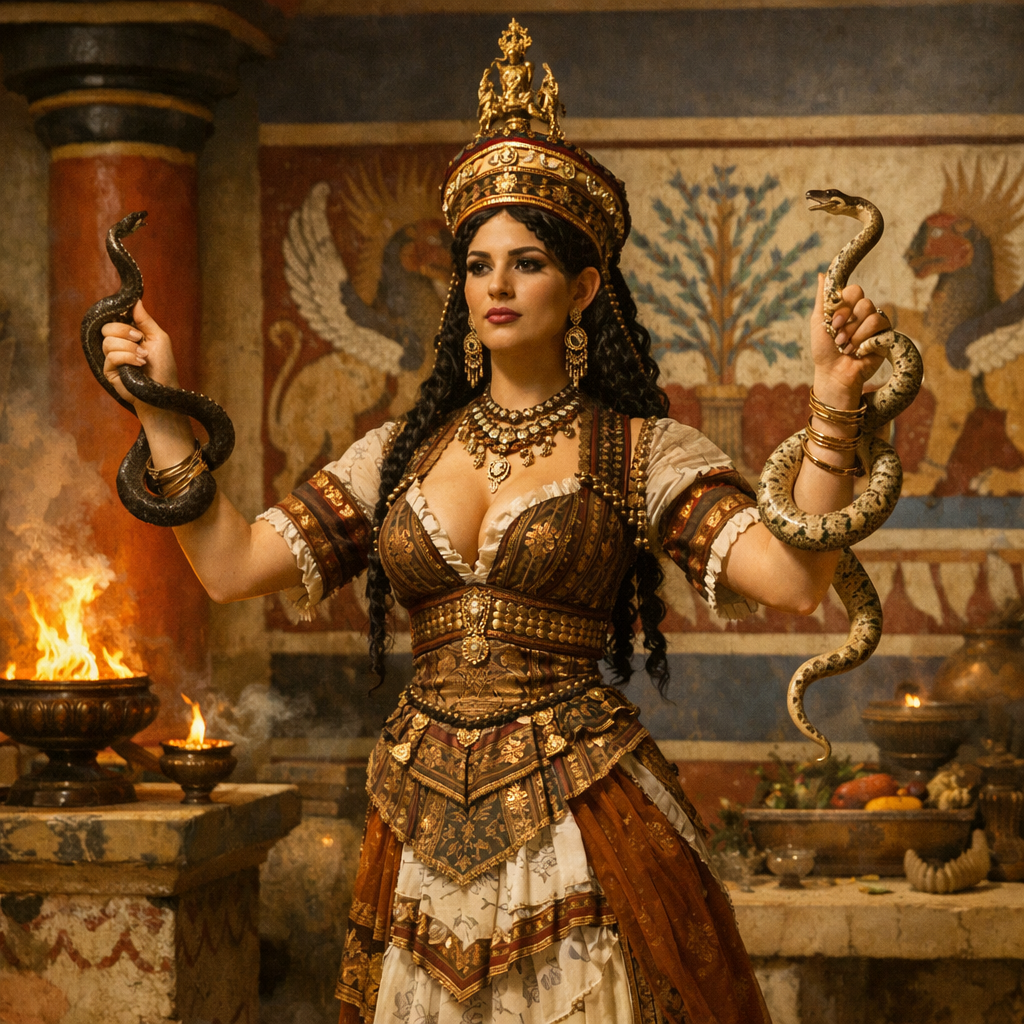


Unveiling the Serpent’s Secret: An Introduction
In the dim, dusty light of a stone-lined cist beneath the labyrinthine palace of Knossos, a glint of glazed faience caught the eye of an excavator in 1903. What emerged from the earth would become one of the most iconic, debated, and romanticized images of the ancient world: the so-called Minoan “Snake Goddess.” For over a century, this figurine—with her bared breasts, sinuous serpents, and flounced skirt—has stood as a symbol of a sophisticated, enigmatic, and seemingly matriarchal civilization. But who, or what, does she truly represent? The story of her discovery, reconstruction, and interpretation is a tale of archaeological ambition, cultural projection, and an ongoing quest to understand the powerful women of Bronze Age Crete. This is a journey beyond the myth, into the complex world of Minoan religion, art, and society.
The 1903 Knossos Find: Excavating the Repositories
The faience figurine was discovered by the British archaeologist Sir Arthur Evans during his pioneering excavations at Knossos. Evans, who had begun digging in 1900, was driven by a desire to prove the historical reality behind the Greek myths of King Minos and the Labyrinth. In 1903, attention turned to a small room near the Throne Room complex, where a sagging pavement hinted at secrets below.
Beneath the floor lay two large stone-lined cists, dubbed the “Temple Repositories.” These were not mere storage pits but carefully constructed cultic depositories, sealed after the palace’s destruction around 1600 BCE. Within a layer of earth and broken objects, Evans’ team found a stunning cache of faience artifacts: votive robes, sacred girdles, plaques depicting animals, and fragments of several figurines. Among these shattered pieces were the remains of two female statuettes that would consume Evans’ imagination. He first published the find in 1904, but it was his monumental work, The Palace of Minos (1921), that launched the “Snake Goddess” into the realm of archaeological celebrity, cementing her status as a canonical image of Minoan culture.
Goddess or Devotee? The Identity of the “Votary”
From the outset, Evans faced an identification puzzle. The more complete figurine, standing 34.2 cm tall, was missing its head, right arm, and parts of its skirt. Evans initially labeled this figure a “votary”—a human priestess or worshipper. Its reconstruction was an exercise in archaeological conjecture. A separately found faience cat (interpreted as a lioness) was placed atop a reconstructed headpiece based on a fragment with raised medallions. A left forearm and snake were fabricated, completing the now-familiar image of a woman holding serpents aloft.
The figurine’s costume is a masterpiece of Minoan textile art, rendered in exquisite faience detail. The skirt is composed of seven overlapping, thick woolen flounces, arranged in a checkerboard pattern of solid and striped panels. Over this sits a distinctive tongue-shaped double apron. Most striking is the tight, open-fronted bodice that exposes the breasts, cinched at the waist by a wide, possibly metal, girdle that emphasizes a pronounced “wasp-waist.” This girdle may have held profound ritual significance, evoking later Greek myths of Aphrodite’s enchanted girdle of desire. Evans himself speculated that these details were not merely fashionable but symbolic, connecting the figure to a powerful realm of female divinity and magic.
Context of a Cult: Inside the Temple Repositories
The repositories themselves tell a story of ritual and catastrophe. They were found packed with the carefully placed debris of a shrine, swept together and interred after a devastating earthquake. Alongside the figurine fragments were libation tables, seal impressions, ivory ornaments, and hundreds of faience objects, including sacred knots and girdles decorated with saffron flowers. Evans believed these items constituted a portable shrine, and he famously staged a reconstruction showing the “Goddess” and her “Votary” flanked by hanging votive robes. This context is crucial: these were not everyday objects but elite cult paraphernalia, deliberately hidden or buried in a time of crisis, linking them irrevocably to the highest levels of Minoan religious practice.
Evans’s Vision: Reconstructing the “Snake Goddess”
The larger figurine, which Evans confidently proclaimed was the “Snake Goddess” herself, is even more a product of reconstruction. Only the torso, right arm, head, and part of the hat were original. Evans envisioned her crowned with a tall hat, with three snakes coiling around her body: one held in her right hand and winding over her shoulders, a second looping from her ear over her breast and up to her hat, and a third knotted around her waist. He described her coloration as milky white with purple and brown details. However, scholars now caution that this elaborate serpentine arrangement is largely Evans’s own invention. The evidence for three distinct snakes is tenuous, and the reconstruction has profoundly shaped—and potentially distorted—our perception of Minoan religion.
Cultural Icon: The Goddess in the Minoan Worldview
The figurine’s appeal lies in its perfect alignment with a romanticized view of the Minoans as a peaceful, nature-loving, and matriarchal society—a stark contrast to their warlike Mycenaean successors. Evans, influenced by James Frazer’s theories in The Golden Bough, was predisposed to see a Great Mother Goddess at the heart of prehistoric religion. The “Snake Goddess” fit this paradigm perfectly, becoming a cornerstone for the argument that Minoan society was matrilineal, if not matriarchal, with women dominating religious and perhaps political life.
This view is seductive but problematic. It is built on an absence: a lack of obvious fortifications, royal tombs, or monumental kingly statuary at Knossos. Yet, the absence of evidence is not evidence of absence. The decipherment of Linear B tablets (post-dating Evans) revealed a Mycenaean-style palatial administration at Knossos, suggesting a more familiar hierarchical structure. While women undoubtedly held significant religious roles, as seen in frescoes and seal rings, declaring Minoan Crete a matriarchy projects modern desires onto an incomplete archaeological record.
A Singular Image? Snake Goddesses Across Crete
If the Snake Goddess was central to Minoan worship, one would expect to find her image replicated across the island. The evidence is surprisingly sparse. A crude terracotta figurine with a snake from Gournià (c. 1350-1200 BCE) and some fragmentary figures from Priniàs have been retrospectively linked to Evans’s find. A vase from Koumasa (c. 2600-2200 BCE) with rope-like appendages has been interpreted as a prototype, though this is highly speculative. A group of figurines from Palaikastro, once thought to depict a goddess with votaries, may instead show a lyre-player surrounded by dancers.
In the vast iconography of Minoan cult—featuring double axes, sacral horns, bulls, and doves—snakes are rare. Evans interpreted the snake as a benign chthonic (underworld) spirit, a “household genius,” but scholar Geraldine Gesell notes the figurines were found in a palatial, not domestic, context. She argues for a broader interpretation as a universal Mother or Earth Goddess, a fertility deity. This, however, may be an oversimplification that obscures a more specific, female-centric function.
Beyond Fertility: Questioning a Patriarchal Label
Labeling any prehistoric female figure a “fertility deity” has become a scholarly reflex, often a catch-all term that halts further inquiry. It typically implies a deity serving a male-dominated agricultural society, ensuring the growth of crops and flocks. This patriarchal lens can erase the possibility that such images served women’s specific needs. What if the “Snake Goddess” was not an allegory for general abundance, but a divine patron for the intimate, powerful, and sometimes perilous biological processes of women’s lives: menstruation, conception, childbirth, and lactation? This shift in perspective opens new interpretive doors.
Mediterranean Connections: Egypt, Magic, and the Divine Feminine
Evans noted a tantalizing link to Egypt, comparing the snake rising from the figurine’s hat to the Egyptian uraeus (rearing cobra) on the crowns of goddesses like Hathor and Wadjyt. A diorite statue of a priest of Wadjyt was even found at Knossos, proving direct contact. Wadjyt, the cobra goddess of Lower Egypt, was associated with fertility and later identified with Aphrodite and Isis. She was also linked to Weret-hekau (“Great of Magic”), a protective goddess depicted with snake wands.
This connection to magic is crucial. A remarkable cache from under the Ramesseum at Thebes (c. 1786-1633 BCE) contained magical papyri and a wooden statuette of a woman with movable arms, holding metal snake-wands and wearing a lioness mask. She is thought to be a sau (a female magician) or a votary of a protective goddess like Wadjyt, involved in rites for women and children. Her nudity and pose are strikingly reminiscent of the Minoan figurines. This Egyptian context suggests the Minoan objects may not depict a supreme goddess, but rather a priestess performing protective magic—a “snake charmer” in the most sacred sense.
Priestesses as Healers: The “Snake Charmer” Hypothesis
Building on this, some scholars propose that the figurines represent priestesses performing magical rites focused on women’s health. In the ancient world, menstruation, conception, and lactation were mysterious, powerful, and fraught with danger. Hippocrates later described ailments caused by “wandering wombs” and blocked menses. Egyptian magical texts include spells for regulating menstruation and ensuring milk flow.
The Minoan figurine’s dominant yellow hue may be significant. Scholar Elizabeth Barber notes yellow, dyed from saffron, was a “woman’s color.” The Akrotiri fresco on Thera shows women gathering saffron, a plant used to alleviate menstrual cramps. Saffron flowers also decorate the faience girdles found with the figurines. This points to a specific, gynecological ritual context.
Decoding the Symbols: Knots, Blood, and Cyclical Renewal
Key symbols on the figurines support this theory. Both figures have a looped cord above a knot between their breasts. Evans called this a “sacral knot,” analogous to the Egyptian tyet, or “Knot of Isis,” which represented the goddess’s blood and served as a protective amulet for women, especially during pregnancy. This knot may symbolize magical protection for the womb.
The snake itself is a near-universal symbol of renewal, shedding its skin as women shed menstrual blood. Some cultures link the first menses to a supernatural encounter with a snake that grants fertility. The snake’s cyclical renewal mirrors the lunar-linked menstrual cycle. The figurine’s knotted waist-snake could symbolize menstrual cramps, its loosening offering relief. The emphasis on the bare, milk-white breasts, alongside faience plaques of suckling animals, may invoke prayers for ample lactation. A controversial marble statuette from Knossos (now at the Fitzwilliam Museum) shows a woman in a similar dress clutching her breasts, possibly a gesture related to milk flow.
The “Parisienne” and the Ubiquitous Sacred Knot
Even outside the context of snakes, Minoan art reinforces the importance of female ritual symbols. The famous fresco fragment, dubbed “La Parisienne,” from Knossos depicts a woman with a sacral knot at her nape, likely a sign of her holy status. These knots, ubiquitous in Minoan art, may be the local counterpart to the Isis-knot, marking priestesses or ritual participants involved in women’s cults.
Later Echoes in Ivory and Gold
The tradition did not die out. A later ivory and gold figurine from Knossos (c. 1500 BCE, now in Boston) depicts a woman holding what appear to be Egyptian hooded cobras. Adorned with gold bands marking her flounced skirt and bodice, with gilded nipples, she represents a later, more luxurious version of the same ritual iconography, confirming the enduring importance of this female-focused symbol set.
The Broader Picture: Women’s Authority in Minoan Religion
While the “matriarchy” thesis may be overstated, archaeology confirms women’s preeminent role in Minoan religion. Goddesses like Potnia (“Mistress”) appear in texts. Frescoes from Knossos and Thera show women as central figures in processions and ceremonies. The Aghia Triadha sarcophagus depicts priestesses as the primary officiants. Men are present but often in subsidiary roles. The famous “Priest-King” fresco from Knossos is now known to be a composite of several figures. This visual record suggests a society where women, particularly elite women, wielded significant sacral authority, mediating between the community and divine forces governing life, death, and fertility.
Conclusion: Reassessing an Ancient Icon
The Minoan “Snake Goddess” is a palimpsest. She is a genuine masterpiece of Bronze Age art, a fragmentary archaeological find, an extensive modern reconstruction, and a powerful screen for our own projections about ancient women. Moving beyond Evans’s “Mother Goddess” narrative and the vague “fertility deity” tag, a more nuanced picture emerges. The figurines likely represent not a universal goddess, but a specialized priestess or a divine patron of women’s biological and social rites. She is a figure of magic (heka), protection (sa), and renewal, deeply connected to Egyptian and Near Eastern traditions of female-centric healing and ritual.
Her exposed breasts are not mere eroticism but signs of her jurisdiction over lactation and nurture; her snakes are not fearsome chthonic beings but symbols of cyclical renewal and perhaps instruments of healing magic; her girdle and knots are amuletic, not just decorative. She embodies the profound link between women’s bodies and the cosmos in the ancient mind. Ultimately, she stands as a powerful testament to the visibility, ritual authority, and complex social roles of women in the Minoan world—a world where the sacred and the feminine were intimately, powerfully entwined.

Brown, A. C. (1983). Arthur Evans and the Palace of Minos. Ashmolean Museum.
Leave a Reply