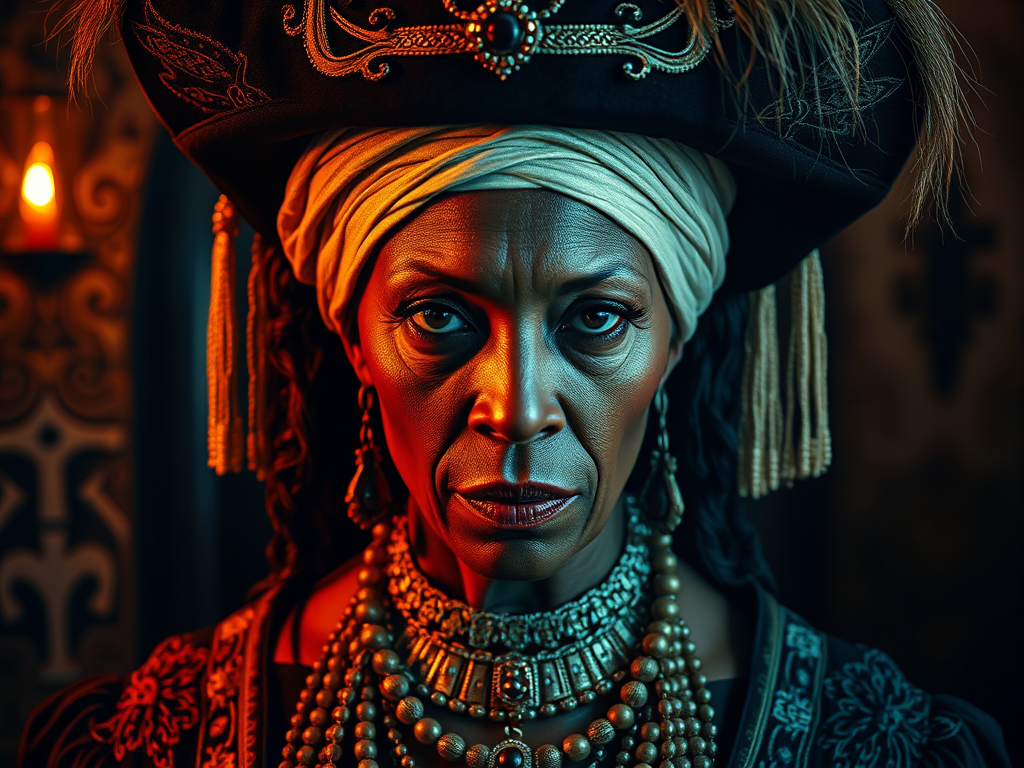
Note: Some details are based on oral traditions, folklore, and unverified accounts.

Some stories are meant to be told more than once. The strange tales that speak of spirits, ghosts, and some may say— demons. The supernatural, but I want to talk about the extraordinary. Ordinary folks against all odds who turn their lives into legend. I have one of those stories tonight, and I’d like to tell it. So come on in. Take a seat. Relax and let’s begin.
Beginnings
Well, the story begins with a girl, a baby born on September 10th, 1801, to Marguerite D’Arcantel, a free woman of African, European, and Native American ancestry. At the time of birth, Marguerite D’Arcantel was not married. So the father is not known. However, there are talks still. Some say the father was a Charles Laveau, the son of Charles Laveau Trudeau, a white Louisiana Creole and politician. And others like to keep it simple and state the baby’s father was a free man of color named Charles Laveaux. The confusion about who this baby’s father was stems from inconsistent spellings in surviving records. Whoever her father may have been, he gave the surname to a remarkable and mysterious woman we still speak of in hushed tones to this day—Marie Catherine Laveau.
Marie Laveau was the first of her maternal line to be born free, but before we go any further, let’s go back a bit to her great-grandmother, Marguerite, who had no surname because she was enslaved. Marguerite was born around 1736, and historical evidence suggests that she was transported from Senegal to Louisiana aboard the last French slave-trading vessel, the St. Ursin, in 1743.
Moving forward in time to the late eighteenth century, Marguerite and her daughter, Catherine, were held in slavery by the white Creole Henry Roche-Belaire, a master shoemaker. Catherine’s father was a Jean Belaire, possibly a slave of Henry Roche-Belaire. Roche-Belaire, or another white man, fathered Catherine’s mixed-race and what they termed at the time, mulatto children. After surviving three more owners, Catherine finally purchased her freedom in 1795 and took the name Catherine Henry. Catherine’s daughter, Marguerite Henry, was freed by Henry Roche-Belaire in 1790. She became the concubine of a Frenchman, Henri Darcantel, with whom she had several children. She subsequently went by the name Marguerite Darcantel.
Marguerite also had a brief relationship with Charles Laveaux, a successful mulatto businessman. Her daughter, Marie Laveau, the future Voudou queen, may have been the result of this union. In 1798, Marie’s grandmother, Catherine Henry, built a small cottage on Saint Anne Street in New Orleans, Louisiana. This is where her granddaughter would be born three years later, at number 179, later number 152. It was a four-room wooden house with wooden board floors, one chimney, a porch, and a few windows. However, as the years passed since her death, descriptions of her home grew more elaborate, richer with fantasy. As many things are told when speaking of the great Voodoo Queen, but I’m getting ahead of myself. There are no photos of the original home; only a sketch depicts a nice but modest home. The original structure was demolished in 1903, and a new structure was built on its foundation at approximately 1020 St. Anne Street in the French Quarter.
On August 4, 1819, Marie Laveau married Jacques Paris (also known as Santiago Paris in Spanish records), a free quadroon carpenter from Saint Domingue (now Haiti) who was among the thousands of émigrés from Saint-Domingue to New Orleans in the wake of the Haitian Revolution. Their marriage certificate is preserved in the Saint Louis Cathedral in New Orleans. The nuptial mass was officiated by Antonio de Sedella. The couple had two daughters, Félicité, born in 1817, and Angèle, born in 1822, who are presumed to have died in childhood. Paris worked as a carpenter in New Orleans until 1822, after which he disappeared from city records. Some historians believe he died in Baton Rouge in 1823; others believe he continued living in America or in Haiti. Though there is no proof of the latter. And then there is the rumor, the alleged secret many of her contemporaries speculated, that Marie had used voodoo to get rid of him. Citing no body was ever found. I guess it really depends on what you believe and what you believe in. The facts stand that Jacques Paris vanished from the records, and by 1824, Laveau was referred to as “the Widow Paris“. She was legally a widow.
Following the reported death of her husband, Jacques Paris, she entered a domestic partnership with Christophe Dominick Duminy de Glapion, a nobleman of French descent, with whom she lived until his death in 1855. They were reported to have had 15 children, but most accounts agree on seven. The other 8 may have been grandchildren, as seven children were listed on birth and baptismal records. Only two children survived into adulthood, though Marie-Héloïse and Marie-Philomène; for the rest of the story, we will refer to them as Heloise and Philomene to avoid confusion.
Now pull up a chair because what I am about to tell you may shock some of you, maybe put you even in a bit of despair, but we must understand that most legends start with a human being. People embody complexities that the greatest minds are still trying to understand.
Saints + Slaves
Now, a little-known fact about Marie Laveau is that she and her domestic partner, Christophe Glapion, were slave owners. They are confirmed to have owned at least seven slaves during their lifetime.
Marie Laveau’s motivation for being a slave owner is still unknown. As she witnessed the largest slave revolt in American history, known as the German Coast Uprising. A lot of you may not have heard of this. It was a revolt that started about 30 miles outside the city. Enslaved men rebelled against the harsh conditions found on sugar plantations. Conditions that should have been deterred by the Louisiana Black Codes.
The Louisiana Black Code, or Code Noir, was enacted in 1724 during the administration of Governor Bienville and was based on earlier codes developed in the French Caribbean colonies. These codes allowed slaves to marry, and families not be divided by way of selling. Slave owners were not allowed to beat or kill their slaves so long as the slave or slaves were baptized in the Catholic faith. These codes were supposedly established to ensure the safety and well-being of the slaves, but instead, they established severe restrictions by way of colorism. These codes restricted the movement of people of African descent and stressed that people with darker skin were considered lower than those with lighter skin.
Fed up with these invisible chains, some slaves resorted to running away from the plantations. These runaways were referred to as Maroons.
So by 1811, when Marie would have been around 11, 200 to 500 enslaved men, armed mostly with hand tools, participated in the march from the sugar plantations on the German Coast toward New Orleans. In the path of this march, five plantation homes were scorched to the ground. Along with the crops the former slaves tilled by hand. The rebels ended up killing two white men. The retaliation for these killings was fast, swift, and brutal. Militias and soldiers hunted down the slaves, executed them by way of firing squad and hanging. After this, over 100 of the rebels were then decapitated. Those parts were publicly displayed as a deterrent to any further rebels.
It is certain that these events impacted Marie, but in what way and how is again another mystery. There is no evidence that Marie was involved in the slave trade prior to her partnership with Christophe Glapion, but there is archival evidence that he was involved in the buying and selling of slaves prior to being with Marie.
Since 1706, chattel slavery had been perpetrated against Native populations in Louisiana until 1768, when, under Spanish rule, the enslavement of indigenous peoples was banned. This ban, however, did not include Africans or people of African descent. Spanish rule eventually introduced a new law that allowed slaves to buy their freedom and freedom for other slaves. It was under this law that Marie’s grandmother, Catherine, purchased her freedom in 1795.
When Marie and Christophe became a couple, they bought and sold 7, maybe 8 slaves. There are no reports or articles available to tell us how they treated their slaves. However, the idea has been put forth that Marie and Christophe’s home served as a Southern depot for the Underground Railroad and that they, or at least she, helped to free slaves. It is worth noting that, according to oral history, Marie is known to have provided slaves with charms to protect them on their journeys to freedom.
The couple continued to buy and sell slaves until 1854, when Christophe sold his final enslaved woman. If Marie were involved in assisting slaves in their quest for freedom, it would make sense that she would not stop Christophe from buying and selling slaves. The reason was that he had previously been known for keeping slaves. Suddenly stopping this would have raised some alarms. Why she participated in the slave trade is a difficult question to answer. Maybe it was finances, a complex guise, or simply a lack of real choice in the matter. Only Marie would have that answer. It is worth mentioning that Marie did not participate in the slave trade after Christophe’s death in 1855.
Before I move on with the story, I want to circle back to Marie and Christophe’s home on Saint Anne St. A former slave named Charles Raphael describes an altar in their front room. On it sat items familiar to those passing through. Which he says: “good luck charms, money-making charms, and husband-holding charms.” He adds, “On this altar she had a statue of St. Peter and St. Marron, a colored saint.” St. Maroon is the patron saint of runaway slaves. Is this concrete evidence she helped with the Underground Railroad, no, but it is an interesting thought? Once again, the truth is a mystery.
In New Orleans Voudou and folk Catholicism, it is common practice to pair up saints according to purpose. For example, St. Expedite, the patron saint of expediency, may be paired with St. Jude, the patron saint of hopeless causes, to ensure petitions to St. Jude are answered with haste. St. Expedite is “sent in” with St. Jude to make the case with Bon Dieu (God) on behalf of the petitioner. This ritualistic system is tantamount to a spiritual buddy system, in which the saints benefit from each other’s special talents while the petitioner benefits from their combined efforts. Petitioning St. Jude alone does not guarantee expediency; in fact, he can be slow to work at times. So, if a petitioner needs a seemingly hopeless case addressed quickly, St. Expedite can make it happen. So, if we consider the two saints on Marie Laveau’s altar in the context of Voudou and folk Catholicism, we can reasonably assume the statues on her altar relate to assisting runaway slaves. So St. Peter, who is syncretized with Papa Legba. St. Peter holds the keys to the kingdom of heaven, while Papa Legba holds the keys to the spirit world. These two energies are tapped into in Voudou when obstacles need to be removed, roads need to be opened, and secrets need to be kept under lock and key. The keys also signify the ability to unlock the chains of slavery. Thus, St. Peter holds the keys to what fugitives referred to as “heaven”. Heaven for escaped slaves was Canada. And St. Maroon, the patron saint of runaways, is there to provide protection on the freedom train. Again, there is no concrete evidence of her mindset.
Marie the Devout
We often hear about Marie the Voodoo Priestess, but seldom hear about Marie the devout Catholic. Despite many fantastical tales surrounding Marie Laveau, she was a lifelong Roman Catholic. She was baptized, married, attended Mass, and had her children baptized at St. Louis Cathedral. She served as godmother to her nephew and granddaughter, and paid for the education of a 7-year-old orphan boy at the Catholic Institution for Indigent Orphans. In her later years, Marie actually abdicated leadership of the Voudou community and devoted the rest of her life to charitable works. But that will be the point we will touch on later in the video.
Faith. Health. Greed.
For right now, let’s talk about Marie, the dedicated practitioner of Voodoo. The healer. The herbalist and the entrepreneur. As a business owner, Marie never owned any land, despite the small cottage her grandmother built. This dispels any myths of her famed wealth and greed. In reality, she preferred to live quite modestly. She opened a beauty parlor, where she worked as a hairdresser for the wealthier families of New Orleans. She excelled at obtaining inside information about her wealthy patrons at the beauty parlor by listening to the ladies gossip or by paying or curing their servants of mysterious ailments. She used this information during her Voodoo consultations with wealthy Orleanian women to enhance her image as a clairvoyant and to give them practical advice.
She also made money by selling her clients gris gris as charms to help their wishes come true. This is a type of voodoo amulet that can bring anything from good luck to painful suffering to the person who possesses it. It’s often considered a form of malevolent black magic, but Marie was known to use it for good.
She went from house to house, selling love charms to the elite and giving lucky amulets to slaves who wanted to escape. Laveau performed her services in three main places: her home on St. Ann Street, at Congo Square, and at Lake Pontchartrain. She was the third female leader of Voodoo in New Orleans (the first was Sanité Dédé, who ruled for a few years before being usurped by Marie Saloppé), a New Orleans voodoo “queen”, or priestess. Marie Laveau maintained her authority throughout her leadership, although an attempt to challenge her was made in 1850.
Marie Vs. Rosalie
The story goes that another Creole woman, Rosalie, in an attempt to gain more followers and insight, erected a large, life-sized wooden doll, possibly imported from Africa. It was common to have fellow practitioners compete to be the main priestess, but Rosalie was the first to oppose a real threat to Marie Laveau’s authority. However, Rosalie underestimated Marie’s network, and before long, the large doll disappeared from Rosalie’s yard. Rosalie accused Marie of stealing it. Some devotees saw Marie’s great powers, while others knew that Marie had simply taken it, and they said nothing about it. The dispute was taken to court, where, thanks to Marie’s influence, she won, and the doll could never be erected again.
John the Conqueror
This reaffirmed her dominance as the most beloved voodoo priestess in the community. Her following increased. She would hold weekly ceremonies at the family cottage. Every Friday evening, the local women would crowd around the room and thump their feet to the rhythmic drums as Marie called down Voodoo spirits known as Loa.
The Loa act as intermediaries between humanity and the distant Supreme God. Each Loa has unique likes, dislikes, songs, dances, and ritual symbols. The most important voodoo celebration of the year was the feast of Saint John, the Catholic patron saint of New Orleans. The slaves called him Hi, John the Conqueror.
At these gatherings, they told each other stories about how he would rise up and bring freedom to his people in America. He was honored as one of the most important figures in voodoo practice, and Marie ensured that the feast of Saint John, during Midsummer, became a citywide celebration every year. On the eve of St. John’s Day, Marie would hold feasts on the shore of Lake Pontchartrain.
Hundreds of men and women would gather in the brackish estuary dressed in white robes. They chanted old Creole songs, encircling a large bon fir. By the beat of a drum, Marie led them in offerings needed to invoke the Loa. Marie, the devotees, and some say the spirits, danced that night until the sun rose the next day.
Marie the Second
We haven’t said much about her children till now. Remember, out of the 7 children Marie had, only two survived, Heloise and her younger sister, Philomine.
As Heloise grew up, she became the star of her mother’s St. John’s Eve feasts. People said she had a gift, a divine one, and before long, she was simply known as Marie the Second. Her younger sister, Philomine, may have been a skeptic of Voodoo. At the very least, it seems she was a devout Catholic. And wanted to have little association with the Voodoo practice.
This polarity in the Laveau’s household highlighted what was happening in New Orleans. The Americans who recently annexed Louisiana were terrified of this mysterious religion that had enveloped New Orleans. Most of them were skeptics of the supernatural, like Philomine, but these white American fears were of a human kind. They were fearful that allowing slaves and free people of color to congregate together would incite a slave rebellion.
When New Orleans was under French control, free people of color were able to maintain a vibrant culture of their own. But after the Louisiana Purchase, the American government began to impose its own system of racial stratification on the people of New Orleans. Marie’s response was to focus on helping the imprisoned. People said she could get anyone released from jail, and she did. Marie clearly had power over the city, but the reason was divided. Some believed it was magic. And others, she was using bribery and blackmail to get favorable verdicts from the judges. But whether it was voodoo or networking, no one could deny the power Marie commanded.
While Marie tended to the imprisoned, Marie the Second, also known as Heloise, still danced at the Voodoo feasts. Many of the devotees would comment on how much she looked like her mother. In fact, she looked so much like her mother that the two were almost indistinguishable. While Marie the Second was dancing and enjoying the fellowship of these gatherings, Philomine was learning Herbology and tending to victims of yellow fever who lined the streets.
Marie Laveau knew Philomine, didn’t want to follow the practices of Voodoo, but instead tended to the sick. She would do this and later get married. Soon after that, she had children of her own. They all lived in the cottage on Saint Ann Street, but Philomene wouldn’t participate in the weekly Voodoo ceremonies that were still held at their house. The only relics in her family’s quarters were rosaries and pictures of Saints.
Philomene would never belong in her family of voodoo priestesses, and with the whispers of darker practices starting to circulate, she no longer wanted to belong around.
Meanwhile, Marie, the Second, learned how to charm amulets and voodoo dolls, how to mix potions like her mother. She did all this good work, but some say she didn’t stop there. There were rumors of a separate altar in the back room on Saint Anne St., a place where she would cast spells, sew charms to break up relationships, spread confusion, and, perhaps even worse, do worse. Gossip said things had changed. No ask was a bad ask if the client was willing to pay. And paid they did, or so the story goes. Some say the backroom took on a strange energy. Devotees spoke of spirits not wanting to leave. Some said it took days for a priest or priestess to regain control of their body after possession, and some believed the spirits never left.
When Two Become One
By the late 1860s, after the Civil War, the prejudice against Voodoo increased. Slavery was dismantled, but systematic racism still existed. The Creole community became a target for fear-mongering against Voodoo practitioners. To the point that a local newspaper suggested that all leaders and followers of Voodoo should be lynched. The practice was labeled as demonic, but this did not stop Marie Laveau, or did it? Marie’s friends and neighbors described a young woman bouncing down the street and dancing at the Bayou, but remember that at this time, Marie Laveau would have been middle-aged. It had been almost 40 years, but she still looked as young and beautiful as she always had. The believers believed her powers were real. That she had become immortal. The reality? The reality was that someone, or more than one person, slowly took over the Voodoo Queen’s role. Perhaps Marie the Second. This is a great debate that continues to this day, but most seem to think they are describing Marie the Second, not her mother. The lives of the two Laveaus were starting to blur into one.
As the elder Marie Laveau got older and weaker, she became housebound and could no longer perform her duties. Marie the Second perhaps took over the daily practices and weekly gatherings, and finally the St. John’s Eve feast. No one ever noticed that the two were separate people. There seemed to be only one Marie who was growing younger, more beautiful, and more powerful over time. Sometimes neighbors would spot an old woman with a seven-pointed headscarf hobbling down the street. They called her Marie Leveau’s mother.
Under Marie the Second’s guidance, Voodoo became more popular than ever. The white establishment tried to demonize Voodoo, but it backfired. Everyone wanted to be part of the taboo ceremonies they read about in the papers. Marie the Second was more than willing to play along. She invited journalists and politicians to her Voodoo celebrations, turning what were once sacred Creole rituals into a spectacle for the white elite.
The St. John’s Eve Festival drew bigger crowds every year until it became a citywide night of dancing and debauchery, more than a religious rite. By 1870, even the upper-class Catholics who despised Voodoo by day came out to eat, drink, and carouse all night.
Marie Laveau, the Voodoo queen, was becoming more famous than ever. This is when the person starts morphing into something more— a legend.
Tales spoke of her divine powers, often from the lips of outsiders or those wanting to share a good story. They spoke of the mysterious rituals, and it spread like fire amongst the Bayou. By now, barely anyone remembers that Marie Laveau and Marie the Second were different people. Marie Laveau was still quietly working at her entrance room altar or visiting the hospitals, but she had lost her prominence and her name. Marie the second was now the Voodoo queen Marie Laveau… perhaps.
Marie Abdicates a Faith
And then in 1871, suddenly and without explanation, Marie the first, the original Marie Laveau, renounced Voodoo forever. She retreated permanently to the cottage and devoted herself entirely to Catholicism. She filled the house with crosses, rosaries, and pictures of Saints. Philomene, the youngest of her daughters, took care of her while Marie the Second still practiced her beloved Voodoo in the backroom. It was a home divided. Much like the city of New Orleans…
So what caused the great Voodoo queen to forsake her practice? Was she disturbed by the way her daughter was taking the practice, the theatrics overriding the devotion and secrecy she had cultivated? Maybe, or maybe she was simply afraid for her soul as she inched closer to death. When a reporter from the local paper, The Picayune, came to speak to Marie the First, she told him, “I am no Voodoo now. I’m a believer in the holy faith”. She told him, “Voodoo had degenerated in the past few years. It was nothing like the faith she practiced when she was queen.”
Where Is Marie?
Whenever they were asked about Marie the second, Marie the 1st, and Philomene would fall silent. They never mentioned her in interviews. Philomene actually denied that she ever existed. Whether they were ashamed or afraid, they refused to acknowledge the new Voodoo queen who still lived in their home.
Marie the Second was still the Voodoo leader in name, but she was becoming reclusive and difficult to locate. No one ever saw her away from her altar except at the annual St. John’s Eve feast. She was seen so rarely that some people believe she is dead. Newspapers began to speculate that she didn’t exist at all.
Marie the Second’s last and greatest appearance happened on St. John’s Eve in 1872. As the ceremony began, she was nowhere to be found. In fact, she had not been seen for some time. Everyone thought she had disappeared for good, so they started without her.
The bonfire was lit. Chanting began, calling for the Voodoo queen to join them. Suddenly, she appeared. A lit candle in each hand. She walked to the shore, dressed in white, and began the ritual. At midnight, her devotee followed her into the shallow part of the water, but she continued further. She was warned not to go further, but something or perhaps someone compelled her to go further. Suddenly, a large tide overtook her, and she disappeared beneath the surface. There was a hush in the crowd. Then screams and wails called out above the storm winds, but the Voodoo Queen… was gone.
Most witnesses that night believed Marie the Second died in the lake, but others? Others were certain they saw her walking down the street in a flowing dress, jingling gold jewelry, and her long black hair tied under her scarf. Eventually, it became clear that she had indeed disappeared that night. So what happened? The simple answer is that she drowned, but much like a lot of things involving the Laveaus, that answer isn’t good enough.
Overtime local would give the following account: That night in 1872, Marie the Second was holding a ritual dance near the Bayou Saint John when a dark storm cloud appeared on the horizon. Never in all her years had Marie had trouble with the rain. The sky was always clear during her ceremonies, but this time was different. The storm was beyond her control. As one of her friends recalled, Marie looked out at the water as the tide began to roll and said I want to die in that lake. At that moment, a massive wave came up and swept over the shore, pulling Marie into the water.
But her neighbors can’t agree on what happened next. Some say she was never found, others are sure her body washed up dead the next morning, and some insist she lived through it and kept living for as long as eight years after the storm.
What we do know is that Marie Laveau never appeared at a St. John’s Eve feast again. Later that summer, three days after the 1st St. John’s Eve feast in decades without a Marie Laveau leading it, a young girl was walking down the Bayou Saint John when she saw a woman in a dress in a veil, floating in the water among the branches. She was pale and motionless, her arms folded over her chest like a corpse in a coffin. The girl lifted the veil, and the woman’s eyes flashed open. The woman whispered. “I love you, my child, and I don’t love many people. I am Marie Laveau.” The girl replied that she thought Marie Laveau was dead. The woman said. “I know Marie Laveau’s been dead before. I’m a strong woman.”
Whatever became of Marie the second, the rest of the family never spoke of her again. After 1872, some sources say 1873, she disappeared so completely that it was as if she had never existed at all. Then, in 1881, when Marie the first died, Philomene finally broke her silence. Philomene went to the district courthouse with Marie the Second’s son, Victor Pierre. They both swore that Marie Hallouise Eucharista, also known as Marie the second, died 19 years ago in 1862.
The Mystery of the 3 Maries
If Marie the second really died in 1862, who was the intoxicating young Marie Laveau who reigned over New Orleans for another 10 years after that?
Was there another woman posing as Marie, another Voodoo devotee who agreed to take up the mantle after Marie the Second died?
Did Marie the First have another daughter or granddaughter who fell through the historical record?
Or was the Laveau family simply…lying?
Maybe, Marie the Second did live past 1862. This is a possibility, for there was never any evidence of records to confirm her date of death. But why would they lie? And why were they all so silent about Marie the Second for decades until right after Marie the First finally died?
If Marie the Second did indeed die in 1862, maybe the Voodoo queen of the 1860s and 70s was something else. Something supernatural—if you believe that sort of thing…
What became of Marie the 2nd, or the woman who took her place after her assumed death, remains a mystery. There was no official record of her death, and there’s no agreement on the location of her remains. She’s as mystifying in death as she was in life.
The Aftermath
New Voodoo Queens replaced Marie after she was gone, but none of them matched the iconic status. The voodoo culture was never again as powerful as it had been under Marie’s control. Philomene continued to live in the cottage on Saint Ann Street until her death in 1897. She always talked about tearing down the house and rebuilding it, but she never had the money to do it. She wanted the house gone, as if the remnants of her Voodoo family legacy would be destroyed with it. When Philomene died, she finally got her wish. The house was sold, and the new owners demolished it. They built another house on the same foundation, and the spirits that were called once upon some say still reside.
A beautiful woman with a 7-pointed headscarf is often still seen wandering the streets where the old house once stood.
A few years ago, a couple visiting New Orleans rented out the house that now stands where the Laveau Cottage once stood. In the middle of the night, they heard chanting and drumming coming from somewhere nearby. They looked outside, but there was nothing there. Eventually, they realized the sound was coming from their own living room. In the morning, they found a single feather on the floor in the center of the living room.
In Voodoo, a single feather is a relic that brings good luck. Maybe Marie’s spirit was trying to help her new visitors in death as she did in life.
Thousands of visitors come to the Saint Louis Cemetery every year to visit the Laveau family tomb. They leave gifts of flowers, candy, or beads, hoping that the Voodoo Queen will grant their wishes. If their wishes come true, the visitors come back and mark an X on the grave. The hundreds of X marks on her two are evidence enough that Marie Leveau’s power still reigns over New Orleans. Her body might have perished, but her spirit is too strong to die.
The St. John’s Eve Feast is still held in New Orleans every year, although it’s become more of a cultural festival than a religious ritual.
If you go out on the lake on St. John’s Eve, you might encounter the spirit of Marie, but which one will you seek? The historical woman, tired from a life of work and wisdom, her feet firmly on the cobblestones. The daughter, walking in a magnified shadow, adds her own chapter. Or the legend, the true Queen, who walks forever, needing no body, fed by every wish, every fear, every longing for a city that magic never forgot.
A Tidy End
I don’t believe in tidy endings. Life ain’t tidy, and the identity of the true Marie Laveau isn’t a problem to be solved; it’s something deeper. It’s the way we use the past to navigate the present. We don’t just remember people; we build them into what we need—a saint, a protector, a symbol of resistance, a keeper of secrets. And so the story runs quietly, for now. But you listen to that quiet, you hear? It’s the sound of a thousand lips whispering a name at a tomb. It’s the sound of a culture remembering itself, not through dates, but through a face it keeps painting in the air. It’s the sound of something resting. Not gone. Just resting. You remember that. The next time you hear her name, you’ll know which of the three is speaking. I’ll be here when you need to talk about what you hear. Thanks for listening.
Don’t forget to subscribe to Wicked Dual. If you want to read more stories like these, let us know in the comments. Bye for now and stay wicked.

Marguerite D’Arcantel. (1801, September 10). Birth record of Marie Catherine Laveau. St. Louis Cathedral Archives, New Orleans, LA.
Paris, J. (1819, August 4). Marriage certificate of Jacques Paris and Marie Laveau. St. Louis Cathedral, New Orleans, LA.
Raphael, C. (1870). Oral history interview on Marie Laveau’s altar and practices [Personal interview].
The Picayune. (1871, June 15). Interview with Marie Laveau (the First) on her renunciation of Voodoo. New Orleans, LA.
Louisiana Black Code (Code Noir). (1724). Edict of Governor Bienville concerning the regulation of slaves. Louisiana Colonial Records.
German Coast Uprising. (1811). Records of slave revolt and subsequent executions. Parish court documents, St. John the Baptist Parish, LA.
Glapion, C. D., & Laveau, M. (1824–1855). Slave transaction records [Property deeds]. New Orleans Notarial Archives.
Saint Louis Cathedral. (Various dates). Baptismal and marriage records for the Laveau family. New Orleans, LA.
Leave a Reply